


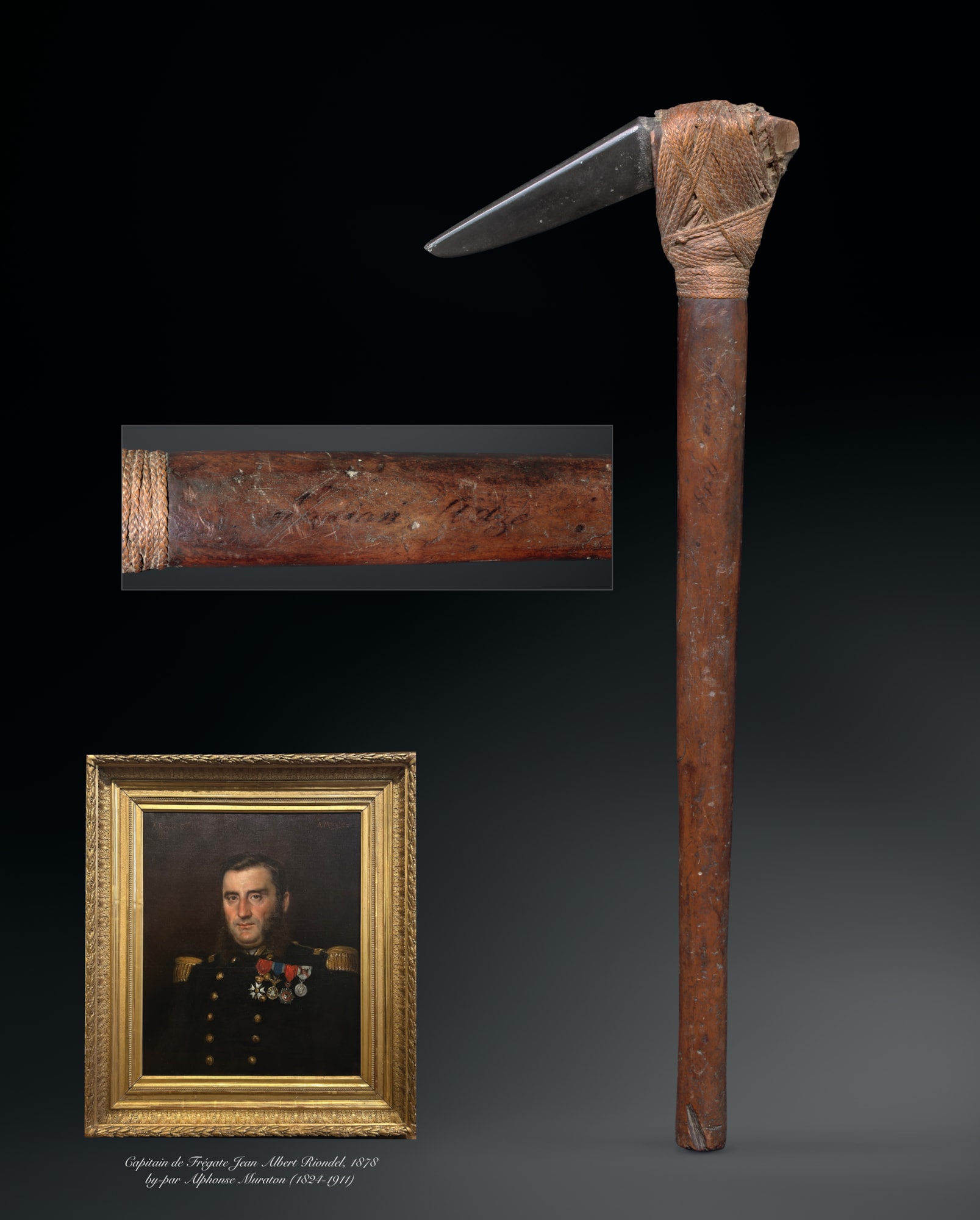
Rarotonga Adze - Capt. de Frégate Riondel
Rarotonga Adze - Capt. de Frégate Riondel
Provenance: Provenance :
Collection of the French Naval Capitain de Frégate Jean Albert Riondel (aka Albert Riondel) 30/06/1830 at Aron, 3/12/1914 at Nantes.
By direct descent.
Acquired from a member of the family.
Capitain de Frégate Jean Albert Riondel joined the French Naval service in 1841, was named Aspirant on August 1, 1846, Enseigne de vaisseau on 26 October 1850, Lieutenant de Vaisseau on 1 December 1855, and Capitaine de Frégate on 9 March 1867. His aunt Pauline was married to Amiral de France François Thomas Tréhouart. Riondel later retired to Cherbourg where he became active in maritime security notably for the Newfoundland fisheries and is credited with the invention of tonnage related shipping lanes. There is no trace of his early voyages so far and no information regarding Pacific Ocean postings. The family recalls that he was on post in the “Islands”, but this is possibly hearsay. The collection is composed of objects of substantial quality and choice from many parts of the Pacific offering the probability that the collection was formed in France and sourced from travelers and Naval personnel.
Portrait of Capitain de Frégate Jean Albert Riondel by Alphonse Muraton (1824-1911) painted in 1878
Literature: “The stone adzes were secured to their wooden hafts by means of fine sinnet, itself esteemed divine. It was fabled that the peculiar way in which the natives of Mangaia fasten their axes was originally taught them by the gods. A famous god, named Tane-mataariki [the god of craftsmen], i.e., Tane-of-royal-face, was considered to be enshrined in a sacred triple axe […] to use an adze was to be a man of consequence, the skill necessary in using it being invariably referred back to the gods as its source.” (W. Wyatt Gill, Jottings from the Pacific, London, 1885).

Galerie Meyer-Oceanic Art
Tribal Art dealer specializing in early Oceanic Art since 1980 and archaic Eskimo Art since 2010
More artworks from the Gallery


