
Keith VAUGHAN
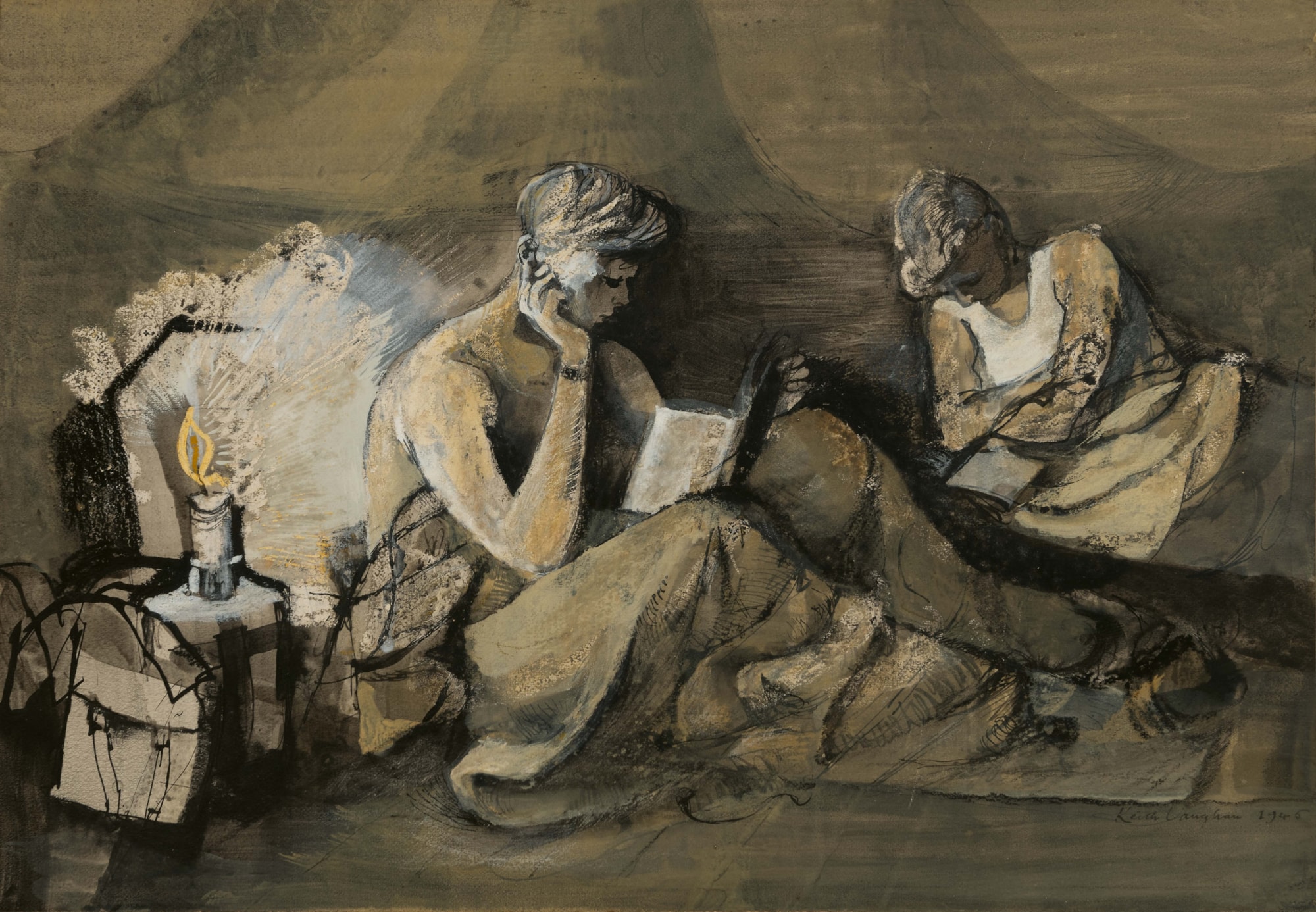
Under Canvas: Night Orderlies Tent
Marketplace
Under Canvas: Night Orderlies Tent
Keith VAUGHAN
Under Canvas: Night Orderlies Tent
While serving in the Non-Combatant Corps during the Second World War, and since there was a limited range of media that could be carried in a regulation army knapsack, Keith Vaughan became adept at expressing himself through the graphic mediums of Indian ink, pencil, crayon and gouache; the latter usually in dark military colours of green and ochre. As he wrote in the foreword to his first gallery exhibition of drawings in 1944, in which several of his army drawings were included, ‘On New Year’s Day 1941, the first thing that went into my brand new army haversack was the largest drawing book it would accommodate and an unbreakable bottle of black ink…I now spent my off-duty hours with a pad on my knee on my bed in a barrack room. For a year I drew the raw material that was in front of me. By 1942 I had done all I wanted of this…To accommodate my slightly increased ambitions, I added to my materials one or two more bottles of ink, two pots of gouache and a few crayons. With these I hoped to be able to recover something of the solidity and depth of oil, while satisfying the requirements of intermittent work and total concealment of the result.’ The early 1940s found Vaughan executing numerous drawings of his surroundings, the barracks and fellow soldiers and labourers, some in sketchbooks and some on much larger paper and typically filled out with gouache. Dated 1945, the present sheet is an exceptional example of the latter, and can be counted among the very finest of Vaughan’s rare wartime drawings.
This fairly large, fully-signed and dated gouache composition, almost certainly intended as an autonomous work of art, is likely to have been drawn at Eden Camp, a prisoner of war detainment centre near Malton in North Yorkshire, midway between York and Scarborough, where the artist was stationed in the summer of 1943. As a biography of Vaughan notes of his time at Eden Camp, ‘At first he lived in the huts with the other men, and made a few more of the barrack-life sketches he had done [earlier], but he soon volunteered to go on almost permanent night-duty, sleeping in the office in case the telephone should ring. He wrote [to his friend Norman Towne]…‘For nearly 12 hours each day, from 7pm to 7am, I am alone and undisturbed and quiet by the fire in the Company office, where I sleep, and think.’ It was the nearest thing you could get to being in a twentieth-century monastery, he told Towne…Eden Camp was a safe haven from the war so the sufferings of Europe could be forgotten for weeks at a time.’ Vaughan remained at Eden Camp, working as a clerk and occasional German interpreter, until his demobilisation from the Pioneer Corps in March 1946.
Although Vaughan began to focus on oil painting from 1946 onwards, he continued to work in the water-based medium of gouache throughout his career, usually for highly finished, independent works. As has been noted, ‘Between 1941 and 1946 Vaughan had produced well over 400 works in gouache…which relied for their effects on the quick-drying qualities of gouache and the way it could be washed over water-resistant crayon or drawn over in ink when dry. He continued to work prolifically in this medium throughout the 1940s and 1950s.’ In 1943 the War Artists’ Advisory Committee purchased twelve of Vaughan’s wartime gouaches, a number of which were included in an exhibition of war art organized by Kenneth Clark at the National Gallery. By the 1950s Vaughan’s gouaches were being exhibited at galleries in London and New York, and were much in demand among collectors.
This fairly large, fully-signed and dated gouache composition, almost certainly intended as an autonomous work of art, is likely to have been drawn at Eden Camp, a prisoner of war detainment centre near Malton in North Yorkshire, midway between York and Scarborough, where the artist was stationed in the summer of 1943. As a biography of Vaughan notes of his time at Eden Camp, ‘At first he lived in the huts with the other men, and made a few more of the barrack-life sketches he had done [earlier], but he soon volunteered to go on almost permanent night-duty, sleeping in the office in case the telephone should ring. He wrote [to his friend Norman Towne]…‘For nearly 12 hours each day, from 7pm to 7am, I am alone and undisturbed and quiet by the fire in the Company office, where I sleep, and think.’ It was the nearest thing you could get to being in a twentieth-century monastery, he told Towne…Eden Camp was a safe haven from the war so the sufferings of Europe could be forgotten for weeks at a time.’ Vaughan remained at Eden Camp, working as a clerk and occasional German interpreter, until his demobilisation from the Pioneer Corps in March 1946.
Although Vaughan began to focus on oil painting from 1946 onwards, he continued to work in the water-based medium of gouache throughout his career, usually for highly finished, independent works. As has been noted, ‘Between 1941 and 1946 Vaughan had produced well over 400 works in gouache…which relied for their effects on the quick-drying qualities of gouache and the way it could be washed over water-resistant crayon or drawn over in ink when dry. He continued to work prolifically in this medium throughout the 1940s and 1950s.’ In 1943 the War Artists’ Advisory Committee purchased twelve of Vaughan’s wartime gouaches, a number of which were included in an exhibition of war art organized by Kenneth Clark at the National Gallery. By the 1950s Vaughan’s gouaches were being exhibited at galleries in London and New York, and were much in demand among collectors.
Provenance: Acquired from the artist by a private collector in the 1950s
Thence by descent to a private collection, Virginia.
Découvrez la galerie
Stephen Ongpin Fine Art
Old Master, 19th Century and Modern Drawings, Watercolours and Oil Sketches
Plus d'œuvres d'art de la Galerie


_T638634158266256528.jpg?width=500&height=500&mode=pad&scale=both&qlt=90&format=jpg)