


Keith VAUGHAN
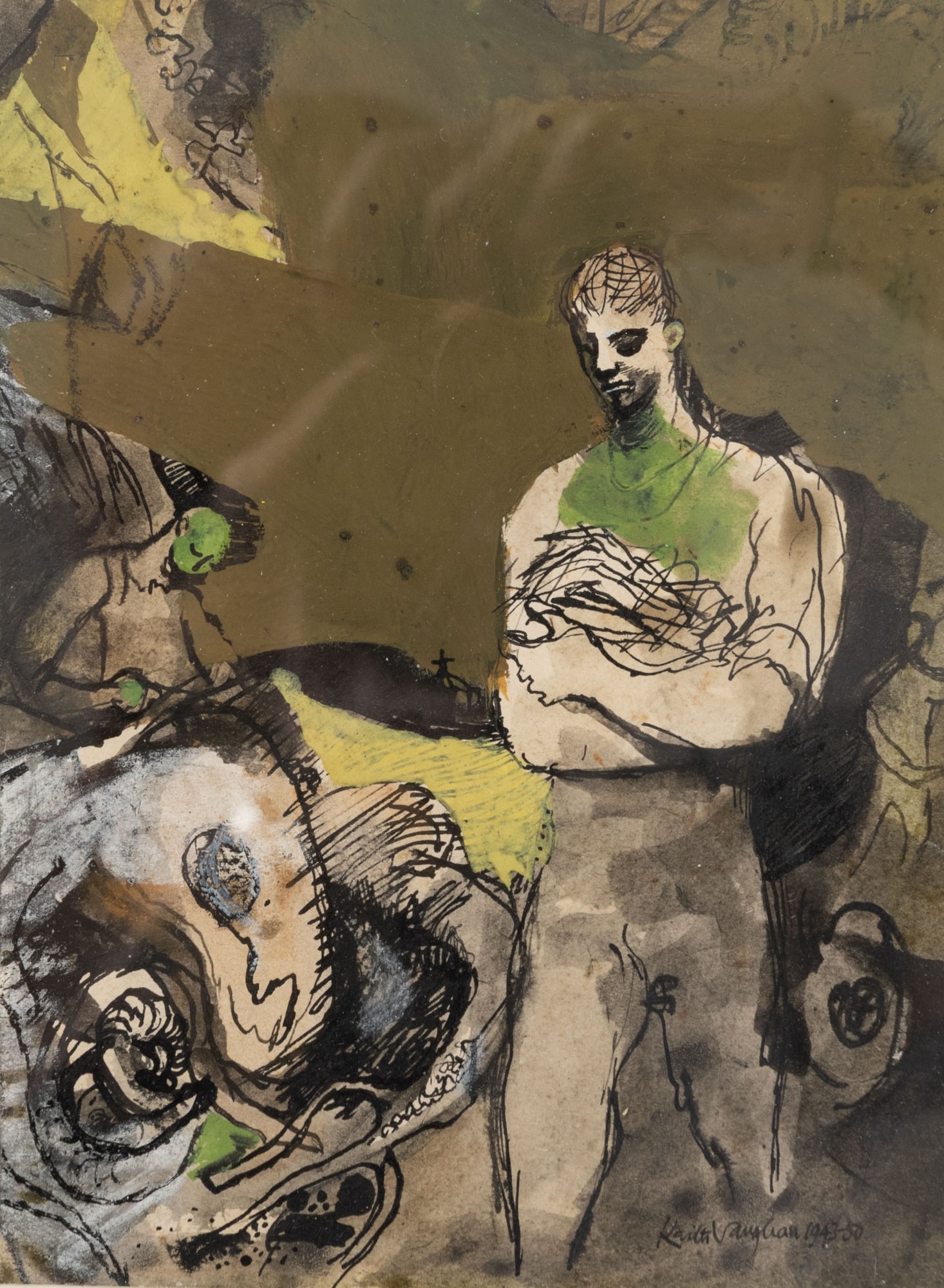
Woodman Carrying Faggots
Marketplace
Woodman Carrying Faggots
Keith VAUGHAN
Woodman Carrying Faggots
While serving in the Non-Combatant Corps during the Second World War, and since there was a limited range of media that could be carried in a regulation army knapsack, Keith Vaughan became adept at working in the graphic mediums of Indian ink, pencil, crayon and gouache; the latter usually in dark military colours of green and ochre, which are also often found in his postwar work. While serving in the NCC during the Second World War, and since there was a limited range of media that could be carried in a regulation army knapsack, Vaughan became adept at expressing himself through the graphic mediums of Indian ink, pencil, crayon and gouache; the latter usually in dark military colours of green and ochre.
As he wrote in the foreword to his first gallery exhibition of drawings in 1944, in which several of his army drawings were included, ‘On New Year’s Day 1941, the first thing that went into my brand new army haversack was the largest drawing book it would accommodate and an unbreakable bottle of black ink…I now spent my off-duty hours with a pad on my knee on my bed in a barrack room. For a year I drew the raw material that was in front of me. By 1942 I had done all I wanted of this…To accommodate my slightly increased ambitions, I added to my materials one or two more bottles of ink, two pots of gouache and a few crayons. With these I hoped to be able to recover something of the solidity and depth of oil, while satisfying the requirements of intermittent work and total concealment of the result.’ During the early 1940s Vaughan made numerous drawings of his surroundings, the barracks and fellow soldiers and labourers, some in sketchbooks and some – known as the ‘Army Drawings’ - on much larger paper and typically filled out with gouache. In 1943 the War Artists’ Advisory Committee purchased twelve of Vaughan’s wartime gouaches, a number of which were included in an exhibition of war art organized by Kenneth Clark at the National Gallery.
In the summer of 1942 Vaughan was stationed at a barracks in Codford in Wiltshire, near Ashton Gifford House, where he and his fellow non-combatant soldiers were tasked with clearing the overgrown walled garden and grounds. As he described the garden at Ashton Gifford, in a letter to a friend, ‘The white and ochre branches plunging down into the oceanic surging tangle of nettles. People walking through waist-high grass, through the aqueous leaf-green shadow, arms full of dead wood…And the wall running as an indefatigable horizontal, losing and finding itself in the jungle of weed and ivy…I wanted to capture this in lassoes of line and nets of colour, but it’s more difficult than writing about it.’
A very similar figure carrying a bundle of wood appears in a related gouache and crayon drawing by Vaughan of The Garden at Ashton Gifford, signed and dated 1942, in the Ingram Collection in London. An analogous figure with arms crossed in front of his chest is also found in several variants of a drawing of The Wall at Ashton Gifford.
As he wrote in the foreword to his first gallery exhibition of drawings in 1944, in which several of his army drawings were included, ‘On New Year’s Day 1941, the first thing that went into my brand new army haversack was the largest drawing book it would accommodate and an unbreakable bottle of black ink…I now spent my off-duty hours with a pad on my knee on my bed in a barrack room. For a year I drew the raw material that was in front of me. By 1942 I had done all I wanted of this…To accommodate my slightly increased ambitions, I added to my materials one or two more bottles of ink, two pots of gouache and a few crayons. With these I hoped to be able to recover something of the solidity and depth of oil, while satisfying the requirements of intermittent work and total concealment of the result.’ During the early 1940s Vaughan made numerous drawings of his surroundings, the barracks and fellow soldiers and labourers, some in sketchbooks and some – known as the ‘Army Drawings’ - on much larger paper and typically filled out with gouache. In 1943 the War Artists’ Advisory Committee purchased twelve of Vaughan’s wartime gouaches, a number of which were included in an exhibition of war art organized by Kenneth Clark at the National Gallery.
In the summer of 1942 Vaughan was stationed at a barracks in Codford in Wiltshire, near Ashton Gifford House, where he and his fellow non-combatant soldiers were tasked with clearing the overgrown walled garden and grounds. As he described the garden at Ashton Gifford, in a letter to a friend, ‘The white and ochre branches plunging down into the oceanic surging tangle of nettles. People walking through waist-high grass, through the aqueous leaf-green shadow, arms full of dead wood…And the wall running as an indefatigable horizontal, losing and finding itself in the jungle of weed and ivy…I wanted to capture this in lassoes of line and nets of colour, but it’s more difficult than writing about it.’
A very similar figure carrying a bundle of wood appears in a related gouache and crayon drawing by Vaughan of The Garden at Ashton Gifford, signed and dated 1942, in the Ingram Collection in London. An analogous figure with arms crossed in front of his chest is also found in several variants of a drawing of The Wall at Ashton Gifford.
Provenance: James Grady, Atlanta, Georgia
Private collection
Anonymous sale, London, Christie’s, 22 May 1996, lot 4
Anonymous sale, London, Christie’s South Kensington, 14 November 1997, lot 296
Private collection, London.
Découvrez la galerie
Stephen Ongpin Fine Art
Old Master, 19th Century and Modern Drawings, Watercolours and Oil Sketches
Plus d'œuvres d'art de la Galerie


