
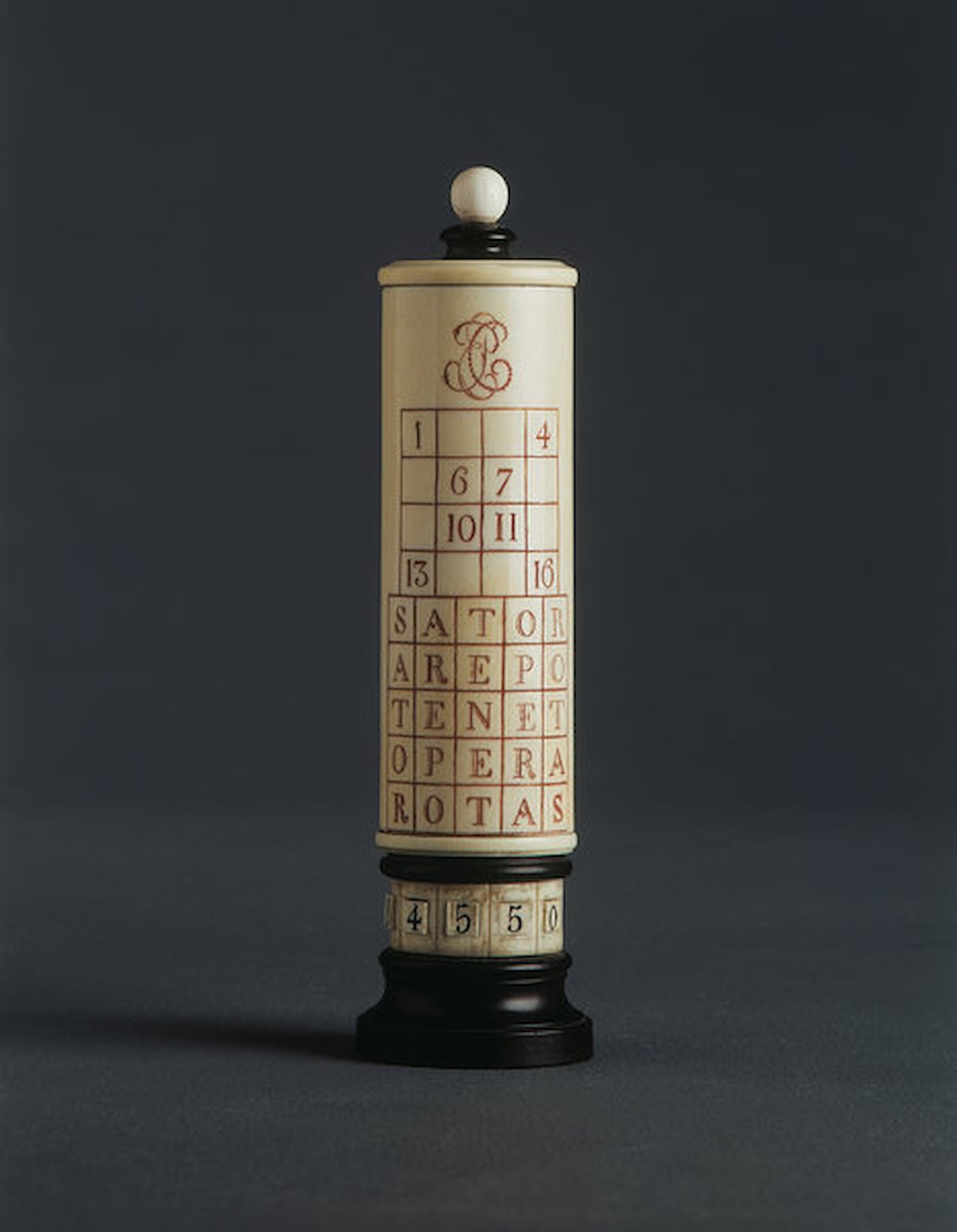
A Very Rare Early Victorian Ivory and Ebony Revolving Calculating Device
A Very Rare Early Victorian Ivory and Ebony Revolving Calculating Device
Period 1800-1900
Origin England
Medium wood (ebony) and ivory
Dimension 21.5 x 6 cm (8¹/₂ x 2³/₈ inches)
Period: 1800-1900
Origin: England
Medium: wood (ebony) and ivory
Dimension: 21.5 x 6 cm (8¹/₂ x 2³/₈ inches)
Literature: As the level of trade increased in Renaissance Europe counting boards and abacuses were replaced by pen and paper and by the 16th and 17th centuries many gadgets had been invented and books written to aid simple arithmetic. By the 18th century reckoning devices of simple calculations were available to tradesmen and the use of these instruments goes some way to demonstrate the low level of arithmetical ability even among the wealthy.
This exceptional, rare and carefully made instrument is probably a variant on Schott's revolving cylinder based on Napier's bones.
John Napier was the inventor of logaritums in 1614 and invented a method of multiplying and dividing called Napier's rods or bones in 1617. This was an ingenious device for calculating by means of square boxwood or ivory rods with numerical tables on each of their four sides, the counting number at the top and the multiples of that number down their lengths. When aligned against the row of multiples, any multiple of the top number can be read off from right to left by adding the digits in each parallelogram in the appropriate row. Thus multiplication is reduced to addition. Samuel Pepys was much impressed by 'the mighty use of Napiers Bones', in 1667 he records in his diary his intention to purchase a set.
In 1668 Gaspard Schott substituted revolving cylinders for Napier's four sided rods, and much later in 1840 McFarlane invented a more complicated calculating cylinder in Edinburgh.
'ne canst thou be an auditor
or make a true survey
nor make a common reckoning
if number be astray'. Thomas Hylles 1600

Finch & Co
Antiquities, ethnographica, natural history, sculpture and works of art
More artworks from the Gallery
_T639191055020334208.jpg?width=500&height=500&mode=pad&scale=both&qlt=90&format=jpg)