

28. Mace Head
Marketplace
28. Mace Head
28. Mace Head
Medium Nephrite
Dimension 10.5 x 9 cm (4¹/₈ x 3¹/₂ inches)
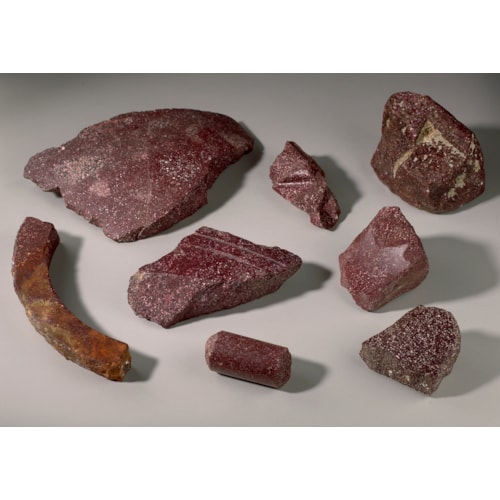
Mace heads have been attested since the latter part of the Neolithic across central Asia and other areas, such as Predynastic Egypt. They were club-like weapons that could play both a functional and a ceremonial role, depending on their period, place of origin and specific characteristics such as size, material, and decoration. In Egypt, for example, they came to be intimately associated with the power of the pharaohs.
The present mace, carved in lustrous nephrite stone, presents the characteristic round shape, with a hole in the middle for the insertion of a handle, which would have likely been of organic material, and as such did not survive. Mace heads have been found by archaeologists in grave sites, which suggests their presence would have connotated the status of the deceased, and proves mace heads were invested with a symbolic, and not solely practical, function.
The present mace, carved in lustrous nephrite stone, presents the characteristic round shape, with a hole in the middle for the insertion of a handle, which would have likely been of organic material, and as such did not survive. Mace heads have been found by archaeologists in grave sites, which suggests their presence would have connotated the status of the deceased, and proves mace heads were invested with a symbolic, and not solely practical, function.
Medium: Nephrite
Signature: £3,800
Dimension: 10.5 x 9 cm (4¹/₈ x 3¹/₂ inches)
Provenance: Nicholas Wright collection, United Kingdom, 1967
Guy Weill Goudchaux collection, Paris, France and London, United Kingdom, late 1960s
Découvrez la galerie
Tomasso
European Sculpture from the Early Renaissance to the Neoclassical periods, Master Paintings and Ancient Art
Plus d'œuvres d'art de la Galerie
-52. Standing Female Nude_T639063181427585204.jpg?width=500&height=500&mode=pad&scale=both&qlt=90&format=jpg)