

Andrea BOSCOLI
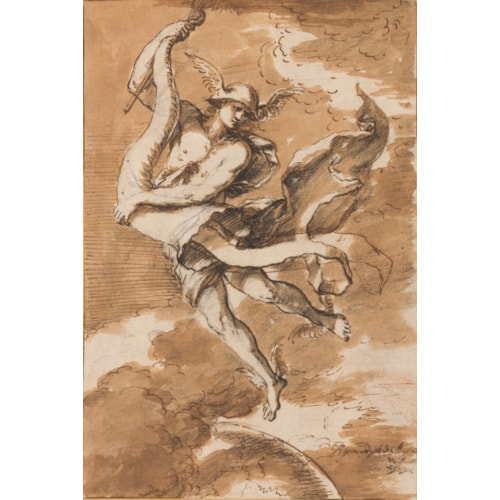
Erminia Tells Her Tale to the Shepherds
Andrea BOSCOLI
Erminia Tells Her Tale to the Shepherds
As Brooks has further noted, the drawings from this series, which are datable to between 1604 and 1608, ‘were highly innovative in the way in which they extracted the romantic episodes from Tasso’s martial epic.’ His comments on another drawing from the Tasso series are equally appropriate to the present sheet: ‘Boscoli takes to bravura extremes the rich and schematic effects of light and shade for which he was well known…it is easy to understand why the drawings in this series were recorded as storiette di chiaro scuro (‘little stories in light and shadow’) in an inventory of c.1611.’ Other drawings by Boscoli of scenes from Tasso’s Gerusalemme Liberata are today in the collections of the Kupferstichkabinett in Berlin, the Art Institute of Chicago, the Courtauld Gallery in London, the Ashmolean Museum in Oxford, the Fondation Custodia in Paris, the Istituto Centrale per la Grafica in Rome and the Hermitage in St. Petersburg, as well as in several private collections.
The provenance of Boscoli’s Gerusalemme Liberata drawings can be traced back to the early 17th century, when they are recorded as a group in an inventory, compiled around 1611, of paintings and drawings belonging to an obscure Marchigian collector, Luca Fei of Filotranno, near Ancona. The Fei inventory, written by Father Francesco Orazio Civalli of Macerata, sheds more light on Boscoli’s drawings and their scope. The inventory not only mentions Boscoli’s drawings, praising their quality, but specifies that the original series included twenty drawings and that it focused specifically on depicting the romantic episodes taken from Tasso’s poems. Some scholars have assumed that the series might have been a starting point for a series of engravings or may have been intended as a commission from an erudite private collector, who must have been very familiar with the writings of Torquato Tasso.
The four drawings by Boscoli devoted to the story of the Muslim princess Erminia are particularly interesting from an iconographical perspective, since they represent one of the first visual depictions of the tale of Erminia and the shepherds, an episode which experienced much popularity throughout the 17th century. Previous visual translations of this episode are known in works by artists such as Santi di Tito, Ludovico Carracci and Bernardo Castello. However, Boscoli’s version betrays the artist’s interest in the realistic depiction of rural life: the artist, in fact, chooses to focus mainly on the dramatic and romantic aspects of the tale of Erminia.
The pose of the horse seen from behind in this drawing is repeated in a drawing of a horse by Boscoli, in red and black chalk, that was formerly in the Jak Katalan collection in New York.
Provenance: Luca Fei, Filottrano, by c.1611
Anonymous sale, London, Sotheby’s, 3 July 1996, part of lot 114
Private collection, South Germany.
Literature: Francesco Orazio Civalli, Le pitture e i disegni che sono appresso del Signor Luca Fei, MS 539, Biblioteca Comunale di Macerata, 1611; Julian Brooks, ‘Andrea Boscoli’s “Loves of Gerusalemme Liberata”, Master Drawings, Winter 2000, pp.452-453, fig.8; Nadia Bastogi, ‘Episodi salienti della fortuna della Gerusalemme liberata nella grafica fiorentina tra Cinque e Seicento’ in Elena Fumagalli, Massimilano Rossi and Riccardo Spinelli, ed., L’arme e gli amori: La poesia di Ariosto, Tasso e Guarini nell’arte fiorentina del Seicento, exhibition catalogue, Florence, Palazzo Pitti, 2001, pp.90-91, fig.8 (as location unknown).
Stephen Ongpin Fine Art
Old Master, 19th Century and Modern Drawings, Watercolours and Oil Sketches
Plus d'œuvres d'art de la Galerie