
, wearing dress with_T639131488067123589.JPG?width=2000&height=2000&mode=max&scale=both&qlt=90)
RICHARD COSWAY
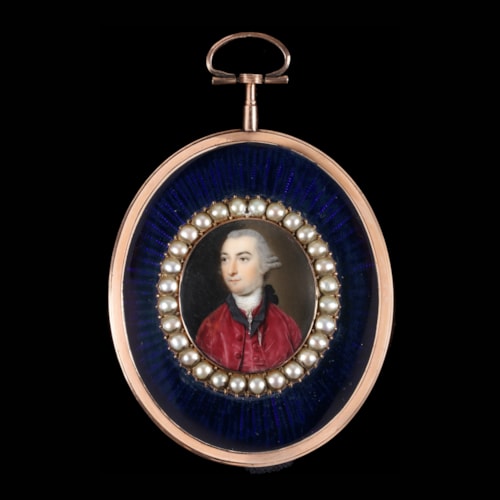
RICHARD COSWAY (1742-1821) Portrait of a Lady, possibly Maria Eleanor Villiers, nee Forbes, Countess of Clarendon (1759-1844), wearing dress with ‘Van Dyck’ collar, bows and pearls, her hair powdered, circa 1780
Marketplace
RICHARD COSWAY (1742-1821) Portrait of a Lady, possibly Maria Eleanor Villiers, nee Forbes, Countess of Clarendon (1759-1844), wearing dress with ‘Van Dyck’ collar, bows and pearls, her hair powdered, circa 1780
RICHARD COSWAY
RICHARD COSWAY (1742-1821) Portrait of a Lady, possibly Maria Eleanor Villiers, nee Forbes, Countess of Clarendon (1759-1844), wearing dress with ‘Van Dyck’ collar, bows and pearls, her hair powdered, circa 1780
The Limner Company : Portrait Miniature
Date circa 1780
Medium Watercolour on ivory
Dimension 3.1 cm (1¹/₄ inches)
The sitter in this portrait, decked out in the latest ‘Van Dyck’ style of dress, bears more than a passing resemblance to Maria Eleanor Villiers, Countess of Clarendon, around the age of twenty. Maria Eleanor was painted by Cosway a few years after this image, and is shown with the same distinct dark eyebrows and blue eyes.[1] Married in 1791, almost a decade later, her husband was her first cousin John Villiers, 3rd Earl of Clarendon. Although handsome with ‘flaxen’ hair, he was also dull and noted for telling ‘interminable long stories’.
There are several reasons for the popularity of what came to be known as 'Vandyke' dress in portraiture in the mid-eighteenth century. One reason was the influence of Sir Anthony Van Dyck himself, whose work was much admired and imitated by eighteenth-century painters, such as Gainsborough and Cosway. Another was the prevalence of masked balls and masquerades, where attendees often wore fancy dress. There was a growing awareness of and interest in history in the mid-eighteenth century, particularly the events of the previous century. The beheading of Charles I during the Civil Wars led to him being seen as a martyr, a romantic and tragic figure who captured the hearts and imaginations of many.
Whatever the reason for the sitter’s choice of dress here, it would have been noted as extremely fashionable – especially with the starched collar and slashed sleeves. This is also Cosway beginning to really get into his stride as an artist – the 1780s were when his friendship with the future George IV, who gave the artist his royal appointment in 1785. This connection introduced Cosway to the rich and fashionable circles who fawned around the Prince of Wales. His artistic response was the confident handling of watercolour, leaving some patches of ivory bare (this can be seen in this example quite clearly) and working quickly to produce a ‘snapshot’ of character, while all the time flattering his important clientele.
[1] Previously with Philip Mould & Co..
There are several reasons for the popularity of what came to be known as 'Vandyke' dress in portraiture in the mid-eighteenth century. One reason was the influence of Sir Anthony Van Dyck himself, whose work was much admired and imitated by eighteenth-century painters, such as Gainsborough and Cosway. Another was the prevalence of masked balls and masquerades, where attendees often wore fancy dress. There was a growing awareness of and interest in history in the mid-eighteenth century, particularly the events of the previous century. The beheading of Charles I during the Civil Wars led to him being seen as a martyr, a romantic and tragic figure who captured the hearts and imaginations of many.
Whatever the reason for the sitter’s choice of dress here, it would have been noted as extremely fashionable – especially with the starched collar and slashed sleeves. This is also Cosway beginning to really get into his stride as an artist – the 1780s were when his friendship with the future George IV, who gave the artist his royal appointment in 1785. This connection introduced Cosway to the rich and fashionable circles who fawned around the Prince of Wales. His artistic response was the confident handling of watercolour, leaving some patches of ivory bare (this can be seen in this example quite clearly) and working quickly to produce a ‘snapshot’ of character, while all the time flattering his important clientele.
[1] Previously with Philip Mould & Co..
Date: circa 1780
Medium: Watercolour on ivory
Dimension: 3.1 cm (1¹/₄ inches)
Provenance: Private Collection, UK.
Découvrez la galerie

The Limner Company : Portrait Miniature
Potrait miniatures from the 16/17th century, the 18th century and 19th century
Plus d'œuvres d'art de la Galerie

_T639131485166669730.jpg?width=500&height=500&mode=pad&scale=both&qlt=90&format=jpg)
-A Gentleman, possibly Henri II of Lorraine (1614-1664), wearing a cloak band and a love lock with a bow_T639130543606717032.JPG?width=500&height=500&mode=pad&scale=both&qlt=90&format=jpg)
_T639131438721554960.JPG?width=500&height=500&mode=pad&scale=both&qlt=90&format=jpg)