


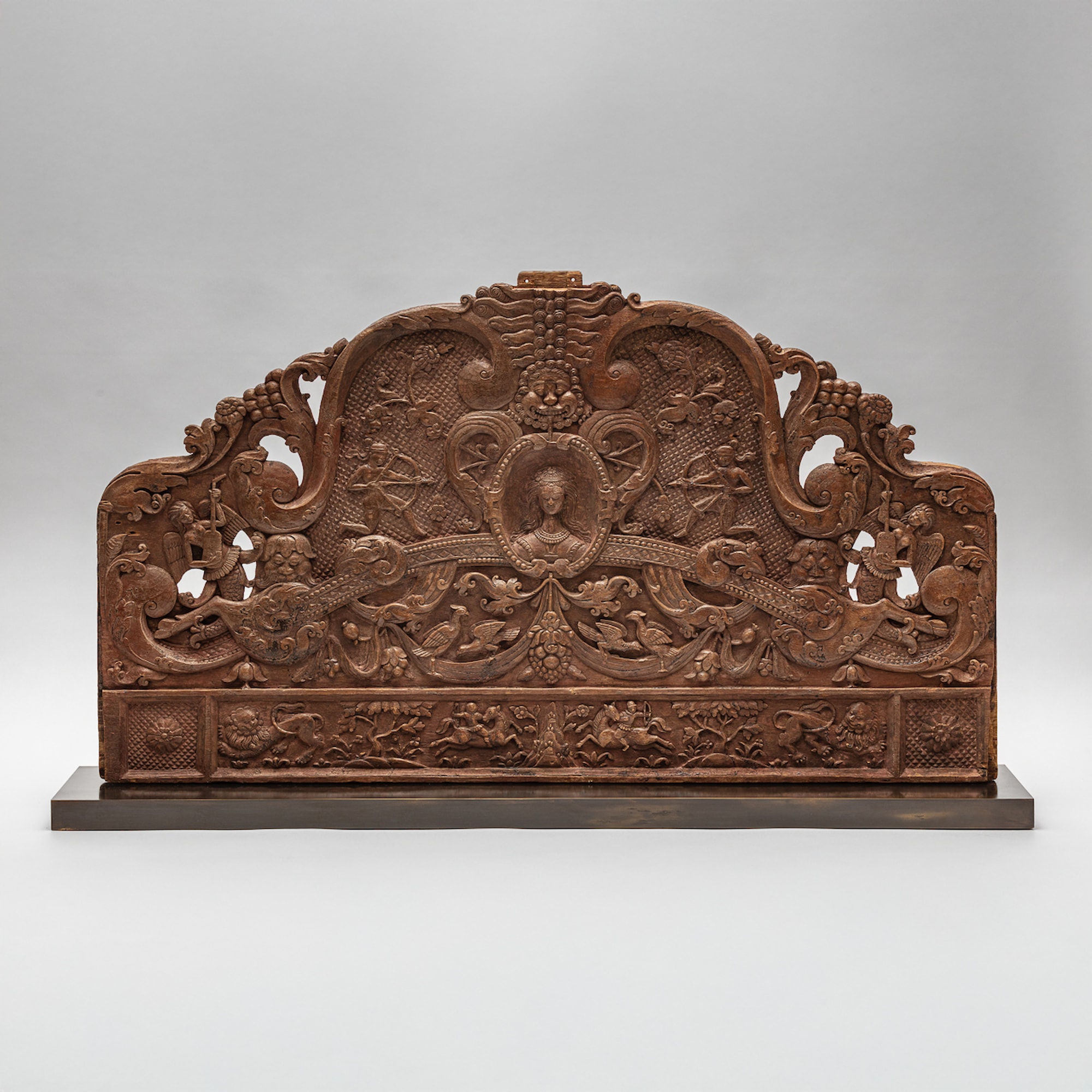
Sino-Portuguese Carved Wooden Headboard
Marketplace
Sino-Portuguese Carved Wooden Headboard
Sino-Portuguese Carved Wooden Headboard
This spectacular headboard, finely carved from wood and once completely covered in black lacquer and decorated in gold, was likely made under Portuguese commission in South China during the early decades of the seventeenth century. Originally part of a complete bedstead, comprising posts, footboard, and side rails, the headboard is carved from a single wooden board. It now lacks its central finial, although the projecting pegged tenon survives. It is probable that only the headboard was preserved owing to its greater iconographic value relative to the posts and rails, having been collected as an objet d’art after falling into disuse. As with other surviving pieces of this type, it has endured thanks to its superior artistic quality, even if its rarity—or possible uniqueness—and the complex transcultural context in which it was created have until now remained unnoticed.
Arched in form with a shaped contour, and pierced elements further highlighting its high-relief carving, the design features a lower register consisting of a frieze of alternating symmetrical motifs: a central rock formation with flowers, flanked by huntsmen on horseback shooting arrows, stylised trees, and slanted rampant heraldic lions. At each end of the frieze, over a diamond-patterned ground, appears a rosette. This particular layout—central hunting scenes bordered by framed motifs—echoes that of contemporary embroidered textiles, generally quilted bedcovers and hangings known as colchas in Portuguese, produced in Gujarat and West Bengal under Portuguese patronage.1 Above this register, also symmetrically arranged, is an oval strapwork cartouche, depicting a youthful woman adorned with flowers in her hair, from whom flowering branches spread outward—flanked by naked, blindfolded figures of Cupid with bows and arrows. Marital in nature, to commemorate betrothal, like many objects commissioned by the Portuguese in Asia, the female figure represents the bride at the moment where love—symbolised by the cupids—reaches her heart. Such depictions of belle donne [‘beautiful women’] were common in Renaissance Europe and frequently adorned painted ceramics also made to celebrate love and marriage.2 The cartouche rests on a curved, curling ribbon—a soft ferronnerie form trimmed with pearled fillets—and is crowned by a menacing mask: a grotesque-like head with open mouth showing fangs and hair in tight curls. Though modelled on contemporary grotesque masks also appearing in Indian colchas as nautical zephyrs, this mask betrays the Asian hand of the carver. Still, in the context of nuptial symbolism, one might recall a sixteenth-century majolica dish featuring a satyr’s head (symbolising lust), encircled by fruits and vegetables—some with explicit sexual connotations.3 Whereas the upper section, with the cartouche and cupids, is set on a diamond-patterned ground, the lower part—on a smooth ground—is filled with drapery, festoons, hanging bunches of fruit and flowers, and perched birds.
Contributing to the joyful, musical atmosphere befitting the piece’s marital symbolism, two winged sirens flank the central composition, each playing the Iberian vihuela de mano—known in Portuguese as viola de mão, and in Italian as viola da mano. A fretted, plucked Iberian stringed instrument with five or six doubled strings, the vihuela resembles a guitar in its figure-of-eight form (providing strength and portability), though it is tuned like a lute.4 While documentary evidence for the vihuela’s presence in Portuguese patrician and aristocratic households remains limited, it is noteworthy that the earliest printed collection of music for the instrument is closely linked to the Portuguese court. Compiled by the Spanish musician Luis de Milán (ca. 1500–ca. 1561), his Libro de música de vihuela de mano intitulado El Maestro was published in 1536 under the patronage of King João III of Portugal (r. 1521–1557).5 The instrument was well known in 16th-century Portugal, appearing frequently in the plays of Gil Vicente (ca. 1465–ca. 1536). It is reported that 2,000 violas de mão were found abandoned after the Portuguese defeat at the Battle of Ksar el-Kebir (1578) in Morocco—a likely exaggeration, but one which attests to the instrument’s popularity. The viola travelled aboard the first carracks of the India Run, reaching Brazil, Iran, China, and Japan, where early depictions of the instrument survive.6 One of the earliest Portuguese depictions appears in a full-page illumination of Duarte Galvão’s Crónica de Dom Afonso Henriques in the Biblioteca Pública Municipal do Porto (Ms. 139), made around 1520. Taking pride of place on the chronicle’s frontispiece is a terrestrial globe, marked with the Portuguese royal possessions in Africa and Asia, flanked by two angels: one on the left playing the viola de mão, and the other on the right playing the lyre. Surviving instruments of the period are exceedingly rare; a single dated example by Belchior Dias (fl. 1581–1627), made in Lisbon in 1581, belongs to the Royal College of Music in London (inv. RCM 171).7 The inclusion of winged sirens playing the viola de mão—also present in contemporary Indian colchas—adds to the amorous symbolism of the piece, for in Renaissance Iberia, the vihuela was often associated with love songs.
As with other artworks commissioned in Asia by the Portuguese elite—ranging from lacquered furniture made in Pegu to embroidered textiles from India—this iconography, intended for a cultivated audience steeped in classical imagery, draws deeply on Greco-Roman mythology. Sirens, with their charming voices and musical instruments, were seen not merely as dangerous temptresses but also as allegories of harmony, cosmic music, and spiritual ascent—particularly in Neoplatonic and Christian reinterpretations. In this context, they symbolised idealised love. Pietro Aretino (1492-1556), in his Stanze (1537), visualises his poetic muse, Angela Tornimbena (Angela Sirena), as a winged, double-tailed siren hovering above the clouds.8 Reflecting a stereotypical view of women as chaste and obedient, Aretino claimed that: '[...] the sounds, the songs, and the letters that women know are the keys that unlock the doors of their modesty'.9 Aristocratic women were expected not only to master needlework and household skills but also to sing and play instruments—especially the lute and the vihuela. Not long after Milán’s publication, Enríquez de Valderrábano issued his Silva de sirenas (1547), explaining the title as an allegory of the seven virtues as sirens, whose concord and harmony elevate the soul.10 It is reasonable to assume that whoever commissioned the headboard—and imagined, and ultimately laid out its iconography—knew Aretino’s poetic oeuvre and was familiar with the vihuela and the repertoire associated with it.
The headboard’s overall design—with its S-scrolls, drapery, festoons, animals, and floral motifs—derives from Netherlandish Mannerist prints of the late 16th-century in the ferronnerie style, itself descended from the strapwork motifs of the School of Fontainebleau.11 Such motifs likely travelled to Asia as printed maps or decorative charts accompanying European merchants and officials. Abraham Ortelius’s Theatrum Orbis Terrarum (Antwerp, 1570), with its cartouches and ferronnerie-inspired imagery, offers eloquent evidence, although no exact print match has yet been found. Nonetheless, the cupids depicted on the headboard bear a marked resemblance to those in Otto van Veen’s Amorum Emblemata (Antwerp, 1608), considered the most influential emblem book in the early modern period and widely circulated.12 Emblem 35, Conservat cuncta Cupido [‘Love sustains all things’], depicts a hovering Cupid transfixing with his arrows heaven and earth, represented as a globe. Though the general composition was likely supplied by the Portuguese patron—perhaps even with prints for reference—the carving bears unmistakably Chinese stylistic elements. These include the tightly curled hair of the grotesque mask, the scholar’s rock-like formations beside the hunters (reminiscent of gōngshí from Lake Taihu), and the two Buddhist lions (shíshī) at the lower frieze ends. While their pose mimics European heraldic lions, they have been transformed into apotropaic protectors, echoing their architectural function in Chinese visual culture. Such decorative elements usually serve a similar function in contemporary pieces of furniture made in Asia for the Portuguese market.13
Alongside better-known Japanese early export lacquers (Namban), other early lacquer wares made for the Portuguese remain understudied. These so-called Luso-Asian lacquers fall into two broad groups.14 The first, recently attributed to Pegu (modern-day Myanmar), is identified through archival, material, and scientific evidence—including the use of thitsi lacquer (derived from the sap of Gluta usitata, common in Southeast Asia) and the shwei-zawa lacquer coating technique. The second, which includes writing boxes, oratories, chairs, trays, shields, and bed frames such as the present piece, features bas-relief carving with gold on black lacquer, and interiors often decorated in red lacquer with Chinese fauna and flora. The second, attributed to China, which includes writing boxes, oratories, chairs, trays, shields, and bed frames such as the present piece, features bas-relief carving with gold on black lacquer, and interiors often decorated in red lacquer with Chinese fauna and flora.
One highly important set of documents offers significant evidence regarding both types of production, identifying Pegu and China as centres for these export lacquers. In the post-mortem inventories of Fernando de Noronha (ca. 1540–1608), 3rd Count of Linhares, and his wife Filipa de Sá (†1618), a substantial number of Asian lacquered and gilded pieces of furniture are recorded.15 These include: one ‘oblong lacquered box from China made in two sections’; ‘another writing cabinet from China [lacquered] in gold and white which has twelve drawers’ and is 44 cm long; ‘one box from China [lacquered] in gold and black fitted with its nook’; ‘two round shields from China without arm supports with their coat of arms’, to which other twelve were added; ‘four trays from China, three of them featuring their coat of arms, lacquered in black and gold’, with three more were added; ‘one other display table from China very old and with the Noronha coat of arms in the middle’; ‘one bedstead from China, gilded throughout and bearing the Noronha coat of arms on the headboard’; and ‘one gilded bedstead from China [lacquered] in gold and black with its frame’. The most frequently recorded pieces of Asian manufacture in the inventory are Chinese items of lacquered furniture.
The present headboard matches those recorded in the Linhares inventories, strongly indicating the high social stand of the Portuguese clients for which this type of lacquered and gilded furniture was produced. Bedsteads of this type and chronology are extremely rare. One complete example, with its intricately carved headboard and its four original bedposts, survives at the Quinta da Bacalhoa, Azeitão; another, floral in design and privately owned in Lisbon, bears a Portuguese coat of arms and may also be Burmese.16 A third, also from Pegu, was recently published.17 A fourth, now stripped of its gilding, is in the Palácio Nacional da Pena, Sintra (inv. PNP1464), and, like the present example, belongs to the South Chinese group. Less refined in carving, it nonetheless combines Mannerist cartouches and bunches of fruit derived from Netherlandish prints with Chinese motifs such as rúyì-shaped clouds.
[1] One fine example belongs to the Museu Nacional de Arte Antiga, Lisbon (inv. 112 Tec). See Karl, Barbara. Embroidered Histories. Indian Textiles for the Portuguese Market during the Sixteenth and Seventeenth Centuries, Vienna, Böhlau Verlag, 2016, pp. 245–247, cat. 29.
[2] Syson, Luke. 'Belle: Picturing Beautiful Women', in Andrea Bayer (ed.) Art and Love in Renaissance Italy (cat.), New York - New Haven - London: The Metropolitan Museum of Art - Yale University Press, 2008, pp. 246–254.
[3] Andrea Bayer (ed.), Art and Love in Renaissance Italy, p. 214, cat. 111 (catalogue entry by Linda Wolk-Simon).
[4] On the Iberian vihuela, see Pope, Isabel. 'La vihuela y su música en el ambiente humanístico', Nueva Revista de Filología Hispánica 15.3-4 (1961), pp. 364–376; and Griffiths, John. 'Hidalgo, merchant, poet, priest: the vihuela in the urban soundscape', Early Music 37.3 (2009), pp. 355–365.
[5] On the vihuela in Portugal, see Morais, Manuel. 'A Viola de Mão em Portugal (c. 1450-c. 1789)', Nassarre. Revista Aragonesa de Musicología 22.1 (2006), pp. 393–462.
[6] See Sumio Omata, 'Plucked instruments in the iconographical sources in the 16th century Japan', Gendai Guitar 124.3 (1977), pp. 32–47; and Hiroyuki Minamino, “European Musical Instruments in Sixteenth-Century Japanese Paintings”, Music in Art 14.1-2 (1999), pp. 41–50.
[7] Griffiths, John. 'Vihuela', in Borghetti, Vincenzo and Tim Shephard (eds.), The Museum of Renaissance Music. A History in 100 Exhibits, Turnhout: Brepols, 2023, pp. 238–241. It is likely that another viola, made around 1590 and formerly in the collection of Robert Spencer, may also be of Portuguese origin and by Belchior Dias.
[8] It is depicted in the frontispiece of the Stanze, in a chiaroscuro woodcut likely conceived by Titian and probably made by Giovanni Britto (1531–1550). On the print and its symbolism, see Bayer, Andrea (ed.), Art and Love in Renaissance Italy, pp. 222–223, cat. 113c (catalogue entry by Wendy Thompson).
[9] Pietro Aretino, Il primo libro delle Lettere, ed. Nicolini, Fausto. Bari, Gius. Laterza & Figli, 1913, p. 160: '[...] i suoni, i canti e le lettre, che sanno le demine, sono le chiavi che aprono le porte de la pudizia loro'.
[10] Valderrábano, Enríquez de. Silva de sirenas, Valladolid, Francisco Fernández de Córdoba, 1547, fols. Aii v-Aiii r.
[11] On this decorative repertoire, based on the influential work of Hieronymus Cock (1518-1570), see Fuhring, Peter. 'Hieronymus Cock and the Impact of his Published Architectural and Ornamental Prints', in Joris van Grieken, Ger Luijten, Jan Van der Stock (eds.), Hieronymus Cock. The Renaissance in Print (cat.), Brussels - New Haven: Mercatorfunds - Yale University Press, 2013, pp, 36–41.
[12] See McKeown, Simon (ed.). Otto Vaenius and his Emblem Books, Glasgow: Stirling Maxwell Centre for the Study of the Word/Image Cultures, 2012.
[13] Crespo, Hugo Miguel. India in Portugal. A Time of Artistic Confluence (cat.), Porto: Bluebook, p. 89.
[14] Crespo, Hugo Miguel. Choices, Lisbon: AR-PAB, 2016, pp. 238–261, cat. 22.
[15] Crespo, Hugo Miguel. 'Global Interiors on the Rua Nova in Renaissance Lisbon', in Annemarie Jordan Gschwend, K.J.P. Lowe (eds.), The Global City. On the Streets of Renaissance Lisbon, London: Paul Holberton publishing, 2015, pp. 121–139: p. 123.
[16] Ferrão, Bernardo. Mobiliário Português. Dos Primórdios ao Maneirismo, vol. 3, Porto: Lello & Irmão Editores, 1990, pp. 41–45.
[17] Amir Mohtashemi, London: Amir Mohtashemi Ltd, 2017, pp. 28–33, cat. 12 (catalogue entry by Hugo Miguel Crespo).
Discover the Gallery

Amir Mohtashemi Ltd.
Indian,Islamic and Cross-Cultural Works of Art
More artworks from the Gallery



 Flower (Small)_T638206163546444815.JPG?width=500&height=500&mode=pad&scale=both&qlt=90&format=jpg)