Chinese Blue and White Ewer for the Indian Market
Marketplace
Chinese Blue and White Ewer for the Indian Market
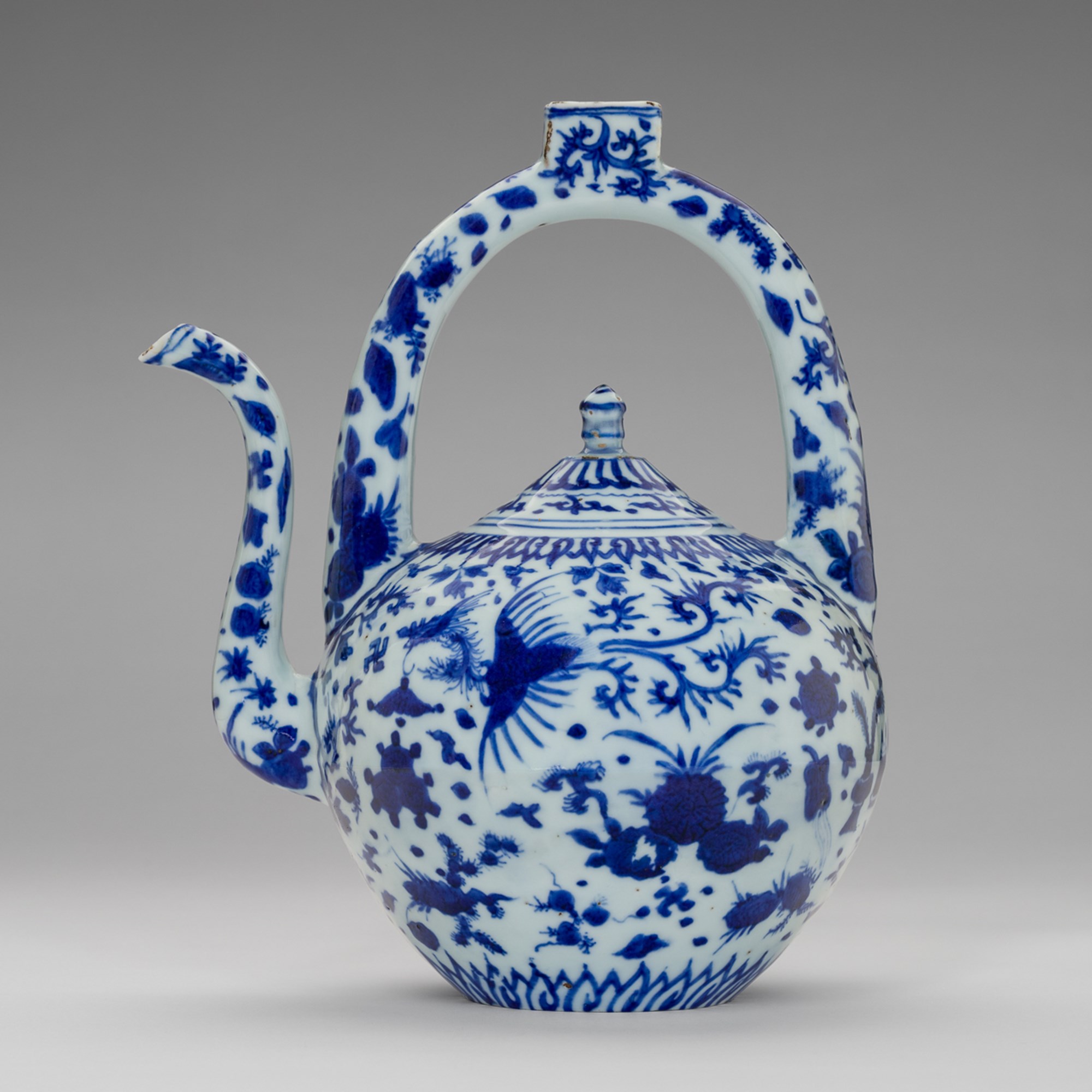
This striking vessel, with its large arched handle, bulbous body, and s-shaped spout, must have been a special commission, for it is unlike any other known Chinese examples. Its shape copies metal kettle ewers, that had centrally placed handles so that they were easy to carry, hanging from the hand like a basket.1 Though
the earliest known example of the kettle ewer was made in Iran (see Victoria and Albert Museum, accession no. 458-1876; dated 1602), examples made in the Deccan, India, have a form closer to that of this porcelain ewer.
While the form is Indian, the decoration of this porcelain kettle ewer is entirely Chinese. Two phoenixes, traditionally associated with Chinese empresses, fly among floral scrolls. They are surrounded by auspicious emblems wishing good fortune, while on the handle are ripe pomegranate fruits symbolising fertility and the birth of many sons.
Creating such an ornate vessel in hardpaste porcelain, with its thick, heavy handle, would have been extremely difficult to accomplish, while firing it successfully in a high-temperature kiln would also have been problematic. The possibility of the handle breaking when the kettle was full was very real. Safavid blue-and-white stonepaste vessels were also made, such as a 17th-century kettle in the British Museum (accession no. 1902,0521.1) and one in the Victoria and Albert Museum (accession no. 618-1889). It may be that softpaste was a more appropriate material for reproducing such an awkward ceramic form.
It seems probable that an Indian client, familiar with both metal and stonepaste kettles, would have put in an order for this piece. China was a reliable source of vessels specially ordered by patrons overseas, and many Chinese custom-made porcelain items were exported to patrons in Iran, Iraq, Egypt, Syria and India. Chinese potters slavishly copied an unfamiliar shape, working from drawings or a model. When they came to decorate the kettle, they employed a range of motifs that were familiar to them, thereby creating a truly novel vessel.
[1] Zebrowski, Mark. Gold, Silver & Bronze from Mughal India. London: Alexandria Press in association with Laurence King, 1997, p. 153.
Découvrez la galerie
Amir Mohtashemi Ltd.
Indian,Islamic and Cross-Cultural Works of Art
Plus d'œuvres d'art de la Galerie