
Émile Gallé
Enamelled Chasse - Émile Gallé
Marketplace
Enamelled Chasse - Émile Gallé
Émile Gallé
Enamelled Chasse - Émile Gallé
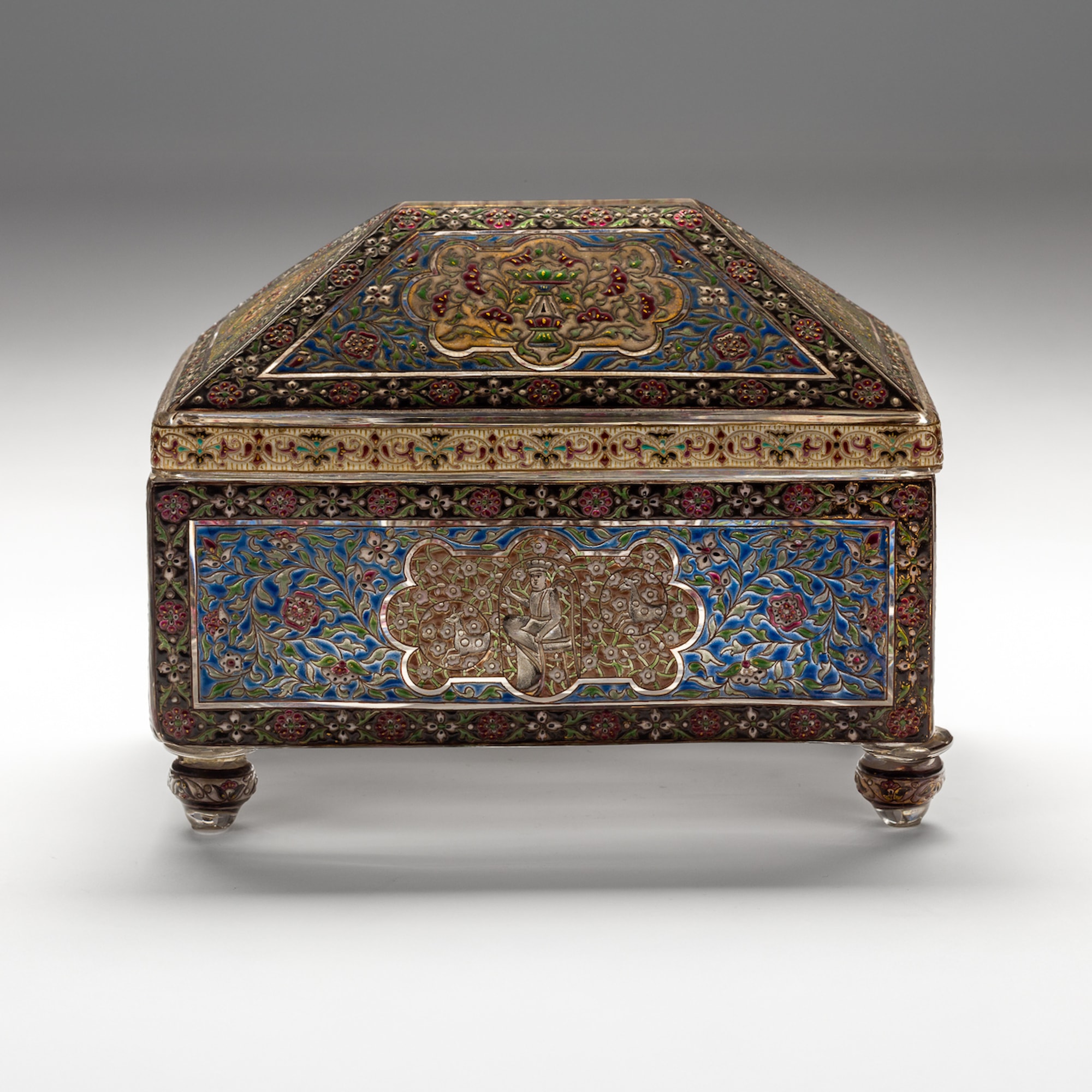
A covered casket made from enamelled glass, signed on the reverse Émile Gallé déposé ['registered design']. The casket stands on four rounded feet and has a pyramidal lid, a form derived from house-shaped reliquaries known as chasses. The influence of Medieval Limoges enamels can also be seen in the colour palette of deep blue, green, orange, and gilding. Examples of Limousin reliquary chasses are in the Metropolitan Museum of Art (accession no. 17.190.513), the British Museum (accession no. 1851,0715.2), and the Musée de Cluny, Paris (accession no. Cl.23822), a collection with which Gallé would have been very familiar.
The body of the box is decorated with white flowers growing from swirling vines on a cobalt blue background. Each side of the box is decorated with a cartouche. The two short faces have quatrefoil cartouches, a shape formed from four partially overlapping circles, typical of Gothic art and a staple of the reliquary chasse. In these quatrefoils are red carnations. The longer faces are decorated with an elongated octofoil cartouche. One contains a vulning pelican, also known as a pelican in her piety, who pecks at her breast to feed her two young with her own blood. Specks of red enamel hint at the gruesome scene. This imagery was used in Medieval bestiaries as an allegory for Christ’s self-sacrifice, and features in Medieval art such as on a reliquary cross in the Louvre (accession no. LP1043). Gallé used the motif on a number of pieces, including a vase in the Musée d’Orsay, Paris (inv. no. OAO 528) which is dated to ca. 1884.
The enthroned figure is harder to find in Limoges enamels. It resembles somewhat the sort of Mozarabic figures of a 10th century ivory, like those Gallé would have seen in the Musée de Cluny (see, for example, nos. Cl. 17050bb and Cl. 17050u). A charming touch is that the figure is sitting on a Thonet no. 18 bentwood chair (see, for example, accession no. W.4-2017 in the Victoria & Albert Museum), a model first exhibited in 1851 at the Great Exhibition in the Crystal Palace.1 On either side of the enthroned figure is a roundel containing a deer, very similar to those seen in Safavid metalwork. Examples in the Hermitage, St Petersburg (accession nos VC-781 and VC-65), feature similar deer with a floral background.
Gallé made at least three other caskets of the same form. One is held in the Musée de L’École de Nancy (accession no. Corbin 303 (c)Men. D. Boyer; 14.2 cm high, 19 cm long, 11.2 cm deep).2 It is part of Gallé’s Persian rider series, featuring a mounted archer in several cartouches. The grisaille colour palette imitates Islamic metalwork, when black paste is applied to the etched design to increase contrast. A further chasse casket is in the Chrysler Museum of Art, Norfolk VA (accession no. 71.6631; 15.2 cm high, 17.8 cm long, 9.5 cm deep). It is enamelled with a more typical Art Nouveau decoration, with a nod to the Medieval influence in cartouches containing pilgrims walking through a forest. Another casket, almost identical to ours but with enthroned figures on both sides, was sold at auction in France in 2022.3
[1] ‘Thonet and the invention of bentwood furniture’, Victoria & Albert Museum, retrieved online via https://www.vam.ac.uk/articles/thonet-and-the-invention-of-bentwood-furniture?srsltid=AfmBOoqeiDax9vQFwToNZmDPCLKiR64GWfzaVCDJaWkXe6S3_vPezU7t on 11.06.2025.
[2] Garner, Philippe. Emile Gallé. London : Academy Editions, 1976, p. 96. Illustrated in Dennis, Richard. ‘The Glass of Emile Gallé’, Antiques International (1967), pp. 182–192: p. 183, fig. 2.
[3] Millon, L'Europe de l'Art Nouveau, 24 November 2022, lot 76.
Découvrez la galerie

Amir Mohtashemi Ltd.
Indian,Islamic and Cross-Cultural Works of Art
Plus d'œuvres d'art de la Galerie
_T638671088209735808.jpg?width=500&height=500&mode=pad&scale=both&qlt=90&format=jpg)


_T639137462177898452.jpg?width=500&height=500&mode=pad&scale=both&qlt=90&format=jpg)