Unique Ottoman Dagger
Marketplace
Unique Ottoman Dagger
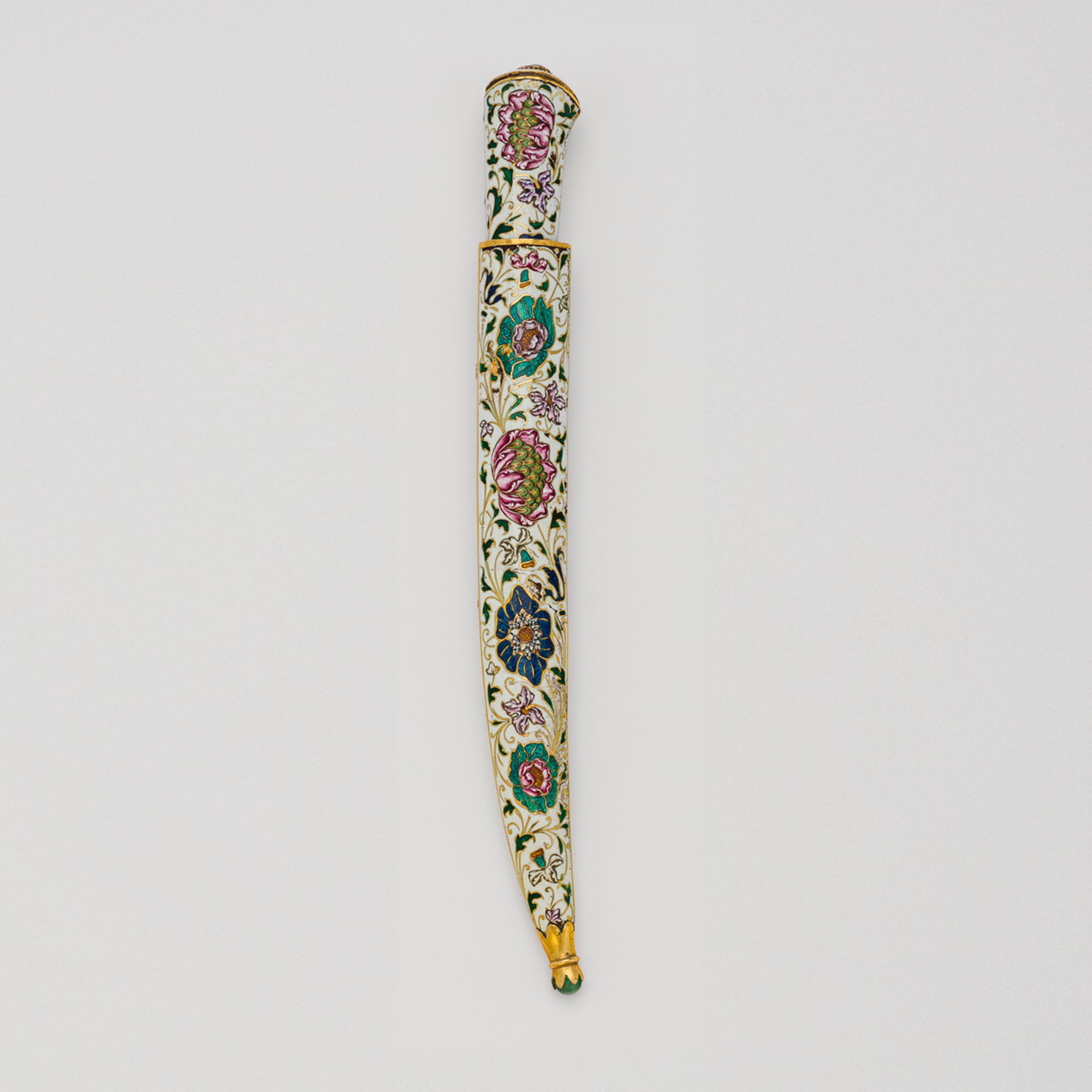
A rare 17th-century Ottoman dagger with ornate enamelled floral decoration. Daggers of this form, with a straight single-edged blade and no cross-guard, are generally referred to with the Persian term kard. However, the Ottoman version tends to have a larger and more asymmetrical pommel.1 The dagger slides deeply into the scabbard so that the plain grip is hidden, and only the enamelled pommel is visible. Both the scabbard and the pommel are enamelled and decorated with colourful flowers, outlined and highlighted with gold. The watered-steel blade has a pomegranate maker’s mark.
A similar Ottoman kard in the Metropolitan Museum of Art, New York (accession no. 17.190.821a,b) is dated to late 17th century Turkey.2 The classic Ottoman kard form, is paired with the distinctive gem at the end of the scabbard. The large flowers, viewed from the same angle as the present example, are similarly highlighted with gold inlay. A hançer in the Topkapı Palace Museum (inventory no. 2/238) has similar white enamel work, with colourful flowers highlighted with gold.3 It also has a plain, golden handle. A jambiya (no. 1004_LRK) in the Livrustkammaren (Royal Armoury) of Sweden, Stockholm, is similarly enamelled with flowers on a white ground and is dated to the 16th or 17th century. A pocket watch case held in the Kremlin (no. M3-4089/1), dated to the mid-17th century and made in Istanbul, provides another example of enamelled flowers on a white ground.4
This dagger was owned by the Rothschild family living in Paris. Following the occupation of Paris by the Nazis in May 1940, the dagger was looted by the Einsatzstab Reichsleiter Rosenberg, where it was packed in crate 251, alongside 99 other Rothschild treasures, and taken to Jeu de Paume, a gallery in the Tuileries Gardens. The Einsatzstab Reichsleiter Rosenberg (ERR), or Reich Leader Rosenberg Taskforce, was set up on the directive of Alfred Rosenberg, with the objective of collecting and studying the cultural patrimony of the Jews of the Reich. After the war, the looted art would go to a proposed Institute for Research on the Jewish Question in Frankfurt, where the future Nazi elite would learn anti-Jewish ideology. The Rothschild family, alongside other prominent Jewish families and art dealers, were priority targets.
Nazi art dealer Bruno Lohse staged 20 exhibitions at the Jeu de Paume, comprising the looted artworks, from which Göring selected 594 pieces for his own collection. This dagger was later moved to ‘Lager Peter’, the ERR art repository in Altaussee, Austria, where it saw out the rest of the war.5 Items from this complex were earmarked for the Führermuseum in Linz, Austria. However, after the allied occupation of Altaussee in May 1945, the art repository and its contents were seized by the US Army. Every item had been meticulously logged, which proved useful for restitution. The dagger was taken to the Munich Central Collecting Point by the so-called 'Monuments Men' and given the MCCP number 1371/86. A year later, the dagger was returned to the Rothschild family in Paris, where it remained until 2023.
[1] Alexander, David G, Stuart W. Pyhrr, Will Kwiatkowski, and Cynthia Clark. Islamic Arms and Armor in the Metropolitan Museum of Art. New York: Metropolitan Museum of Art, 2015, p. 201.
[2] Ibid., p. 201.
[3] Aydın, Hilmi. Sultanların Silahları. Istanbul: T.C. Kültür ve Turizm Bakanlığı, 2007, p. 18.
[4] Konstantinovich Levykin, Alexey. The Tsars and the East: Gifts from Turkey and Iran in the Moscow Kremlin. London: Thames and Hudson, 2009, p. 102, cat. 49.
[5] ‘Cultural Plunder by the Einsatzstab Reichsleiter Rosenberg’, Database of Art Objects at the Jeu de Paume. Retrieved from https://www.errproject.org/jeudepaume/ on 25/3/24.
A similar Ottoman kard in the Metropolitan Museum of Art, New York (accession no. 17.190.821a,b) is dated to late 17th century Turkey.2 The classic Ottoman kard form, is paired with the distinctive gem at the end of the scabbard. The large flowers, viewed from the same angle as the present example, are similarly highlighted with gold inlay. A hançer in the Topkapı Palace Museum (inventory no. 2/238) has similar white enamel work, with colourful flowers highlighted with gold.3 It also has a plain, golden handle. A jambiya (no. 1004_LRK) in the Livrustkammaren (Royal Armoury) of Sweden, Stockholm, is similarly enamelled with flowers on a white ground and is dated to the 16th or 17th century. A pocket watch case held in the Kremlin (no. M3-4089/1), dated to the mid-17th century and made in Istanbul, provides another example of enamelled flowers on a white ground.4
This dagger was owned by the Rothschild family living in Paris. Following the occupation of Paris by the Nazis in May 1940, the dagger was looted by the Einsatzstab Reichsleiter Rosenberg, where it was packed in crate 251, alongside 99 other Rothschild treasures, and taken to Jeu de Paume, a gallery in the Tuileries Gardens. The Einsatzstab Reichsleiter Rosenberg (ERR), or Reich Leader Rosenberg Taskforce, was set up on the directive of Alfred Rosenberg, with the objective of collecting and studying the cultural patrimony of the Jews of the Reich. After the war, the looted art would go to a proposed Institute for Research on the Jewish Question in Frankfurt, where the future Nazi elite would learn anti-Jewish ideology. The Rothschild family, alongside other prominent Jewish families and art dealers, were priority targets.
Nazi art dealer Bruno Lohse staged 20 exhibitions at the Jeu de Paume, comprising the looted artworks, from which Göring selected 594 pieces for his own collection. This dagger was later moved to ‘Lager Peter’, the ERR art repository in Altaussee, Austria, where it saw out the rest of the war.5 Items from this complex were earmarked for the Führermuseum in Linz, Austria. However, after the allied occupation of Altaussee in May 1945, the art repository and its contents were seized by the US Army. Every item had been meticulously logged, which proved useful for restitution. The dagger was taken to the Munich Central Collecting Point by the so-called 'Monuments Men' and given the MCCP number 1371/86. A year later, the dagger was returned to the Rothschild family in Paris, where it remained until 2023.
[1] Alexander, David G, Stuart W. Pyhrr, Will Kwiatkowski, and Cynthia Clark. Islamic Arms and Armor in the Metropolitan Museum of Art. New York: Metropolitan Museum of Art, 2015, p. 201.
[2] Ibid., p. 201.
[3] Aydın, Hilmi. Sultanların Silahları. Istanbul: T.C. Kültür ve Turizm Bakanlığı, 2007, p. 18.
[4] Konstantinovich Levykin, Alexey. The Tsars and the East: Gifts from Turkey and Iran in the Moscow Kremlin. London: Thames and Hudson, 2009, p. 102, cat. 49.
[5] ‘Cultural Plunder by the Einsatzstab Reichsleiter Rosenberg’, Database of Art Objects at the Jeu de Paume. Retrieved from https://www.errproject.org/jeudepaume/ on 25/3/24.
Découvrez la galerie
Amir Mohtashemi Ltd.
Indian,Islamic and Cross-Cultural Works of Art
Plus d'œuvres d'art de la Galerie
_T638447280897797885.jpg?width=500&height=500&mode=pad&scale=both&qlt=90&format=jpg)

_T638204241155849494.jpg?width=500&height=500&mode=pad&scale=both&qlt=90&format=jpg)
_T638491371114922044.jpg?width=500&height=500&mode=pad&scale=both&qlt=90&format=jpg)