
Mughal Dagger with Jade Horsehead Hilt
Marketplace
Mughal Dagger with Jade Horsehead Hilt
Mughal Dagger with Jade Horsehead Hilt
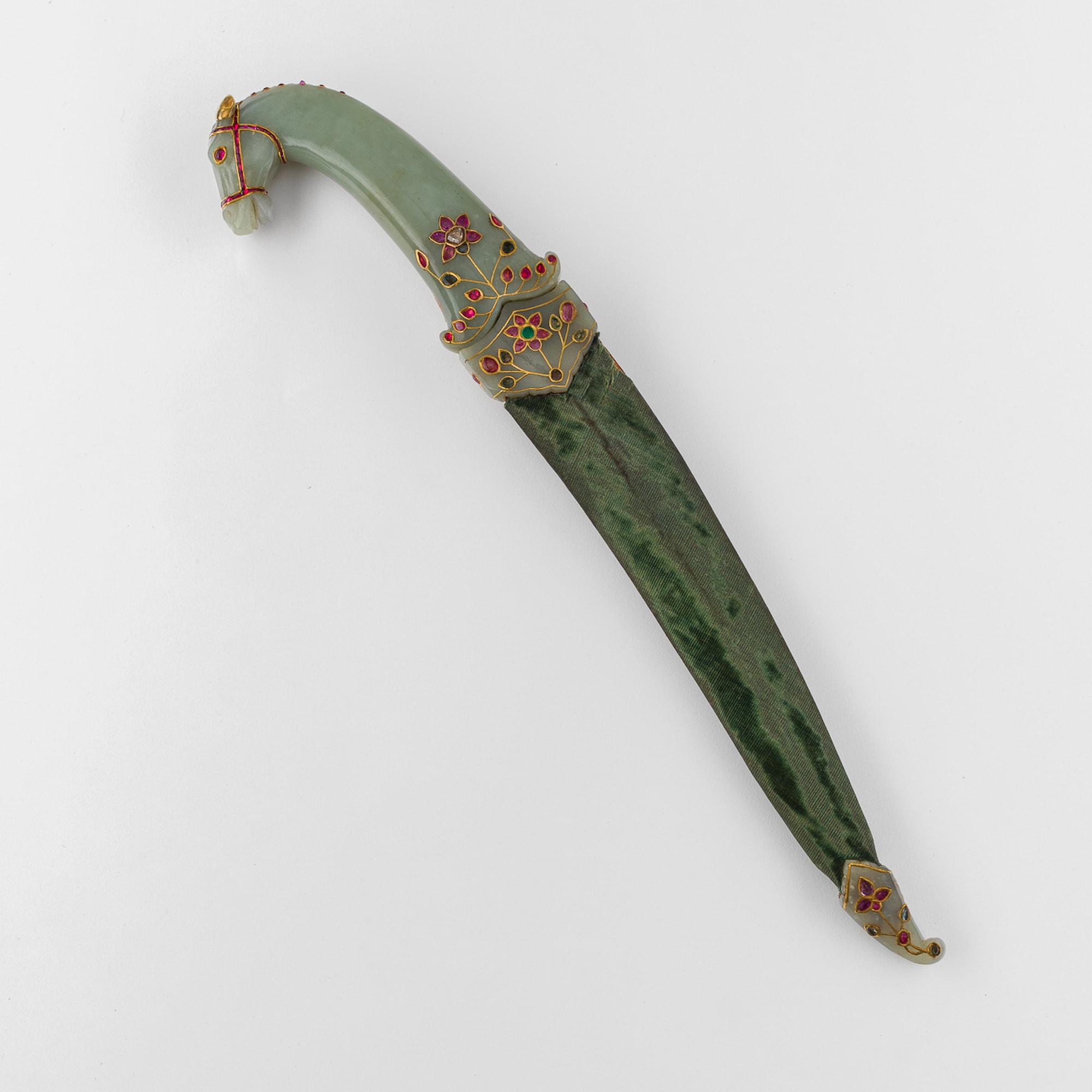
A khanjar dagger with double-edged recurved watered steel blade and a jade hilt inset with rubies. Unusually, it retains its original scabbard, of wood covered with green velvet with panels of gem-set jade at the locket and chape. The hilt is finely carved to the shape of an Arabian horse. Its teeth and mane are particularly closely observed. Rubies stud the mane, eyes, and bridle. At the bottom of the hilt, precious stones are set into gold inlay in the shape of a flower. The horse’s ears have been sensitively restored with gold tips.
Alongside gemstones and jewellery, jade-hilted weapons are the most frequently mentioned presentation gift to or from Mughal emperors.1 Stuart Cary Welch’s study of the Padshah-nama reveals that the most common form of dagger worn was the katar, with the khanjar in second place. However, only a small number of these have animal head hilts, which appear to be reserved for use by princes.2 Jade was particularly highly prized in Mughal India, in part because it was imported from Central Asia and was therefore a reminder of their Timurid ancestry, and in part because it required so much time and skill to abrade and polish it.3
A comparative example, gifted to Prince Edward during his 1875 tour of India, is held in the Royal Collection Trust (RCIN 11234). It measures 37.2 cm long and is dated to the early 18th century, though the blade and scabbard are thought to be contemporary to the royal tour. A dagger in the Musée Guimet, Paris (MA 6797), dated to the 18th century and 35.8 cm long (without scabbard), has a similar flower pattern on the horse’s neck and ruby eyes and bridle.
[1] Markel, Stephen. ‘Inception and Maturation in Mughal Jades’ in Markel (ed.) The World of Jade. Mumbai: Marg Publications, 1992. pp. 49–64: p. 51.
[2] Welch, Stuart Cary. India: Art and Culture, 1300-1900. New York: The Metropolitan Museum of Art, 1985, p. 168.
[3] Markel, Stephen. ‘Carved Jades of the Mughal Period’, Arts of Asia 17.6 (1987), pp. 123–30; p. 124.
Découvrez la galerie

Amir Mohtashemi Ltd.
Indian,Islamic and Cross-Cultural Works of Art
Plus d'œuvres d'art de la Galerie