
-Portrait miniature of a Lady, traditionally identified as Mrs. Haseler, wearing white dress with light blue ribbon and _T639131521654172434.JPG?width=2000&height=2000&mode=max&scale=both&qlt=90)
ANNE MEE
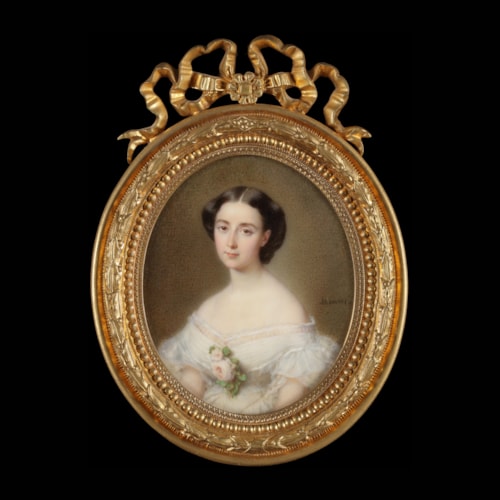
Portrait miniature of a Lady, traditionally identified as Mrs. Haseler, wearing white dress with light blue ribbon and light blue shawl; circa 1810
ANNE MEE
Portrait miniature of a Lady, traditionally identified as Mrs. Haseler, wearing white dress with light blue ribbon and light blue shawl; circa 1810
The Limner Company : Portrait Miniature
Date circa 1810
Period 19th C
Medium Watercolour on ivory
Dimension 6.7 cm (2⁵/₈ inches)
When sold in 2001, this portrait was instead identified as Georgiana Dalrymple Elliott (1782-1813). Georgiana had multiple identities in her life, and was baptised as Elliot, later called Georgiana Augusta Frederica Seymour, and married to become Lady Charles Bentinck. Her life began with scandal; she was the daughter of Grace Dalrymple Elliot, notorious courtesan of the Georgian court. It is said that when she was born, Georgiana’s paternity was claimed by the Prince of Wales, Charles Windham, Lord Cholmoneley, and George Selwyn. Though her surname may suggest that it was the Prince of Wales who took charge of her upbringing, she instead grew up in the Cholmondeley household, during which time she was painted by Sir Joshua Reynolds (MET museum, collection no. 15.30.38).
In 1808 Georgiana married Lord William Charles Augustus Cavendish-Bentinck (1780-1826). She died only a few years later, in 1813, at which point Mee painted her portrait as part of the ‘Gallery of Beauties’ series commissioned by the then George IV, the same man who may well have been her father (Royal Collection, RCIN 420871).
A comparison with the portrait in the Royal Collection may suggest that this is the same sitter, especially given the extreme stylistic exaggerations Mee appears to have used in this series of portraits. However, there is one main difference; the lady in the Royal Collection has brown eyes. Given that Reynolds also paints Georgiana with brown eyes in his portrait of her as a child, it is highly unlikely that the sitter in the present work, who is clearly painted with blue eyes, is the same woman. Another reason for the identification may have been the ‘GE’ on the reverse, though these can often be misleading and may have either been added later, or instead be the initials of the intended recipient of the miniature.
We are therefore left with the identity of ‘Mrs. Haseler’, as inscribed on the identical miniature by Mee, sold in the 1981 sale of the collection of Edward Grosvenor Paine. The inscription on the reverse of this miniature is unusual, as addresses are more typically inscribed in relation to an artist’s instead of sitter’s, name. There is no known miniature painter called Haseler, and the other version appears to have been painted by Mee. Nevertheless, it remains as the closest identification for the woman depicted here.
Anne Mee was one of the most successful female miniature painters of her generation. Historically, many of her works have been confused with the oeuvre of Richard Cosway (1742-1821), but more recently her distinct hand has become more commonly recognised. She is known for painting her sitters with large, wide, and drooped eyes, and painting with an extremely stylistic hand, as is evident in the present work. As has been mentioned, she was commissioned by George IV, and many of her works remain in the Royal Collection.
Date: circa 1810
Period: 19th C
Medium: Watercolour on ivory
Dimension: 6.7 cm (2⁵/₈ inches)
Provenance: Bonham’s, Knightsbridge, 2 February 2000, lot 144 (called Mrs Haseler);
Philips, London, 10 April 2001, lot 775 (called Georgiana Dalrymple Elliott);
Private collection.

The Limner Company : Portrait Miniature
Potrait miniatures from the 16/17th century, the 18th century and 19th century
More artworks from the Gallery
, the band tassels visible below, his ha_T639131522303800948.jpg?width=500&height=500&mode=pad&scale=both&qlt=90&format=jpg)
 and Johnson Wilkinson_T639131447919961530.jpg?width=500&height=500&mode=pad&scale=both&qlt=90&format=jpg)