

David BOMBERG
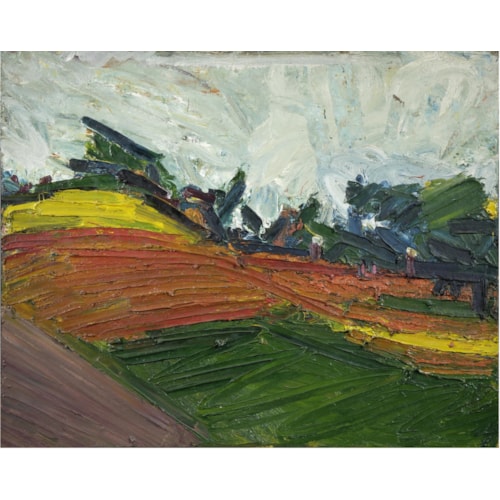
El Barrio San Francisco, Ronda
Marketplace
El Barrio San Francisco, Ronda
David BOMBERG
El Barrio San Francisco, Ronda
Date 1954
Medium Oil on board
Dimension 63.2 x 76.2 cm (24⁷/₈ x 30⁰/₁ inches)
The fifth child of a Polish immigrant leather worker, Bomberg spent his earliest years in Birmingham and then grew up in the Whitechapel area of London. He suffered considerable financial hardship while studying at evening classes given by Walter Byes (1869-1956) at the City and Guilds Institute from about 1905 to 1908 and by Walter Sickert at Westminster Art School from 1908 to 1910. With the help of John Singer Sargent and the Jewish Education Aid Society, he secured a place at the Slade School of Fine Art, London, in 1911. It was a period of dramatic change, stimulated in part by Roger Fry’s two Post-Impressionist exhibitions and the display of Italian Futurist works at the Sackville Gallery in 1912.
Bomberg was one of the most audacious painters of his generation, proving in works such as Vision of Ezekiel (1912) and Ju-jitsu (c.1913; both London, Tate) that he could absorb the most experimental European ideas and come up with a robust style of his own. Later he would evolve a form of expressionism that reflected a personal response to the landscape around him and in his famous classes at the Borough Polytechnic in the 1940s and 1950s urged artists to seek the “spirit in the mass”.
Bomberg travelled to Spain for the first time in 1929. There he broke through to a more free and expressive style andevery painting arose from intense observation. The city of Ronda in Andalucia, where Bomberg moved in 1935, is perched on a rocky plateau before a spectacular gorge. The artist responded to this dramatic position with bold pigments, assertive brushmarks and thick impastos. In 1954, Bomberg returned to Ronda, the same year the present work was painted. He had not been back to Spain since 1935, when he had been forced to flee the Spanish Civil War. His being there again rekindled the intensity with which he had reacted to the landscape two decades before. The powerful pictures from this period feature vigorously handled paint and sharply contrasting colours. Ronda would beonce again for Bomberg the subject of several powerful paintings and drawings made on the spot, in the last years before his death.
The diagonal lines of green, red and ochre pigment across the lower half of the painting describe the gloriously untamed terrain that gave rise to Bomberg’s newly dynamic and liberated style. El Barrio San Francisco, Ronda, was painted nearly twenty years after Bomberg first arrived in the city, but the artist’s deep connection to the city endured. He and his wife Lillian returned with the intention of establishing a school of painting and language. For the site of this endeavour, the couple rented Villa Paz, ‘part of an old palace, crumbling but beautiful’, which offered panoramic views of the gorge and the mountains far beyond. Despite its awe-inspiring location, the structure’s poor conditions led to the school’s failure. This, however, recentered Bomberg who returned to painting the landscape that had stirred him decades before. The artist’s uninhibited and bold strokes in the present work testify to the artistic freedom the land granted him. He appears to be searching for the light in the sky in his 1950s landscapes, perhaps a poignant reminder of his premature demise in 1957.
Bomberg was one of the most audacious painters of his generation, proving in works such as Vision of Ezekiel (1912) and Ju-jitsu (c.1913; both London, Tate) that he could absorb the most experimental European ideas and come up with a robust style of his own. Later he would evolve a form of expressionism that reflected a personal response to the landscape around him and in his famous classes at the Borough Polytechnic in the 1940s and 1950s urged artists to seek the “spirit in the mass”.
Bomberg travelled to Spain for the first time in 1929. There he broke through to a more free and expressive style andevery painting arose from intense observation. The city of Ronda in Andalucia, where Bomberg moved in 1935, is perched on a rocky plateau before a spectacular gorge. The artist responded to this dramatic position with bold pigments, assertive brushmarks and thick impastos. In 1954, Bomberg returned to Ronda, the same year the present work was painted. He had not been back to Spain since 1935, when he had been forced to flee the Spanish Civil War. His being there again rekindled the intensity with which he had reacted to the landscape two decades before. The powerful pictures from this period feature vigorously handled paint and sharply contrasting colours. Ronda would beonce again for Bomberg the subject of several powerful paintings and drawings made on the spot, in the last years before his death.
The diagonal lines of green, red and ochre pigment across the lower half of the painting describe the gloriously untamed terrain that gave rise to Bomberg’s newly dynamic and liberated style. El Barrio San Francisco, Ronda, was painted nearly twenty years after Bomberg first arrived in the city, but the artist’s deep connection to the city endured. He and his wife Lillian returned with the intention of establishing a school of painting and language. For the site of this endeavour, the couple rented Villa Paz, ‘part of an old palace, crumbling but beautiful’, which offered panoramic views of the gorge and the mountains far beyond. Despite its awe-inspiring location, the structure’s poor conditions led to the school’s failure. This, however, recentered Bomberg who returned to painting the landscape that had stirred him decades before. The artist’s uninhibited and bold strokes in the present work testify to the artistic freedom the land granted him. He appears to be searching for the light in the sky in his 1950s landscapes, perhaps a poignant reminder of his premature demise in 1957.
Date: 1954
Medium: Oil on board
Dimension: 63.2 x 76.2 cm (24⁷/₈ x 30⁰/₁ inches)
Provenance: Purchased at the 1973 exhibition on behalf of the previous owners, to 2025
Literature: David Bomberg en Ronda, exhibition catalogue by R. Cork and M. Jacobs, Salisbury, 2004, p. 38-39.
Exhibition: London, Fischer Fine Art, Bomberg: Paintings, Drawings, Watercolours and Lithographs, March - April 1973, no. 39.
Découvrez la galerie
Daniel Katz Gallery
Fine Art from Antiquity to the Twentieth Century
Plus d'œuvres d'art de la Galerie