

Barniz de Pasto Casket
Marketplace
Barniz de Pasto Casket
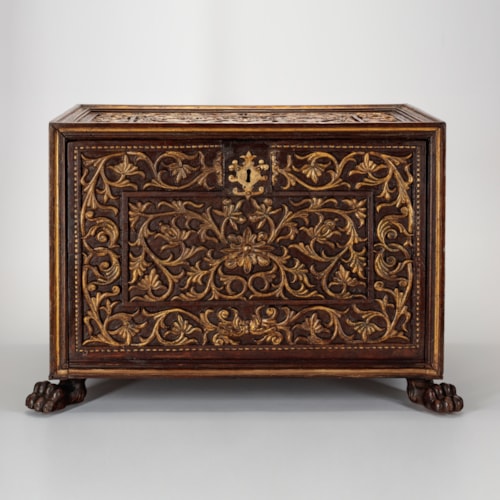
Though this workbox belongs to a group of objects termed Barniz de Pasto, meaning ‘varnish from Pasto’, it is neither varnished nor made in Pasto. Rather, it is lacquered with the resin
of the Elaegia pastonensis tree, known locally as mopa-mopa. Unlike other natural resins used for lacquering, mopa-mopa is insoluble. Artisans chew the resin to soften it and then knead in pigments. The resin is stretched into thin layers and cut into intricate shapes. The pieces of resin are layered onto an organic material, chiefly wood or gourd, and without the need for any additional adhesive.1
When the Spanish arrived in Pasto in the first half of the 16th century, the indigenous population already used mopa-mopa to decorate beads, which are the only pre-Columbian pieces to survive to today.2 In the late 16th century, during the Viceroyalty of Peru’s consolidation, lacquer began to be used as a coating for wooden surfaces, giving rise to the association with barniz or varnish. Artisans would stretch the coloured resin into thin sheets with their hands and teeth, cut the sheets to shape, then apply to the wood with no need for additional adhesive.3 Pieces are catageorised as either barniz brillante, where silver leaf is added between layers of resin, and matte barniz, as in this case, where no silver is added.
On the lid of the work box is a heraldic escutcheon, featuring a phoenix sinister with wings displayed and elevated, emerging from fire. In Christian iconography the phoenix is typically seen to be a symbol of the resurrection. The Latin phrase ex me ipso renascor, meaning ‘I am born again from myself’ wraps around the typical Iberian oval cartouche. The same escutcheon appears on a Barniz de Pasto writing desk (accession no. W.5-2015) in the Victoria & Albert Musuem, London, dated 1625-1675. This emblem appears to have been appropriated from the printers’ devices of Juan de Bonilla and Nicolás de Asiain, who worked together in the first half of the 17th century in Zaragoza and Navarra, Spain.3 The former the editor and the latter the printer, they published the works of great authors like Cervantes, in addition to legal, royal, and religious decrees.4 Another example of this emblem on a Barniz de Pasto coffer is held in a private collection, and illustrated in Yayoi Kawamura’s ‘The Art of Barniz de Pasto and its Appropriation of Other Cultures’.5 A similar phenomenon occurs in the Church of Carabuco, next to Lake Titicaca, a Quechua cultural area. A mural on the wall of the choir of a large golden compass and the phrase ‘Labore et Constantia’ matches the printer’s device of the Antwerp publisher Plantin-Moretus.6
Non-native animals like camels and lions, in addition to mythical beings like griffins, derive from fifteenth- and sixteenth-century European sources, such as illuminated manuscripts, prints, and drawings, most likely supplied by Catholic missionaries.7
A tabletop and a portable writing desk of similar design are held in the Hispanic Society of America Museum and Library (accession nos LS2447 and LS2446), both dated to circa 1643. The latter similarly opens to reveal a pistachio-green crucifix and the ‘INRI’ device above. An inscription just above the drawers reads 'CAPSULA H(A)EC EST MARTINI DE TOLOSA', which means 'this box belongs to Martin de Tolosa'. Martin de Tolosa was chief sacristan at the Cathedral of Popayán, Colombia, from 1630 to 1643. In the present example the crucifix is flanked by two smaller crosses, representing the bandits crucified alongside Jesus. The initials Y.S. appear on either side of the crucifix, perhaps representing the name of the owner.
The visual language of Barniz de Pasto was also derived from Japanese lacquer. In 1573, the Spanish trade route between Manila and Acapulco was launched, allowing for shipments of Namban and pictorial lacquer between the Asian and American outposts of the Spanish Empire. This led to ‘the greater commoditisation of Asian goods in the viceroyalty of New Spain than in Castile.’8 The red border with gold diaper pattern is reminiscent of shippo, a pattern of interlocking circles made from mother of pearl, found on Japanese Namban lacquer.9 Examples of this border can be seen on a retable in the Peabody Essex Museum, Salem (accession no. AE85752), a cabinet in the British Museum, London (accession no. 1977,0406.1), and a coffer in the Metropolitan Museum of Art, New York (accession no. 2016.508). The shift from orange-brown backgrounds to black in the later Barniz de Pasto pieces further increased the resemblance to Japanese Namban.
[1] Newman, R.; Kaplan, E.; Derrick, M. ‘Mopa Mopa: Scientific Analysis and History of an Unusual South American Resin Used by the Inka and Artisans in Pasto, Colombia’. Journal of the American Institute for Conservation 54.3 (2015). pp. 123-148. For photographs of contemporary Colombian craftsmen making Barniz de Pasto, see ‘Colombia Artesanal: Barniz de Pasto, un proceso inspirador’, Artesanías de Colombia, 23/04/2021. Retrieved online via https://artesaniasdecolombia.com.co/PortalAC/Noticia/colombia-artesanal-barniz-de-pasto-un-proceso-inspirador_14722 on 01/11/2024.
[2] Álvarez-White, María Cecilia. ‘El barniz de Pasto: Reflejo de la naturaleza’, Naturaleza & Paisaje: IX Encuentro internacional sobre barroco (2019), pp. 339-346; 340.
[3] ‘Box of mysteries’, Victoria & Albert Museum, retrieved online via https://www.vam.ac.uk/articles/box-of-mysteries on 22/05/2024.
[4] See for example the cover of Emblemas morales by Juan de Horozco y Covarrubias (1604), published by Juan de Bonilla.
[5] Itúrbide Díaz, Javier. Los libros de un reino: historia de la edición en Navarra (1490-1841). Navarra: Gobierno de Navarra, 2015. p. 140.
[6] Kawamura, Yayoi. ‘The Art of Barniz de Pasto and its Appropriation of Other Cultures’, Heritage 6 (2023), pp. 3292-3306; p. 3302, figs 14 and 15.
[7] Ibid., pp. 3303, 3304.
[8] Codding, Mitchell. ‘The lacquer Arts of Latin America’, in Dennis Carr (ed.) Made in the Americas – The New World Discovers Asia. Boston: MFA Boston, 2015. pp. 75-82; p. 79.
[9] Gasch-Tomás, José L. The Atlantic World and the Manila Galleons: Circulations, Market, and Consumption of Asian Goods in the Spanish Empire, 1565-1650. Leiden: Brill, 2019. p. 42.
[10] Impey, Oliver and Jörg, Christiaan. Japanese Export Lacquer 1580 – 1850. Amsterdam: Hotei, 2005. p. 78.
Découvrez la galerie

Amir Mohtashemi Ltd.
Indian,Islamic and Cross-Cultural Works of Art
Plus d'œuvres d'art de la Galerie