
RICHARD CROSSE
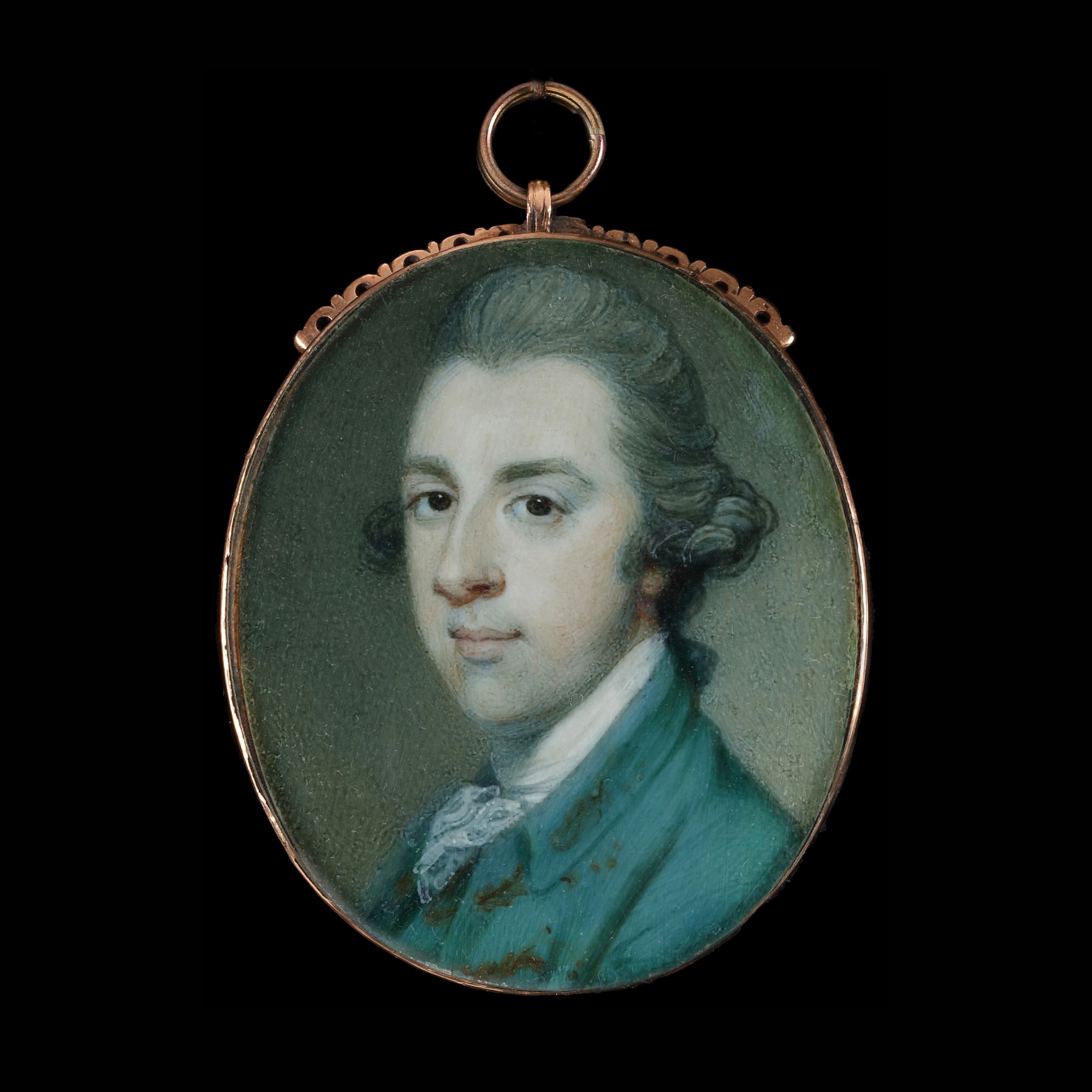
Portrait miniature of a Gentleman, wearing green coat with gold details, white stock and lace cravat, his hair powdered grey and worn 'en queue'
RICHARD CROSSE
Portrait miniature of a Gentleman, wearing green coat with gold details, white stock and lace cravat, his hair powdered grey and worn 'en queue'
The Limner Company : Portrait Miniature
Date circa 1770
Epoque Georgian
Origine England
Medium Watercolour on ivory
Dimension 4 cm (1⁵/₈ inches)
Crosse was born deaf and non-verbal but this did not detract from his abilities as a miniature painter. He was one of many miniature painters with these conditions, such as Charles Shirreff (1749-1829). It is said that he first took this up as a hobby, though he was able to carve a career out of his craft, later becoming the enamel painter to King George III and achieving the status of both a prolific and successful artist. His most famous works in public collections depict those closest to him, including his brothers and himself. One self-portrait can be found in the Art Gallery of Ontario (AGOID.68426), and a portrait of one of his brothers, either James or Edward, can be found in the Victoria and Albert Museum, London (P.148-1929).
It was his brother James who cared for the artist for many years, according to Foskett (1972). James may have also provided support to his brother when he fell in love with Miss Sarah Cobbe, only for her to reject a proposal and run away with a Mr Haydon. The sorrow resulting from this heartbreak appears to have followed Crosse throughout his life. In the memoirs of Benjamin Robert Haydon (1786-1846), the son of Miss Sarah Cobbe (later Mrs Haydon) and Mr Haydon, the painter recounts a meeting between the pair later in life, which evidences this. Mrs Haydon was travelling to London in her dying days, and met Crosse again at her Brother’s house, where he was staying. Haydon recounts Crosse’s reaction:
‘He saw her before him, broken and dying; he felt all his affection return, and flinging himself forward on the table, he burst into a paroxysm of tears, as if his very heart-strings would crack.’ [1]
Tragically, Mrs Haydon died the next day.
[1] B. R. Haydon, The Autobiography and Memoirs of Benjamin Robert Haydon (1786-1846), 1926, p. 60.
Date: circa 1770
Epoque: Georgian
Origine: England
Medium: Watercolour on ivory
Dimension: 4 cm (1⁵/₈ inches)
Provenance: Christie’s, South Kensington, The Frederick Joachim Collection Part III, 1 November 1995, lot 107;
Bonhams, London, 30 June 1999, lot 103 (illustrated on back cover);
Private collection.

The Limner Company : Portrait Miniature
Potrait miniatures from the 16/17th century, the 18th century and 19th century
Plus d'œuvres d'art de la Galerie
, ‘Katherine of Aragon’ (1485-1536), ‘Anne Boleyn’ (c.1501-15_T639258442325460181.jpg?width=500&height=500&mode=pad&scale=both&qlt=90&format=jpg)


 when a boy, wearing gilt-studded armour and gold-trimmed white _T639199046204364900.jpg?width=500&height=500&mode=pad&scale=both&qlt=90&format=jpg)