


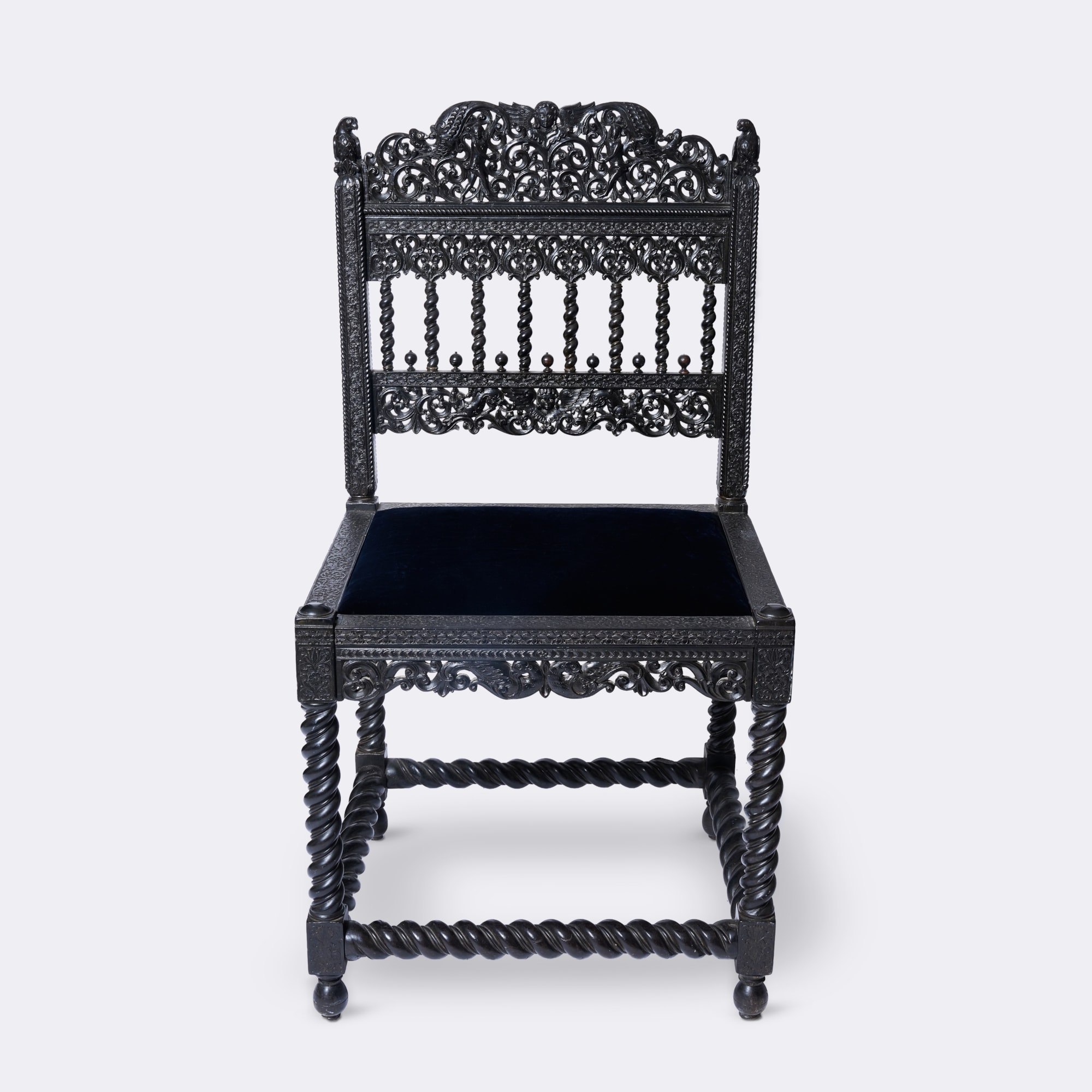
Indo-Dutch Carved Ebony Chair
Marketplace
Indo-Dutch Carved Ebony Chair
Indo-Dutch Carved Ebony Chair
A richly-carved solid ebony chair, typical of work made for the European market in the Coromandel Coast, Southeastern India. It has spiral-turned legs, stretcher, and spindles. The mid and top rails are carved and pierced with swirling foliage, known in Sinhala as liya væela.1 The finials are in the form of parrots (giravā). At the centre is a winged head which frequently appears on coromandel ebony furniture. It has sometimes been described as an amorino, but it is possible that this is a Sinhalese motif.
Carved ebony chairs of this kind have been recorded in English collections from as early as the mid-eighteenth century, leading to the belief for much of the 19th century that they were made in Tudor England.2 They were therefore used to furnish many of Britain’s great houses in the belief that they were period pieces. For example, the National Trust properties of Tyntesfield, a Victorian Gothic Revival house in Somerset (see NT 20196.1) and Treasurer’s House (see NT 592861), a Medieval house in York which was renovated in the 19th century. They were even purchased for Windsor Castle: an illustration of the Grand Corridor at Windsor Castle in 1846 (see Royal Collection Trust RCIN 919781) shows several Coromandel chairs. The chairs in this illustration may have been the set of seven purchased by George IV (1762–1830) which are nearly identical to ours (see accession no. RCIN 21606). Another near-identical chair in the Victoria & Albert Museum, London (accession no. IS.6-2000) is attributed to the Coromandel Coast and dated 1860–1880.
Please note that all ivory has been removed and substituted with inorganic material.
n.b. accession nos are clickable links
[1] Coomaraswamy, A.K., Medieval Sinhalese Art, 2nd ed., New York: Pantheon Books, 1956, pp. 98–99.
[2] Jaffer, Amin. Luxury Goods form India: The Art of the Indian Cabinet-Maker. London: V&A, 2002, pp. 46–47; Wainwright, Clive. ‘Only the True Black Blood’, Furniture History 21 (1985), pp. 250–257: p. 251.
Découvrez la galerie

Amir Mohtashemi Ltd.
Indian,Islamic and Cross-Cultural Works of Art
Plus d'œuvres d'art de la Galerie


_T638760967371334545.jpg?width=500&height=500&mode=pad&scale=both&qlt=90&format=jpg)
