


, wearing armour and white ruff, his curled h_T639175400464972509.JPG?width=2000&height=2000&mode=max&scale=both&qlt=90)
Attributed to PIERRE SIGNAC
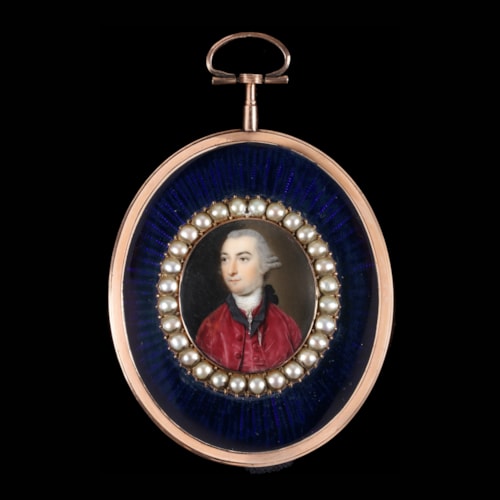
Portrait enamel, believed to be Victor Amadeus II of Savoy (1666-1732), wearing armour and white ruff, his curled hair powdered
Marketplace
Portrait enamel, believed to be Victor Amadeus II of Savoy (1666-1732), wearing armour and white ruff, his curled hair powdered
Attributed to PIERRE SIGNAC
Portrait enamel, believed to be Victor Amadeus II of Savoy (1666-1732), wearing armour and white ruff, his curled hair powdered
The Limner Company : Portrait Miniature
Date circa 1680s
Epoque Baroque
Medium Enamel
Dimension 2.5 cm (1 inches)
Dimension avec cadre 4 cm (1⁵/₈ inches)
The identification of this sitter as Victor Amadeus II of Savoy comes from a comparison with a near-identical portrait in the collection of the Hofburg Palace, Vienna. It is not clear where their identification of Victor comes from. If this is him, he is likely to be a young man, only just made King of Sardinia, evident from the slight moustache, which at a glance looks like it could just be a shadow on his upper lip. There are only a few portraits of Victor at a young age, and it is therefore difficult to compare this work with other known likenesses.
Victor was the only son of Charles Emmanuel II, the Duke of Savoy (1634-1675) and only gained full control of this title in 1684, after nine years of his mother, Marie Jeanne of Savoy (1644-1724), acting as regent. This portrait is likely to have been painted after that year, when he banished his mother from being involved in the running of the state. Victor held many titles during his life, including the King of Sicily (1713) and the King of Sardinia (1720). One of Victor’s most radical actions as King of Savoy was to end his country’s dependence on France. In both the Nine Years’ War and the War of Spanish Succession, Victor allied himself with England and the Dutch Republic, France’s enemies.
His later life was filled with fewer political successes. Victor had abdicated in 1730 and he was succeeded by his son, Charles Emmanuel III (1701-1773). By this point, he had been left with little family, and he had married his long-time mistress, Anna Canalis di Cumiana (1680-1769), on the same day he announced his abdication. His wish to remain out of politics did not last long, however. In 1731, after a stroke, he told his son he intended to return to the throne. In turn, Charles arrested him and sent di Cumiana to a house for reformed prostitutes. Though she was later allowed to live with Victor, he blamed her for his arrest and was violent towards her at the end of his life.
Given Victor Amadeus’ apparent age and date of birth, as well as the dating of his hairstyle, it is likely that this portrait was painted towards the end of Signac’s life. Like other court enamellers of this period, Signac likely ran a workshop to deal with the demands of portraits produced in this exacting and time-consuming technique. Signac had been taught the art of enamel painting by Henri Toutin (b.1614), who was the first artist to paint in this medium on gold in the 1630s. Signac would go on to become one of the most skilled enamel painters of his age in his own right. He was employed by the Swedish court in the late 1640s, and as a result, many of his works depict Swedish Royals and remain within the national collections of Sweden. There were other enamel painters active in other parts of Europe in this period but the style of the present work heavily suggests the artist responsible was following the work of Signac, rather than his contemporaries. These included Jean Petitot (1607-1691) and Jacques Bordier (1616-1684). The white counter-enamel is typical of enamelled portraits of the 17th century.
Victor was the only son of Charles Emmanuel II, the Duke of Savoy (1634-1675) and only gained full control of this title in 1684, after nine years of his mother, Marie Jeanne of Savoy (1644-1724), acting as regent. This portrait is likely to have been painted after that year, when he banished his mother from being involved in the running of the state. Victor held many titles during his life, including the King of Sicily (1713) and the King of Sardinia (1720). One of Victor’s most radical actions as King of Savoy was to end his country’s dependence on France. In both the Nine Years’ War and the War of Spanish Succession, Victor allied himself with England and the Dutch Republic, France’s enemies.
His later life was filled with fewer political successes. Victor had abdicated in 1730 and he was succeeded by his son, Charles Emmanuel III (1701-1773). By this point, he had been left with little family, and he had married his long-time mistress, Anna Canalis di Cumiana (1680-1769), on the same day he announced his abdication. His wish to remain out of politics did not last long, however. In 1731, after a stroke, he told his son he intended to return to the throne. In turn, Charles arrested him and sent di Cumiana to a house for reformed prostitutes. Though she was later allowed to live with Victor, he blamed her for his arrest and was violent towards her at the end of his life.
Given Victor Amadeus’ apparent age and date of birth, as well as the dating of his hairstyle, it is likely that this portrait was painted towards the end of Signac’s life. Like other court enamellers of this period, Signac likely ran a workshop to deal with the demands of portraits produced in this exacting and time-consuming technique. Signac had been taught the art of enamel painting by Henri Toutin (b.1614), who was the first artist to paint in this medium on gold in the 1630s. Signac would go on to become one of the most skilled enamel painters of his age in his own right. He was employed by the Swedish court in the late 1640s, and as a result, many of his works depict Swedish Royals and remain within the national collections of Sweden. There were other enamel painters active in other parts of Europe in this period but the style of the present work heavily suggests the artist responsible was following the work of Signac, rather than his contemporaries. These included Jean Petitot (1607-1691) and Jacques Bordier (1616-1684). The white counter-enamel is typical of enamelled portraits of the 17th century.
Date: circa 1680s
Epoque: Baroque
Medium: Enamel
Dimension: 2.5 cm (1 inches)
Provenance: Private collection, Europe.
Découvrez la galerie

The Limner Company : Portrait Miniature
Potrait miniatures from the 16/17th century, the 18th century and 19th century
Plus d'œuvres d'art de la Galerie
, the band tassels visible below, his ha_T639131522303800948.jpg?width=500&height=500&mode=pad&scale=both&qlt=90&format=jpg)


