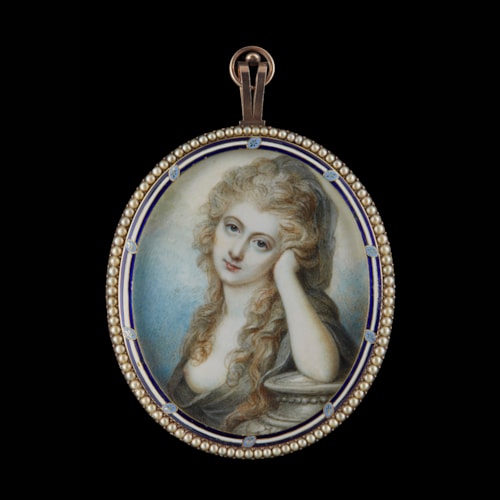


PETER CROSS
A Gentleman, wearing crimson velvet coat with gold buttons, over embroidered blue silk waistcoat and white shirt with tied neck scarf; powdered wig, circa 1700
PETER CROSS
A Gentleman, wearing crimson velvet coat with gold buttons, over embroidered blue silk waistcoat and white shirt with tied neck scarf; powdered wig, circa 1700
The Limner Company : Portrait Miniature
Date circa 1700
Origine England
Medium Watercolour on vellum / parchment / paper
Dimension 7.4 cm (2⁷/₈ inches)
Painted by the miniaturist Peter Cross, who was historically referred to as Lawrence Cross(e), the present work bears his distinctive monogram delineated in gold paint.[1] Miniatures by Peter Cross were surrounded by confused attributions due to a monogram thought to spell either ‘PC’ or ‘LC’. It was not until 1935 when a miniature of a William Gore surfaced, signed with the apparent monogram ‘LC’, but signed and dated on the reverse ‘P. Cross, 1670’, that both ‘LC’ and ‘PC’ were understood to be the same artist.
Described as one of the most talented miniature painters of the 17th century, Peter Cross’s work has been called finer than that of Samuel Cooper (1607/8-1672), with whom Cross may have trained.[2] Ancestrally Cross is presumed to have been French, with the surname ‘de Crosse’; his parents Anthony and Margaret Crosse had considerable wealth and lived in London. Peter was the youngest child of seven. He married Arabella Burman in 1667 and had seven children of his own. Arabella died in 1700 and Cross went on to marry the widow of his brother-in-law. His studio and residence at the Sign of the Blue Anchor in Henrietta Street, Covent Garden - the very street where Cooper and his wife Christiana lived from at least as early as 1650 until Cooper's death in 1672.
[1] In 1979 in The Burlington Magazine Mary Edmond definitively concluded that Lawrence and Peter Cross were the same miniaturist named Peter Cross; M. Edmond, ‘Peter Cross, Limner: Died 1724’ in The Burlington Magazine, vol.121, no.918, pp.585-6.
[2] L.R. Schidlof, The Miniature in Europe, (Graz, Austria) p.173; D. Foskett, Miniatures Dictionary and Guide,
(Woodbridge, 1987) p.520.
Date: circa 1700
Origine: England
Medium: Watercolour on vellum / parchment / paper
Signature: Signed with monogram ‘PC’ in gold
Dimension: 7.4 cm (2⁷/₈ inches)
Provenance: Bonhams, London, 22 November 2006, lot 34;
Private collection, UK (since 2006).

The Limner Company : Portrait Miniature
Potrait miniatures from the 16/17th century, the 18th century and 19th century
Plus d'œuvres d'art de la Galerie
, 1st Lord Southampton, semi-profile to the left, wearing scarlet coat with blue_T639199045785173142.jpg?width=500&height=500&mode=pad&scale=both&qlt=90&format=jpg)
 wearing dark blue buttoned coat, black waistcoat and white s_T639258419110530247.jpg?width=500&height=500&mode=pad&scale=both&qlt=90&format=jpg)
-A Gentleman, possibly Henri II of Lorraine (1614-1664), wearing a cloak band and a love lock with a bow_T639130543606717032.JPG?width=500&height=500&mode=pad&scale=both&qlt=90&format=jpg)