
Balkan Yatagan
Marketplace
Balkan Yatagan
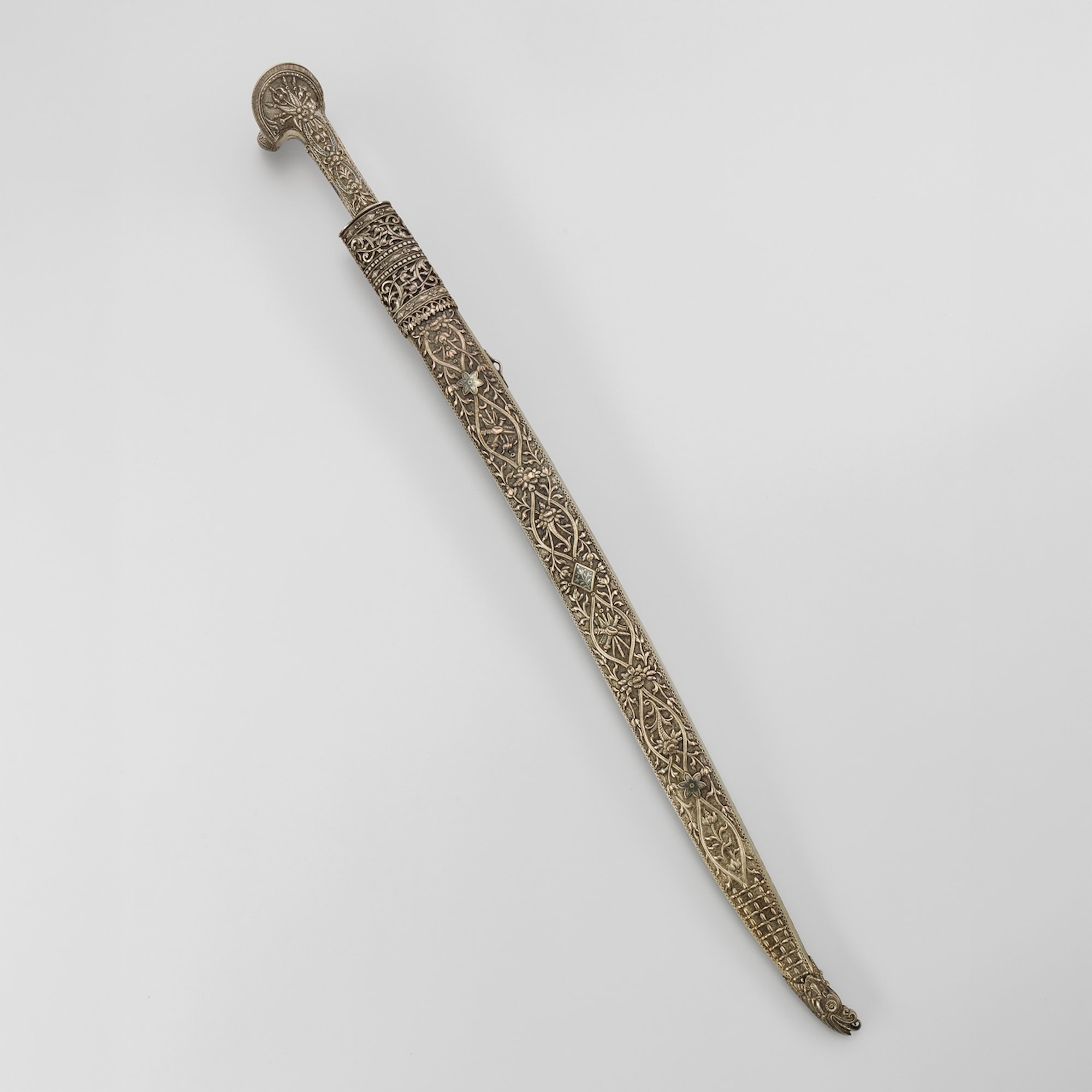
A fine yatagan of characteristic form with eared hilt and slightly recurved blade. This example is richly decorated throughout the silver gilt scabbard and hilt with embossed and repoussé floral ornamentation.
Yatagans were made throughout the Ottoman Empire. However, Balkan examples tend to have larger ears than Turkish or Algerian yatagans. Furthermore, the fish or dolphin head at the end of the scabbard is also associated with yatagans made in Kotor and Crete.
An unusual feature of this yatagan is a series of self-referential illustrations in the form of a trophy or panoply of arms, the depiction of a display of arms and armour, under the ears of the hilt and on the scabbard. These were common in Early Modern European printed material such as the Panoplia sev armamentarium by Hans Vredeman De Vries (see V&A no. 17314) or illustrations after Enea Vico (see British Museum 1937,0915.449.146).
The watered steel blade is decorated on one side with a floral spray in silver damascene, and on the other it is signed Mustafa. Several yatagans in the collection of the Croation History Museum, Zagreb, feature very similar signatures by a craftsman named Mustafa, dating between 1794 and 1815.1
[1] See Bošković, Dora. Zbirka Jatagana u Hrvatskom Povijesnom Muzeju u Zagrebu / The Yatagan Collection of the Croation History Museum in Zagreb. Zagreb: Hrvatski Povijesni Muzej, 2006, cats 16, 19, 28, 34, 42, 45. Read online here.
Yatagans were made throughout the Ottoman Empire. However, Balkan examples tend to have larger ears than Turkish or Algerian yatagans. Furthermore, the fish or dolphin head at the end of the scabbard is also associated with yatagans made in Kotor and Crete.
An unusual feature of this yatagan is a series of self-referential illustrations in the form of a trophy or panoply of arms, the depiction of a display of arms and armour, under the ears of the hilt and on the scabbard. These were common in Early Modern European printed material such as the Panoplia sev armamentarium by Hans Vredeman De Vries (see V&A no. 17314) or illustrations after Enea Vico (see British Museum 1937,0915.449.146).
The watered steel blade is decorated on one side with a floral spray in silver damascene, and on the other it is signed Mustafa. Several yatagans in the collection of the Croation History Museum, Zagreb, feature very similar signatures by a craftsman named Mustafa, dating between 1794 and 1815.1
[1] See Bošković, Dora. Zbirka Jatagana u Hrvatskom Povijesnom Muzeju u Zagrebu / The Yatagan Collection of the Croation History Museum in Zagreb. Zagreb: Hrvatski Povijesni Muzej, 2006, cats 16, 19, 28, 34, 42, 45. Read online here.
Découvrez la galerie

Amir Mohtashemi Ltd.
Indian,Islamic and Cross-Cultural Works of Art
Plus d'œuvres d'art de la Galerie