
George Romney
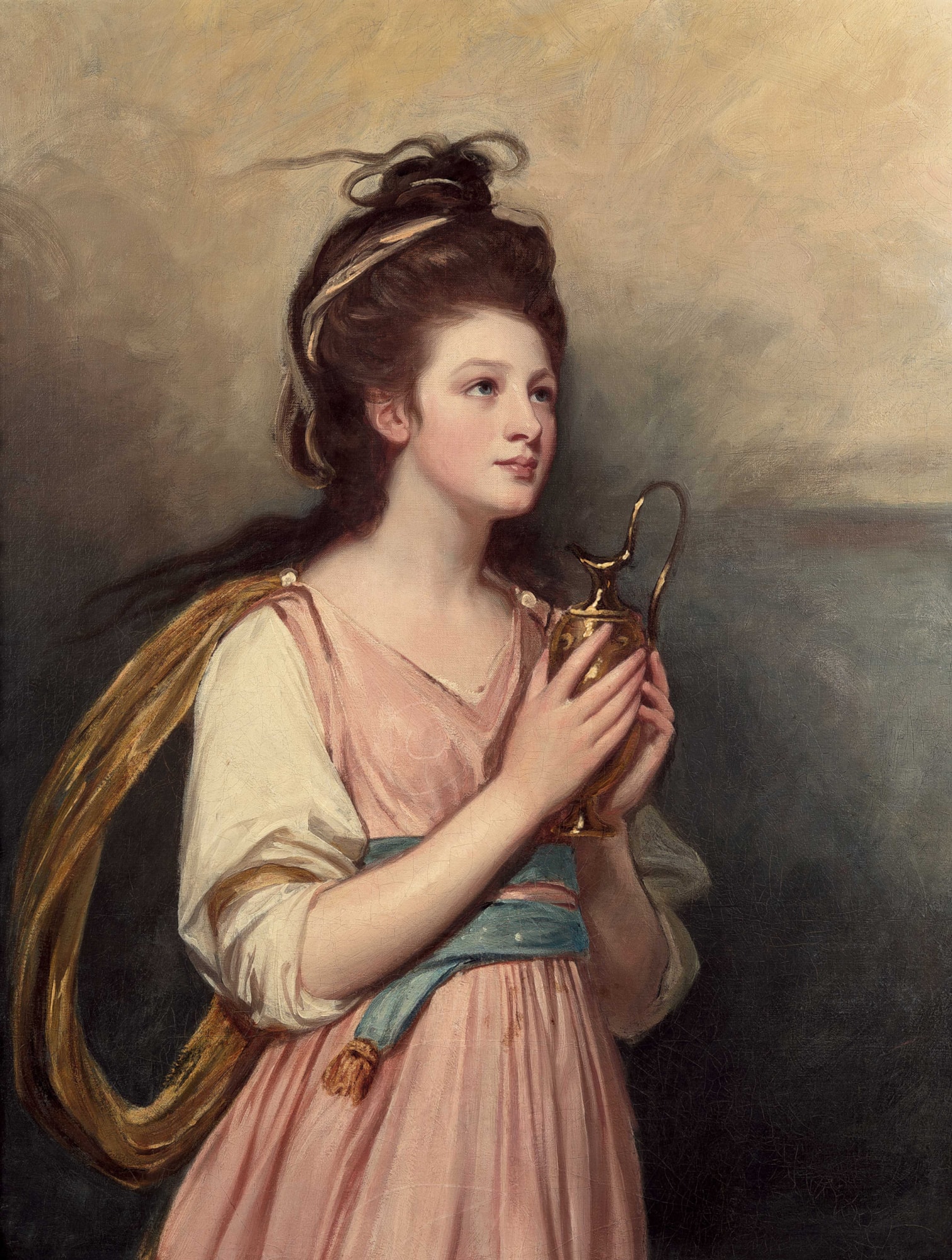
Miss Vernon as Hebe
George Romney
Miss Vernon as Hebe
Date 1777
Medium Oil on canvas
Dimension 104.5 x 80.5 cm (41¹/₈ x 31³/₄ inches)
The present portrait depicts Miss Caroline Vernon (1761-c.1833) who belonged to a successful family of parliamentarians, her father was Richard Vernon of Hilton Park, the MP for Tavistock. In 1798, Vernon married Robert Percy Smith, who between 1803 and 1810, through the influence of William Petty, 1st Marquess of Lansdowne and Sir Francis Baring, obtained the appointment of Advocate-General of Bengal. After seven years he returned to England with a fortune and settled in London with his wife. Their only son Robert Vernon (1800-1873) was a member of the Liberal Party and became the 1st Baron Lyveden in 1859.
This arresting portrait depicts Miss Vernon as the ancient Greek goddess, Hebe – cup-bearer of the gods of Mount Olympus. Derived from the Greek meaning ‘youth’, Miss Vernon posed for this portrait at the tender age of 16. It was commissioned by her brother-in-law, George Greville, 2nd Earl of Warwick, whom had married Caroline’s elder sister, Henrietta, the year prior. Romney had previously painted a portrait of Henrietta Vernon in a half-length format, however the location of this painting is no longer known, except for the survival of a mezzotint which dates to 1780. Romney, having recently returned from his travels in Rome, was undoubtedly inspired by the classical world and the theme of Hebe as a subject, having painted the Viscountess Bulkeley the year prior.
Lord Warwick was one of the most important aristocratic patrons and collectors of his time, of which many of the antiquities and paintings he collected were displayed at the family seat, Warwick Castle. A generous patron, Lord Warwick commissioned numerous portraits from Romney, but financial trouble meant may of the works were not paid for until years later. In this instance, the present portrait (one of two versions) was not paid for until May 20th 1801, approximately 24 years later.
Here Miss Vernon stands elegantly dressed in pink classical robes, clasping a wine jug as she gazes upwards with a delicate and contemplative expression; her pose almost frieze-like, much in the pervading Neoclassical taste. Her white sleeves are fastened with gold bands and a blue sash around her waist, with her flowing hair caught by a gust of wind against the backdrop of a tempestuous sky. This painting is mentioned in Romney's register as a portrait in full-length (he converted it to three-quarter length at a later date), and is the original composition kept by Romney for nearly twenty-four years, until the Earl of Warwick payed for it in 1801. Two other studies of Miss Vernon are known. One is kept at the Hunterian Museum and Art Gallery, Glasgow, which is probably a study for the present painting, and another is in a private collection.
Franz Frantsevich von Uthemann (1868–1925), whom acquired this painting from Agnew’s, was a prominent figure in the business world of Saint Petersburg, continuing the entrepreneurial legacy established by his father, Franz Vasilievich von Uthemann. Closely associated with Ferdinand Karl Krauzkopf, he played an active role in the development of the family enterprise, the Treugolnik rubber factory, founded in 1867 and one of the largest industrial concerns in the Russian Empire. His marriage to Paulina Hilda von Krauzkopf, heir to the renowned Krauzkopf rubber-boot manufacturing business, further strengthened the ties between two of the empire's leading industrial dynasties. After completing his law studies at the Saint Petersburg State University, von Uthemann served in the Ministry of Finance, bringing his legal expertise to public administration. He also sat on the boards of several major companies, including Treugolnik and the Bavaria Brewery, reflecting his considerable influence within Russian business circles.
Von Uthemann owned a country house distinguished by its eclectic and highly refined interiors. His remarkable art and furniture collection attracted the attention of the art historian and critic Alexandre Benois, who wrote in Starye Gody:
“It is a luxurious setting, preserved almost entirely in the spirit of the eighteenth century. The objects serve the house rather than being displayed, and therein lies the charm of the collection.”
Several pieces from his collection later entered major museums. Among them are a flat desk attributed to Charles Cressent, now in the collection of the J. Paul Getty Museum in Los Angeles, and a bronze statue of Louis XIV after a model by Martin Desjardins, today housed in the National Gallery of Art. The upheavals of the Russian Revolution forced von Uthemann and his family into exile. They first sought refuge in Finland before settling in Switzerland. Their residence, Villa Beau Soleil, overlooking the tranquil shores of Lake Geneva, became the family home and remained in their possession until 1965. The present painting was thus subsequently sold the following year at Sotheby’s, London, whereby it entered a private European collection until the present day.
Date: 1777
Medium: Oil on canvas
Dimension: 104.5 x 80.5 cm (41¹/₈ x 31³/₄ inches)
Provenance: Commissioned by George, 2nd Earl of Warwick in 1777, and by family descent;
Warwick House, St. James’s, London, by 1904
Agnew's Gallery, London, by 1905
Franz Frantsevich Utheman (1868-1925), St. Petersburg, before 1908
Stayed with his descendants in the Swiss Grisons by 1917 until sold;
Sale; Sotheby's, London, November 23, 1966, No. 75
Private Collection, to 2026
Literature: H. Ward and W. Roberts, Romney: a biographical and critical essay with a catalogue raisonné of his works, 1904, Vol. II, p. 162 (locates the painting with the Earl of Warwick, with additions of 4-inch lateral stripes on both sides).
The Art Journal, 1905, p.44 (located at the Agnew Gallery)
Alexandre Benois, Collection of F. F. Utenan in St. Petersburg (sic), in the magazine Starye Gody, April 1908, Saint Petersburg 1908, p.189-199.
G. Ch. Rump, George Romney (1734-1802): zur Bildform der Bürgerlichen Mitte in der Englischen Neoklassik, 1974, vol.1, p. 259, n°362, vol.2, reproduced Abb.13
Alex Kidson, George Romney: A Complete Catalogue of His Paintings, Yale University Press, 2015, No. 1336 (with incomplete history, listed at Francis, 5th Earl of Warwick, at Warwick House, St. James's in 1910, then lost and reproduced in black and white from the Sotheby's 1966 sale).H. Ward and W. Roberts, Romney: a biographical and critical essay with a catalogue raisonné of his works, 1904, Vol. II, p. 162. (locates the painting with the Earl of Warwick, with additions of 4-inch lateral stripes on both sides).
The Art Journal, 1905, p.44 (located at the Agnew Gallery)
Alexandre Benois, Collection of F. F. Utenan in St. Petersburg (sic), in the magazine Starye Gody, April 1908, Saint Petersburg 1908, p.189-199.
G. Ch. Rump, George Romney (1734-1802): zur Bildform der Bürgerlichen Mitte in der Englischen Neoklassik, 1974, vol.1, p. 259, n°362, vol.2, reproduced Abb.13
Alex Kidson, George Romney: A Complete Catalogue of His Paintings, Yale University Press, 2015, No. 1336 (with incomplete history, listed at Francis, 5th Earl of Warwick, at Warwick House, St. James's in 1910, then lost and reproduced in black and white from the Sotheby's 1966 sale).
Exhibition: London, British Institution, 1863, No. 160 "a lady as Hebe", belonging to the Earl of Warwick.
Daniel Katz Gallery
Fine Art from Antiquity to the Twentieth Century
More artworks from the Gallery