
Sir Stanley Spencer
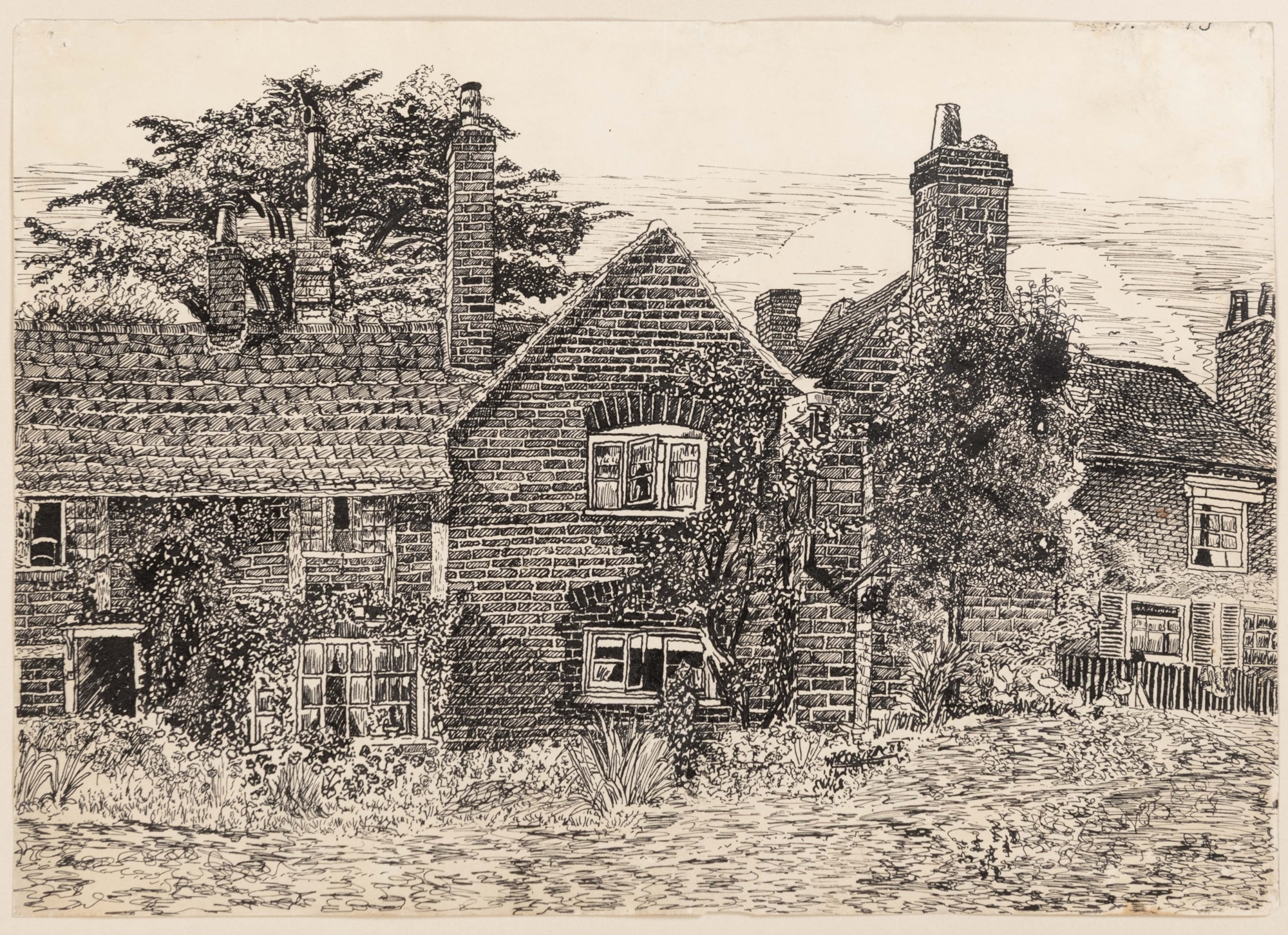
Houses at Cookham
Marketplace
Houses at Cookham
Sir Stanley Spencer
Houses at Cookham
As the art critic David Sylvester noted, on the occasion of an Arts Council exhibition of Stanley Spencer’s drawings in 1954-1955, ‘In most painters’ houses you will find hanging, or at least stacked away somewhere, a few favourites among their own canvases which they have withheld from sale. The only paintings of his own in Stanley Spencer’s house are barely or not yet dry. On the other hand, the place is swarming with his drawings. There are stacks of them in every room – from highly elaborate and finished portraits and compositions to the sketchiest notes on scraps of paper – covering nearly fifty years’ activity and numbering many thousands. Of this great hoard, only a tiny proportion has ever been publicly exhibited or reproduced, for all that the number of first-rate examples of his work which it includes far exceeds that of those drawings which have found their way into the hands of collectors and museums. Spencer’s unwillingness to part with his drawings – either via the dealer or via the dustbin – suggests the immense personal importance they have for him.’
Datable to c.1907-1909, this refined early pen drawing by Spencer depicts his home village of Cookham in Berkshire. The artist favoured the medium of pen and black ink, applied with a precise hatched technique, in many of his earliest drawings, several of which are set in and around his beloved Cookham, situated on the banks of the Thames some thirty miles west of London. As Andrew Causey has written, ‘Stanley Spencer did not start out by wanting to become an artist, but by wanting to communicate something about his native village, Cookham. Later on he recalled how when he was young he had spent a lot of time drawing in different parts of the village, at first with no particular sense of purpose or even satisfaction. ‘The moment I realized there might be a next step was when one day I was drawing old Sarah Sandall’s cottage from her garden. I felt there was something there that was very much my business...’’
In a list of his early works compiled by Spencer sometime around 1945 in an unpublished notebook, now in the Tate Gallery Archives, a total of thirty pen and ink landscape drawings are recorded for the years between 1905 and 1909. Among stylistically comparable drawings of this early date are an Interior of a Barn with a Sack of Potatoes in a private collection4, and Liza’s Cottage, Cookham, drawn on a page from Spencer’s first sketchbook5, as well as Roy, a study of a young boy in the Holy Trinity church in Cookham, which is today in the collection of the Stanley Spencer Gallery there6. Over the next few years the artist continued to apply this technique of fine crosshatched pen and ink lines in other youthful studies, notably for a handful of self-portrait drawings executed between 1912 and 19147.
Spencer was to return often to the subject of the houses and cottages at Cookham in his later landscape paintings, typified by such canvases as Cookham Moor, painted in 1937, in the collection of the Manchester Art Gallery8, or the lost painting Cookham Moor Posts of the previous year9, as well as Cookham Rise of 1938 in the Leamington Spa Art Gallery and Museum10. As one scholar has pointed out, ‘Later in his career Spencer made a point of dismissing his landscapes as ‘pot-boilers.’ Yet that fact belies the sense of place which is fundamental to his art…his early visions were inseparable from Cookham and its hinterland.’11 Another writer has observed that ‘The topography of Cookham was indelibly imprinted on the artist’s imagination. Through childhood walks and visits in the village, and through stories and gossip, Spencer had an intimate knowledge of its features and its inhabitants…The Cookham he carried with him in his head was a map where every spot had particular associations, atmospheres, moods and meanings deriving partly from events and meetings that happened in those places, but also from an indelible aura that suffused them…Such as the identification of Spencer with his home village, that we has known as ‘Cookham’ by his fellow-students at the Slade. Cookham was more than simply the place Spencer came from, and it was far more than the ‘backdrop’ of his most famous paintings…Spencer saw Cookham as a whole as a place with a unique flavour, the mystical source of his inspiration, and the yardstick of every other place he ever visited. Later he came to think of his home village as the very ‘suburb of heaven.’'
Datable to c.1907-1909, this refined early pen drawing by Spencer depicts his home village of Cookham in Berkshire. The artist favoured the medium of pen and black ink, applied with a precise hatched technique, in many of his earliest drawings, several of which are set in and around his beloved Cookham, situated on the banks of the Thames some thirty miles west of London. As Andrew Causey has written, ‘Stanley Spencer did not start out by wanting to become an artist, but by wanting to communicate something about his native village, Cookham. Later on he recalled how when he was young he had spent a lot of time drawing in different parts of the village, at first with no particular sense of purpose or even satisfaction. ‘The moment I realized there might be a next step was when one day I was drawing old Sarah Sandall’s cottage from her garden. I felt there was something there that was very much my business...’’
In a list of his early works compiled by Spencer sometime around 1945 in an unpublished notebook, now in the Tate Gallery Archives, a total of thirty pen and ink landscape drawings are recorded for the years between 1905 and 1909. Among stylistically comparable drawings of this early date are an Interior of a Barn with a Sack of Potatoes in a private collection4, and Liza’s Cottage, Cookham, drawn on a page from Spencer’s first sketchbook5, as well as Roy, a study of a young boy in the Holy Trinity church in Cookham, which is today in the collection of the Stanley Spencer Gallery there6. Over the next few years the artist continued to apply this technique of fine crosshatched pen and ink lines in other youthful studies, notably for a handful of self-portrait drawings executed between 1912 and 19147.
Spencer was to return often to the subject of the houses and cottages at Cookham in his later landscape paintings, typified by such canvases as Cookham Moor, painted in 1937, in the collection of the Manchester Art Gallery8, or the lost painting Cookham Moor Posts of the previous year9, as well as Cookham Rise of 1938 in the Leamington Spa Art Gallery and Museum10. As one scholar has pointed out, ‘Later in his career Spencer made a point of dismissing his landscapes as ‘pot-boilers.’ Yet that fact belies the sense of place which is fundamental to his art…his early visions were inseparable from Cookham and its hinterland.’11 Another writer has observed that ‘The topography of Cookham was indelibly imprinted on the artist’s imagination. Through childhood walks and visits in the village, and through stories and gossip, Spencer had an intimate knowledge of its features and its inhabitants…The Cookham he carried with him in his head was a map where every spot had particular associations, atmospheres, moods and meanings deriving partly from events and meetings that happened in those places, but also from an indelible aura that suffused them…Such as the identification of Spencer with his home village, that we has known as ‘Cookham’ by his fellow-students at the Slade. Cookham was more than simply the place Spencer came from, and it was far more than the ‘backdrop’ of his most famous paintings…Spencer saw Cookham as a whole as a place with a unique flavour, the mystical source of his inspiration, and the yardstick of every other place he ever visited. Later he came to think of his home village as the very ‘suburb of heaven.’'
Provenance: Harry Moore-Gwyn, London
Day and Faber, London, in 2013
Diane Nixon, New York.
Découvrez la galerie
Stephen Ongpin Fine Art
Old Master, 19th Century and Modern Drawings, Watercolours and Oil Sketches
Plus d'œuvres d'art de la Galerie