


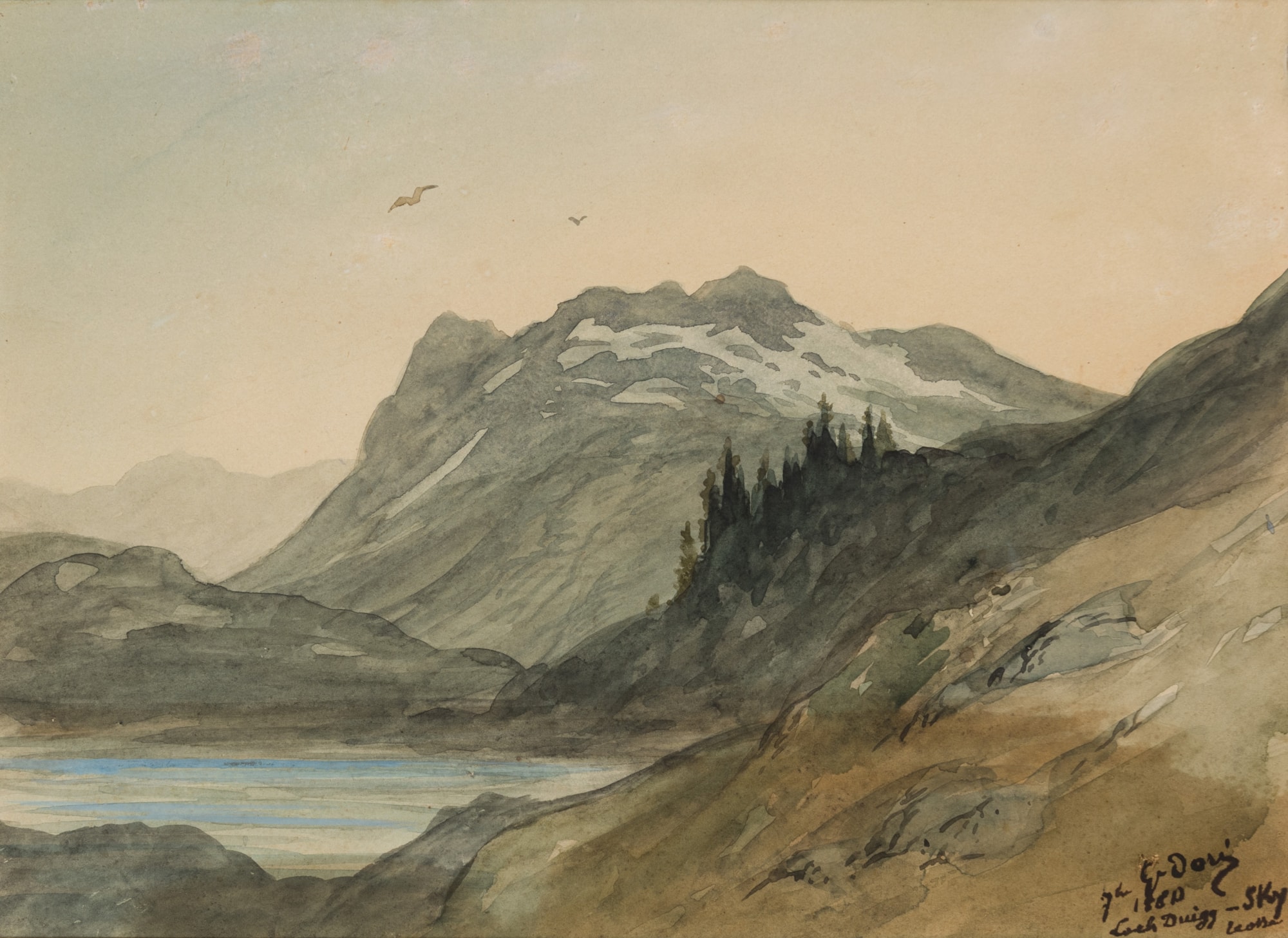
Gustave DORÉ
Loch Duich, Scotland
Marketplace
Loch Duich, Scotland
Gustave DORÉ
Loch Duich, Scotland
In April 1873 Gustave Doré visited Scotland, ostensibly to go salmon fishing with his close friend Col. Christopher Teesdale, an equerry to the Prince of Wales. However, the artist soon abandoned fishing in favour of sketching. On his return to Paris, he wrote of his trip to his friend, the English writer Amelia Edwards: ‘I took a good many notes and jottings in water colour – the first time I have tried that medium. I have employed it solely in obtaining qualities of intention or impression.’ It is from this year onwards that Doré began to work extensively in watercolours, and he first exhibited his work in this medium at the Exposition de L’Union Artistique in Paris in 1877. He also exhibited several works at the Société d’Aquarellistes Français in 1879, 1880 and 1882. Notwithstanding this, the artist seems to have regarded his watercolours mainly as personal, rather than public, works; as he is supposed to have said, ‘To me, watercolour is nothing more than writing with which one takes notes.’ Dore’s oeuvre as a watercolourist was certainly much admired in his day, and one contemporary biographer described these works as ‘the most perfect achievements of any water-colour painter since the Renaissance. In this branch of art Gustave Doré had few rivals, and may unhesitatingly claim unlimited praise. Critic and connoisseur may pick flaws here and there in Doré the illustrator, Doré the oil-painter, Doré the etcher, Doré the sculptor; but no one in justice can deny the ripe perfection of Doré the aquarellist.’
Doré became very fond of the landscapes of the Scottish Highlands and often depicted them in paintings and watercolours. As he wrote to Amelia Edwards in 1873, ‘Henceforth, when I paint landscapes, I believe that five out of every six will be reminiscences of the Highlands: of Aberdeenshire, Braemar, Balmoral, Ballater, &c. I hope to go back there again and again. I went with a party of friends, under the pretext of salmon fishing; but, unskilled as I am in that kind of sport (which is not easy!), I caught, as you may suppose, very few fish, and soon devoted myself exclusively to the catching of landscapes.’ Doré returned to Scotland the following year, and produced several oil paintings of Highland landscapes between 1874 and 1881; some of these are today in the collections of, among others, the Walters Art Museum in Baltimore, the Musée des Beaux-Arts in Caen, the Glasgow Museums, the Musée de Peinture et Sculpture in Grenoble, the Indianapolis Museum of Art, the St. Louis Art Museum, the Musée d’Art Moderne et Contemporain in Strasbourg and the Toledo Museum of Art. In an account of Doré’s first trip to Scotland in 1873, written ten years later in a letter to the artist’s friend and biographer Blanchard Jerrold, Col. Teesdale recalled that Doré ‘was enthusiastic about the wildness and beauty of the country...His book, from one end to the other, was filled in an incredibly short space of time; for as soon as we came home and had dined he would spend two or three hours in finishing the memoranda he had made during the day, with water-colours, ink, or anything that came under his hand…from these rapid sketches he subsequently produced some of his best and most finished work with wonderful fidelity.’
Loch Duich is a sea loch in the western coast of Scotland. As noted in a 19th century guidebook to this part of the Scottish Highlands, published several years before Doré visited the area, ‘The surrounding country, variously hilly and mountainous, emblossoms some fine scenery; while that along Loch Duich is eminently picturesque.’
A similar watercolour by Doré, a view of Loch Fyne drawn in 1874, appeared at auction in Paris in 2022, while a view of Loch Muick, dated April 1873, is in the collection of the Louvre.
Doré became very fond of the landscapes of the Scottish Highlands and often depicted them in paintings and watercolours. As he wrote to Amelia Edwards in 1873, ‘Henceforth, when I paint landscapes, I believe that five out of every six will be reminiscences of the Highlands: of Aberdeenshire, Braemar, Balmoral, Ballater, &c. I hope to go back there again and again. I went with a party of friends, under the pretext of salmon fishing; but, unskilled as I am in that kind of sport (which is not easy!), I caught, as you may suppose, very few fish, and soon devoted myself exclusively to the catching of landscapes.’ Doré returned to Scotland the following year, and produced several oil paintings of Highland landscapes between 1874 and 1881; some of these are today in the collections of, among others, the Walters Art Museum in Baltimore, the Musée des Beaux-Arts in Caen, the Glasgow Museums, the Musée de Peinture et Sculpture in Grenoble, the Indianapolis Museum of Art, the St. Louis Art Museum, the Musée d’Art Moderne et Contemporain in Strasbourg and the Toledo Museum of Art. In an account of Doré’s first trip to Scotland in 1873, written ten years later in a letter to the artist’s friend and biographer Blanchard Jerrold, Col. Teesdale recalled that Doré ‘was enthusiastic about the wildness and beauty of the country...His book, from one end to the other, was filled in an incredibly short space of time; for as soon as we came home and had dined he would spend two or three hours in finishing the memoranda he had made during the day, with water-colours, ink, or anything that came under his hand…from these rapid sketches he subsequently produced some of his best and most finished work with wonderful fidelity.’
Loch Duich is a sea loch in the western coast of Scotland. As noted in a 19th century guidebook to this part of the Scottish Highlands, published several years before Doré visited the area, ‘The surrounding country, variously hilly and mountainous, emblossoms some fine scenery; while that along Loch Duich is eminently picturesque.’
A similar watercolour by Doré, a view of Loch Fyne drawn in 1874, appeared at auction in Paris in 2022, while a view of Loch Muick, dated April 1873, is in the collection of the Louvre.
Provenance: The studio of the artist, Paris
Anonymous sale (‘Montagne: 29e vente’), Paris, Blanchet & Associés, 25 November 2020, lot 34
Private collection.
Découvrez la galerie
Stephen Ongpin Fine Art
Old Master, 19th Century and Modern Drawings, Watercolours and Oil Sketches
Plus d'œuvres d'art de la Galerie

_T639275745442307072.jpg?width=500&height=500&mode=pad&scale=both&qlt=90&format=jpg)

_T638935546582100355.jpg?width=500&height=500&mode=pad&scale=both&qlt=90&format=jpg)
_T639038882382326384.jpg?width=500&height=500&mode=pad&scale=both&qlt=90&format=jpg)