
Henry FUSELI
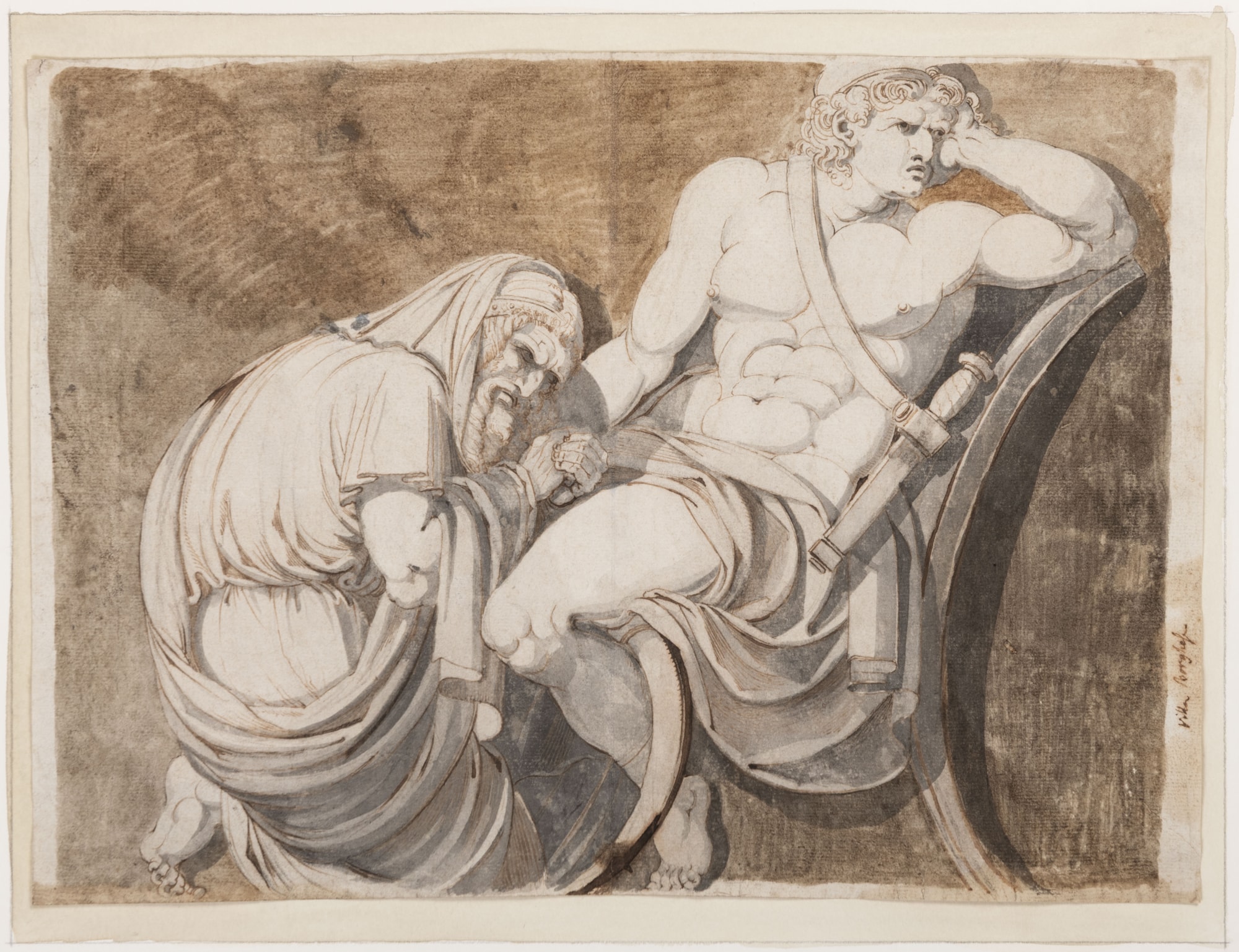
King Priam Begging Achilles to Return the Body of Hector
Henry FUSELI
King Priam Begging Achilles to Return the Body of Hector
The subject of the present sheet is taken from the Illiad, and depicts the aged Priam, King of Troy, on his knees begging for Achilles to return to him the body of his son Hector, whom the Greek hero had killed. Hector had earlier slain Achilles’s great friend Patroclus, and in revenge Achilles kills him and, treating the corpse with disrespect, refuses to return it. Escorted by the god Hermes, Priam enters the Greek camp with a chariot full of treasure. In supplication he pleads with Achilles to take pity on a father who has lost his son, and to return the body of Hector, invoking Achilles’s father Peleus: ‘Godlike Achilles, think of your own father, who is of my generation, and so is likewise on the sad threshold of old age. Perhaps his neighbours are troubling him, and there is no one to protect him from harm, or ward off ruin. But he at least can rejoice in the knowledge that you live, and each day brings the hope of seeing you return from Troy. While I, I am a victim of sad fate. Of the best of my sons, the best in all of Troy, not one is left...Most of them have fallen in furious battle, and the defender of the city and its people, my prime recourse, Hector, you have killed, as he fought for his country. I come now to the ships to beg his corpse from you, bringing a princely ransom. Respect the gods, Achilles, and show mercy towards me, remembering your own father, for I am more to be pitied than he, since I have brought myself to do what no other man on earth would do, I have lifted to my lips the hand of the man who killed my sons.’ Moved by Priam’s words, Achilles agrees to return Hector’s body to the Trojans, and to allow for a temporary truce while the funeral rites are held.
In this powerful drawing, characterized by dramatic lighting and a bold composition that fills the entire sheet, Fuseli has contrasted the proud but physically frail figure of Priam with the muscular and yet melancholic warrior Achilles. The vivid expressions of both the protagonists may reflect Fuseli’s knowledge of the scientific studies in physiognomy developed by the Swiss writer Johann Kaspar Lavater, a close friend of the artist since their schooldays in Zurich, whose treatise on the subject was published while Fuseli was in Rome.
It was during his eight-year stay in Italy that Fuseli began to develop a reputation as a virtuoso draughtsman. As Paul Ganz has written, ‘The large number of designs from the Roman period, which are still extant, fully reveal the mature perfection of Fuseli’s style of drawing and that versatility of expression which enabled him to solve any problem. His compositions no longer show any signs of effort, but are the vigorous and complete expression of his imagination…This style of the Roman period was no mere cartoon art, although he learned from classical models; his aim was not classical beauty but life and movement, often violent movement in which passion finds its most complete expression…It is astonishing with what assurance Fuseli handled pen and pencil and what beautiful effects he could produce by applying brush and wash to his designs. Each design has its own individual character and expresses the artist’s intention with a vehemence of which only Fuseli passionate spirit and genius were at that time capable.’ More recently, Martin Myrone has noted that ‘The drawings that survive from Fuseli’s Roman period certainly demonstrate a restless graphic experimentation, as the linearity already apparent in his English drawings is refined into the most economical notational system. Although there are sketches that appear to be based on specific paintings and sculptures he could have seen in Rome, these are generally free interpretations, emphasizing a sense of dynamic virility.’
The Fuseli scholar Gert Schiff has noted parallels between the present sheet and a number of drawings from the artist’s so-called ‘Roman Album’ of c.1770 now in the British Museum, in particular a composition of Achilles Lamenting the Death of Patroclus, which Fuseli based on a contemporary drawing by his friend in Rome, the Swedish sculptor Johan Tobias Sergel. Another close stylistic comparison may be made with two other drawings from Fuseli’s ‘Roman Album’ in the British Museum; a study of Zethos, Antiope and Anthion, which is a free copy of a Greek sculpted marble relief of Orpheus, Eurydice and Hermes that the artist also studied in the Villa Borghese, and a Relief with Bacchus copied from a sculpture then in the Villa Albani and now in the Museo Torlonia in Rome.
Over three decades later, Fuseli treated the same subject of Priam Pleading with Achilles for the Body of Hector in an oil sketch of an upright format, painted in 1803 as part of a series of seventeen sketches intended to illustrate Alexander Pope’s English translation of Homer’s Illiad and Odyssey, published in 1805; the original painting is lost and is only known through a reproductive engraving9. The kneeling figure of Priam in this vertical composition, like that in the present sheet, may also be based on the Borghese sarcophagus.
As has recently been noted, ‘Fuseli would remain an indefatigable draughtsman till the end of his life; and for him drawing would always retain its capacity to operate as a clandestine area of creative freedom – a space where he could be at liberty to break the rules, and give untrammelled expression to his genius.’
An early owner of the present sheet was Susan North (née Coutts), Countess of Guilford (1771-1837), who was the daughter of Fuseli’s patron Thomas Coutts and had known the artist since her childhood. Fuseli was a close friend of the Countess and a frequent guest at her home in Putney Hill in London, and in fact died there in April 1825. As Fuseli’s early biographer John Knowles noted, in the dedication of his book to the Countess of Guilford, ‘I feel a degree of diffidence in dedicating to your Ladyship the Life and Posthumous Works of Henry Fuseli; because, with regard to the former, no one is better acquainted with the extent of his talents, or can form a more accurate opinion of the powers of his conversation, and the excellent qualities of his head and heart, than yourself.’ This exceptional sheet was one of over eight hundred drawings by Fuseli inherited by the Countess’s daughter Susan, Baroness North (1797-1884), which were eventually sold and dispersed at auction in London in 1885.
Provenance: Probably acquired after the artist’s death, with rest of the drawings among the contents of Fuseli’s studio, by Sir Thomas Lawrence, London
Susan North, Countess of Guilford, Putney Hill, London
By descent to her daughter, Susan North, Baroness North, London
Her sale, London, Sotheby’s, 14-15 July 1885 [lot unidentified]
Frank T. Sabin, London
Acquired from him in January 1947 by Leonard Gordon Duke, London (with his numbering and inscription D1218 [crossed out] / H. Fuseli RA 1741-1835 / c.1770 / LGD in pencil on the verso)
Squire Gallery, London
Acquired from them in 1948 by Spink & Son, London
Acquired from them in 1949 by M. Wronker
His sale, London, Sotheby’s, 24 May 1950, lot 7 (bt. Denton)
Louis Meier, London
Purchased from him in c.1956 by Ralph Holland, Newcastle
His anonymous sale, London, Sotheby’s, 4 July 2012, lot 177
Thomas Le Claire, Hamburg, in 2013
W. M. Brady & Co., New York, in 2014
Private collection, New York.
Literature: Gert Schiff, Johann Heinrich Füssli 1741-1825, Zürich, 1973, Vol.I, p.86 and 311, p.441, no.384, Vol.II, p.85, pl.384 (where dated 1770-1771); Ralph Holland, Italian and Other Drawings 1500-1800, exhibition catalogue, Newcastle, 1974, no.117, pl.XXXVI; Nancy L. Pressly, The Fuseli Circle in Rome: Early Romantic Art of the 1770s, exhibition catalogue, New Haven, 1979, p.30, under no.30; Hamburg, Le Claire Kunst, Cavalier d’Arpino to Nolde: Watercolours, Drawings and Oil Sketches by European Masters, 2013, unpaginated, no.6.
Exhibition: Newcastle upon Tyne, Hatton Gallery, Italian and Other Drawings 1500-1800, 1974, no.117; London, Courtauld Institute Galleries, Italian and other Drawings 1500-1800, from the Ralph Holland Collection, 1975, no.74.
Stephen Ongpin Fine Art
Old Master, 19th Century and Modern Drawings, Watercolours and Oil Sketches
Plus d'œuvres d'art de la Galerie
_T638863564404077225.jpg?width=500&height=500&mode=pad&scale=both&qlt=90&format=jpg)

_T638545819346538474.jpg?width=500&height=500&mode=pad&scale=both&qlt=90&format=jpg)