

Claudio BRAVO
Still Life with Bread and Potatoes
Marketplace
Still Life with Bread and Potatoes
Claudio BRAVO
Still Life with Bread and Potatoes
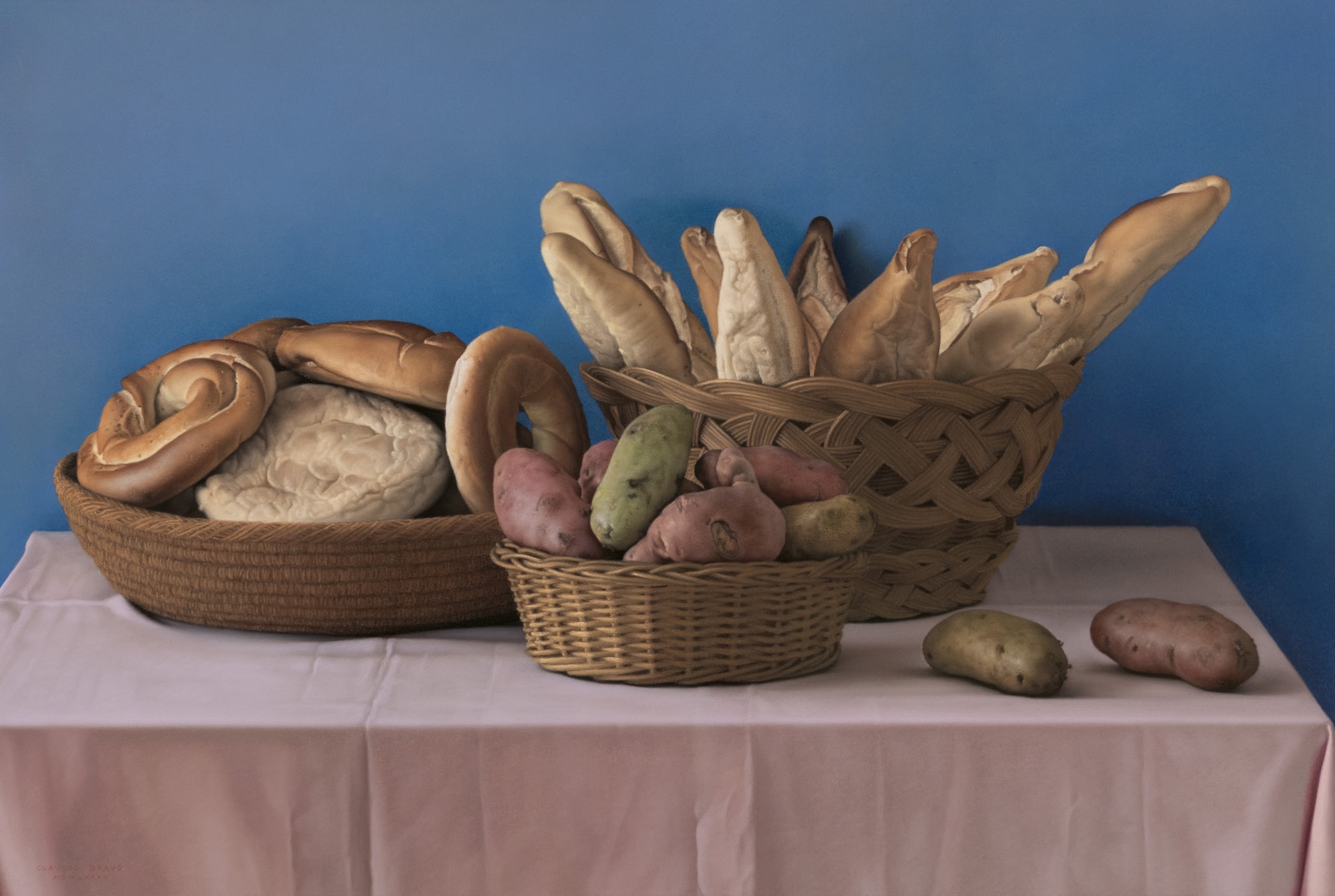
This very large and refined still life, executed in pastel, was drawn in 1985. Characterized by an even illumination in which each of the objects is seen with the utmost clarity, works such as this serve to underscore Claudio Bravo’s comment that ‘The objects in these still life paintings transcend reality. I use light a bit like Zurbarán did. He was one of the few painters that gave true transcendent meanings to objects. This treatment of the light makes things seem more than they are…their essence is greater.’ The larger wicker basket appears in other still life compositions by the artist, such as an equally sizeable pastel drawing of Bread and Artichokes on a Table of 1984, as well as an oil painting of Breads completed in 2000.
Pastel works such as this are a testament to Bravo’s abiding interest in the classical tradition of European still life painting, and in particular the bodegón paintings produced in Spain in the late 16th and 17th century. As the artist’s friend, the Peruvian writer Mario Vargas Llosa, has written of Bravo, ‘His true masters are the great classical masters, particularly Spanish 17th century, the Golden Age of Baroque, such as Fray Juan Sánchez Cotán, Antonio de Pereda or Francisco de Zurbarán, who revolutionized the treatment of the object, conferring on their still lifes – through a scrupulous study of details and the play of light – a dignity and intensity which appear to emancipate them from the inert and humanize them. Claudio Bravo has updated this old school with his oil paintings, pastels and drawings of flowers, fruit, vegetables, jugs, tablecloths, mortars, cruets, cooking pots, ostrich eggs, rugs, glasses, stones, and hampers which it would be unfair to call “still life”, since that label immediately suggests the inanimate, the decorative…these images shimmer like precious jewels, they become giant-like heroes whose outstanding presence has desolated their surroundings.’
Pastel works such as this are a testament to Bravo’s abiding interest in the classical tradition of European still life painting, and in particular the bodegón paintings produced in Spain in the late 16th and 17th century. As the artist’s friend, the Peruvian writer Mario Vargas Llosa, has written of Bravo, ‘His true masters are the great classical masters, particularly Spanish 17th century, the Golden Age of Baroque, such as Fray Juan Sánchez Cotán, Antonio de Pereda or Francisco de Zurbarán, who revolutionized the treatment of the object, conferring on their still lifes – through a scrupulous study of details and the play of light – a dignity and intensity which appear to emancipate them from the inert and humanize them. Claudio Bravo has updated this old school with his oil paintings, pastels and drawings of flowers, fruit, vegetables, jugs, tablecloths, mortars, cruets, cooking pots, ostrich eggs, rugs, glasses, stones, and hampers which it would be unfair to call “still life”, since that label immediately suggests the inanimate, the decorative…these images shimmer like precious jewels, they become giant-like heroes whose outstanding presence has desolated their surroundings.’
Provenance: The estate of the artist
Marlborough Gallery, New York
Marlborough Gallery, Madrid
Acquired from them by a private collection
Anonymous sale, New York, Christie’s, 18 May 2015, lot 4
Anonymous sale, New York, Sotheby’s, 21 November 2017, lot 35
Private collection.
Découvrez la galerie
Stephen Ongpin Fine Art
Old Master, 19th Century and Modern Drawings, Watercolours and Oil Sketches
Plus d'œuvres d'art de la Galerie



_T639132563580169912.jpg?width=500&height=500&mode=pad&scale=both&qlt=90&format=jpg)