


RICHARD COSWAY
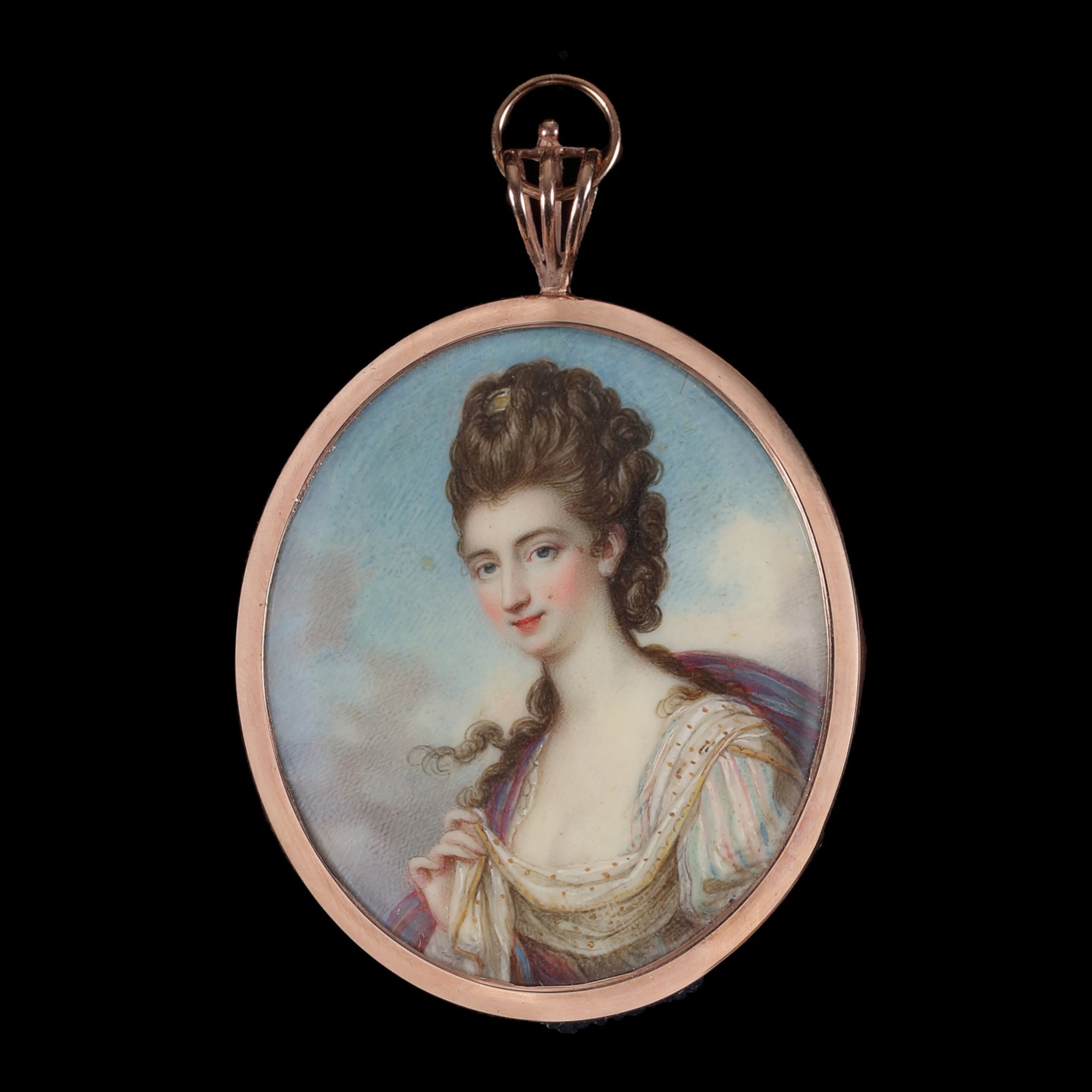
Portrait miniature of a Lady wearing blue, white, and pink striped dress with blue and pink cape, holding a piece of white and gold spotted cloth draped over her left shoulder, her brown hair worn up and curled
RICHARD COSWAY
Portrait miniature of a Lady wearing blue, white, and pink striped dress with blue and pink cape, holding a piece of white and gold spotted cloth draped over her left shoulder, her brown hair worn up and curled
The Limner Company : Portrait Miniature
Date circa 1765-1770
Period Georgian
Origin England
Medium Watercolour on ivory
Dimension 5 cm (2 inches)
Comparable examples by date and composition include the portrait of Lady Sarah Bunbury at the Victoria and Albert Museum, London (P.64-1935) and the Portrait of a Mother and Daughter, in the Museum of Fine Arts, Houston (2005.1629). All three portraits demonstrate a bold use of colour, perhaps more closely associated with that used in Cosway’s portraits of men from later in his career, but certainly not utilised later by the artist when he was painting women. The date is further supported by the fact that the same piece of cloth appears to be held by the woman in this portrait and Bunbury in the V&A example. The same cloth may be worn in a fourth miniature, also dated to 1770, previously sold by The Limner Company (see here).
As has been mentioned, Cosway is not usually associated with the style demonstrated here. Many of his later works show his sitters with powdered hair and women in white flounced dresses. Such fashions were not only distinctive of Cosway’s style but also fashionable in the later decades of the eighteenth century. In the late 1760s and 1770s, lightly patterned silks, like the striped silk used for the dress in this portrait, were popular in women’s clothing. The same can be said about the lower neckline, which was replaced by a fichu in the latter decades of the century, and only came back into fashion in the early nineteenth century, when neoclassicism became the favoured style.
Cosway may have already been in residence at his Piccadilly residence, on 4 Berkeley Street, when this portrait was painted. Living there was a conscious choice- other artists like Engleheart and Smart were based in Soho- and Cosway would remain in this area for much of his career. From this house, he had access to a much more established and higher-class clientele, and in the following decades he would host many of these people at salons, alongside his wife and fellow artist, Maria. He was made an academician at the Royal Academy in 1770, and therefore this date was somewhat of a turning point in his career, partially explaining the major differences in the group of miniatures which includes the present work, and those painted later.
Date: circa 1765-1770
Period: Georgian
Origin: England
Medium: Watercolour on ivory
Dimension: 5 cm (2 inches)
Provenance: Purchased in Launceston, Tasmania, 25 September 1995;
Private collection, UK.

The Limner Company : Portrait Miniature
Potrait miniatures from the 16/17th century, the 18th century and 19th century
More artworks from the Gallery

-Portrait miniature of a chef d’escadron of the Polish Light Horse Guard, possibly Seweryn Fredero (b.1785), wearin_T639117100843786546.jpg?width=500&height=500&mode=pad&scale=both&qlt=90&format=jpg)
-Portrait of a Gentleman, possibly John Rawdon 3rd Bt., wearing white stock, red cloak, and blue jacket with slash_T639131522857476856.jpg?width=500&height=500&mode=pad&scale=both&qlt=90&format=jpg)
, father of Jane Leigh-Perrot (nee Cholmeley), aunt of the English author J_T639259429058479716.jpg?width=500&height=500&mode=pad&scale=both&qlt=90&format=jpg)
-Portrait enamel of a Lady, wearing pink and white dress with white underslip, her brown hair falling over her ri_T639258437250760077.jpg?width=500&height=500&mode=pad&scale=both&qlt=90&format=jpg)
