Kirman Polychrome Kalian
Marketplace
Kirman Polychrome Kalian
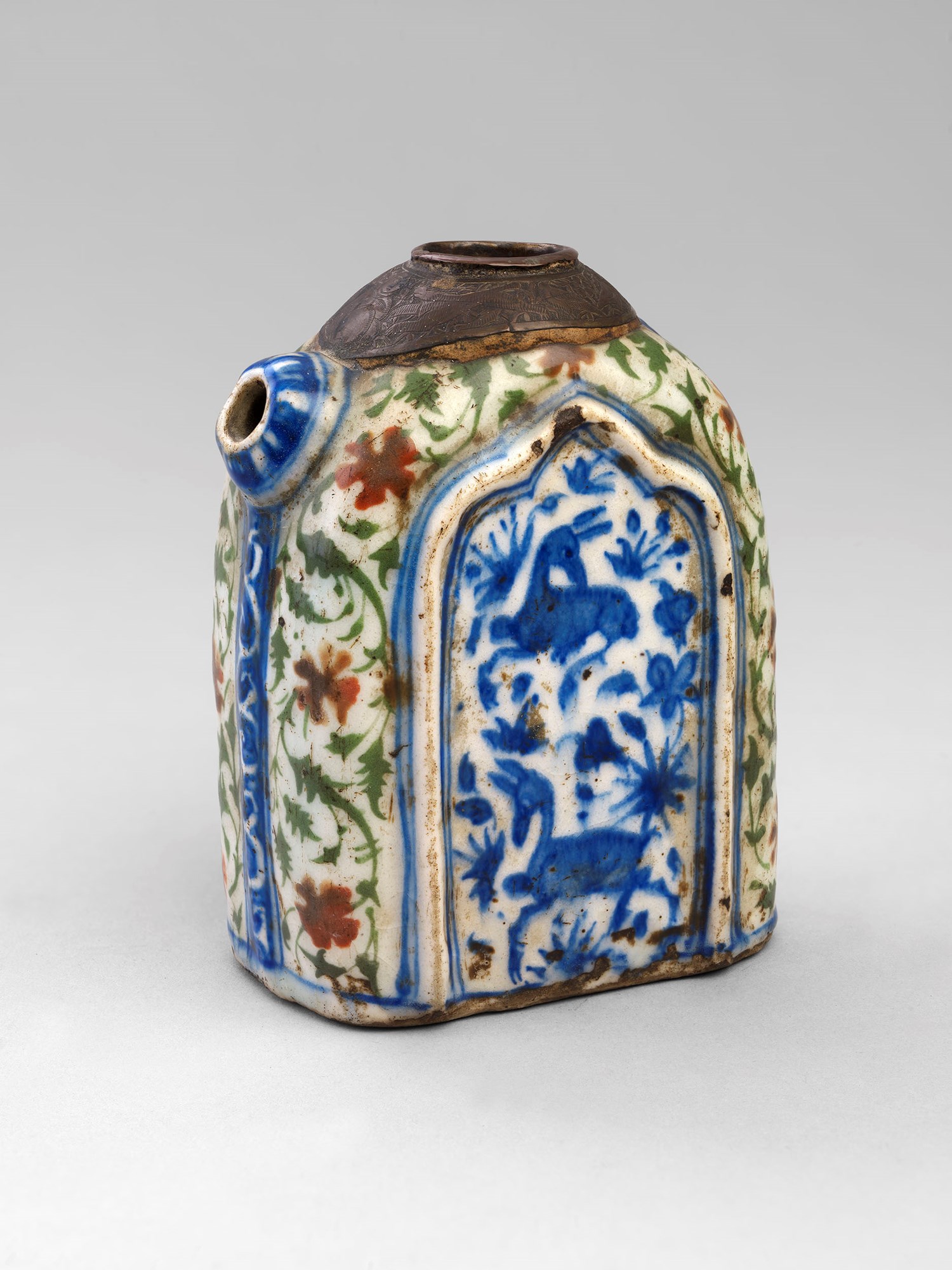
A Safavid huqqa base or kalian with panels decorated in the Kirman polychrome style and a Qajar metal mount.
Kirman polychrome is a subcategory of Safavid blue-and-white ware, adding splashes of distinctive tomato reds, and small amounts of black, chocolate-brown, and green to the colour palette. The blue-and-white sections are generally treated with ornament drawn from late Ming blue-and-white ceramics.1 Polychrome areas, conversely, feature more indigenous designs. Such motifs include cypress trees, peacocks, pheasants, and less frequently, as in the present example, galloping gazelles.
The flattened form of this kalian derives from European bottles made for schnapps or gin.2 However, the form likely reached Safavid potters via Chinese bottles, themselves based on the European form.3 The potter has transformed the bottle in a kalian by pushing out a small hole on the shoulder.
The front and back of the bottle are formed from flat panels with a trefoil arch top, contained within moulded borders. Two deer amongst tufts of grass appear on each panel. Though it is quite common for deer to be depicted on Kirman polychrome ceramics – see, for example nos. 420-1878 and 611-1889 in the Victoria & Albert Museum – it is unusual for them to feature in the blue and white portion. Similar floral work comprising olive green vines and rust red flowers is seen on a large jar dated to 1650–1700 Kirman, held in the Victoria & Albert Museum (accession no. 543-1878).
n.b. accession nos are clickable links
[1] Watson, Oliver. Ceramics from Islamic Lands. London: Thames & Hudson in association with The al-Sabah Collection, 2004, p. 471.
[2] Crowe, Yolande. Persia and China : Safavid Blue and White Ceramics in the Victoria & Albert Museum, 1501-1738. Geneva: La Borie, 2002, p. 164.
[3] Golombek, Lisa, Robert B. Mason, Patricia Proctor, and Eileen Reilly. Persian Pottery in the First Global Age : The Sixteenth and Seventeenth Centuries. Arts and Archaeology of the Islamic World. Leiden: Brill, 2013, p. 350.
Kirman polychrome is a subcategory of Safavid blue-and-white ware, adding splashes of distinctive tomato reds, and small amounts of black, chocolate-brown, and green to the colour palette. The blue-and-white sections are generally treated with ornament drawn from late Ming blue-and-white ceramics.1 Polychrome areas, conversely, feature more indigenous designs. Such motifs include cypress trees, peacocks, pheasants, and less frequently, as in the present example, galloping gazelles.
The flattened form of this kalian derives from European bottles made for schnapps or gin.2 However, the form likely reached Safavid potters via Chinese bottles, themselves based on the European form.3 The potter has transformed the bottle in a kalian by pushing out a small hole on the shoulder.
The front and back of the bottle are formed from flat panels with a trefoil arch top, contained within moulded borders. Two deer amongst tufts of grass appear on each panel. Though it is quite common for deer to be depicted on Kirman polychrome ceramics – see, for example nos. 420-1878 and 611-1889 in the Victoria & Albert Museum – it is unusual for them to feature in the blue and white portion. Similar floral work comprising olive green vines and rust red flowers is seen on a large jar dated to 1650–1700 Kirman, held in the Victoria & Albert Museum (accession no. 543-1878).
n.b. accession nos are clickable links
[1] Watson, Oliver. Ceramics from Islamic Lands. London: Thames & Hudson in association with The al-Sabah Collection, 2004, p. 471.
[2] Crowe, Yolande. Persia and China : Safavid Blue and White Ceramics in the Victoria & Albert Museum, 1501-1738. Geneva: La Borie, 2002, p. 164.
[3] Golombek, Lisa, Robert B. Mason, Patricia Proctor, and Eileen Reilly. Persian Pottery in the First Global Age : The Sixteenth and Seventeenth Centuries. Arts and Archaeology of the Islamic World. Leiden: Brill, 2013, p. 350.
Découvrez la galerie
Amir Mohtashemi Ltd.
Indian,Islamic and Cross-Cultural Works of Art
Plus d'œuvres d'art de la Galerie