Ottavio LEONI
Portrait of a Young Woman
Marketplace
Portrait of a Young Woman
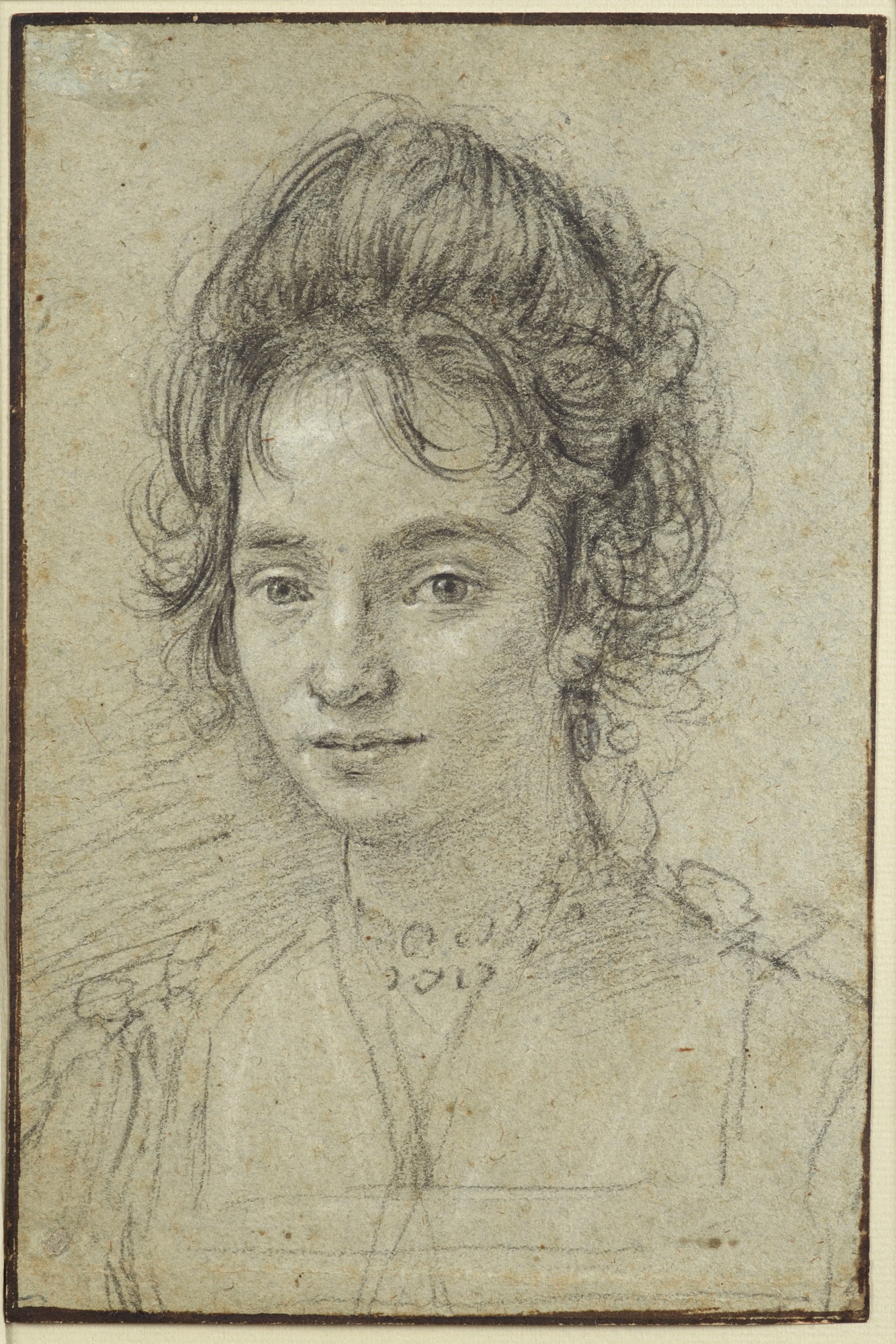
This fine sheet, characterized by an informality unusual in Ottavio Leoni’s drawn oeuvre, may be grouped with a handful of less polished portrait drawings by the artist, some of which depict of sitters of modest means and professions. Salomon has observed that ‘Not everyone depicted by Leoni was an aristocrat or an intellectual. It is charming to see that among the faces worthy of being recorded for posterity [among the drawings by Leoni in the Accademia Toscana di Scienze e Lettere ‘La Colombaria’ in Florence], Ottavio chose to portray Anna, a “copertara” (a blanket maker/seller)6. Other drawings by Leoni in other collections also depict similarly humble sitters, such as Margherita “orzarola” (barley vendor), Giulia “cappellara” (milliner), and Angela “calzettara” (sock vendor), in Berlin, Cambridge, and Stanford, respectively.’ Other drawings of female sitters of this type are in the Staatliche Graphische Sammlung in Munich and the Albertina in Vienna.
The Leoni scholar Yuri Primarosa, whose monumental catalogue raisonné of the artist’s drawings and paintings was published in 2017, has dated the present sheet to between 1607 and 1612. It is during this period that the artist’s drawings reach the peak of their naturalistic expression, whether he was portraying members of the Roman nobility or people from everyday life and the lower middle class. In many of these drawings, it is evident that Leoni was working from of a genuine interest in the psychological depiction of his subjects. As Primarosa notes, ‘Leoni depicted people of humble origins with the same technical diligence, analytical attention and poetic sensitivity that he usually applied when portraying princes and influential prelates…The artist’s interest was primarily directed towards young female workers, whose attractive appearance he certainly appreciated, but also and above all their vitality – if not joie de vivre – which often shone in their eyes. Almost all of them belonged to the lower middle class of artisans and merchants, and lived in a state of moderate economic well-being. They were young, attractive and passionate...In his fragments of everyday life, Ottavio celebrated the Roman ‘people’ with extraordinary immediacy, offering for the first time a vivid and passionate, yet never folkloric, description of their proud and composed faces, sometimes joyful and carefree, sometimes ‘heroic’ or even happy.’
According to a note on a photograph of this drawing in the files of the art historian Roberto Longhi, the present sheet was at one time in the collection of the Milanese print scholar, dealer and photo historian Lamberto Vitali (1896-1992).
The Leoni scholar Yuri Primarosa, whose monumental catalogue raisonné of the artist’s drawings and paintings was published in 2017, has dated the present sheet to between 1607 and 1612. It is during this period that the artist’s drawings reach the peak of their naturalistic expression, whether he was portraying members of the Roman nobility or people from everyday life and the lower middle class. In many of these drawings, it is evident that Leoni was working from of a genuine interest in the psychological depiction of his subjects. As Primarosa notes, ‘Leoni depicted people of humble origins with the same technical diligence, analytical attention and poetic sensitivity that he usually applied when portraying princes and influential prelates…The artist’s interest was primarily directed towards young female workers, whose attractive appearance he certainly appreciated, but also and above all their vitality – if not joie de vivre – which often shone in their eyes. Almost all of them belonged to the lower middle class of artisans and merchants, and lived in a state of moderate economic well-being. They were young, attractive and passionate...In his fragments of everyday life, Ottavio celebrated the Roman ‘people’ with extraordinary immediacy, offering for the first time a vivid and passionate, yet never folkloric, description of their proud and composed faces, sometimes joyful and carefree, sometimes ‘heroic’ or even happy.’
According to a note on a photograph of this drawing in the files of the art historian Roberto Longhi, the present sheet was at one time in the collection of the Milanese print scholar, dealer and photo historian Lamberto Vitali (1896-1992).
Provenance: Lamberto Vitali, Milan
Anonymous sale, London, Sotheby’s, 10 July 2002, lot 141
Hazlitt, Gooden & Fox, London
Private collection, London, in 2004
By descent to a private collection, USA.
Literature: Yuri Primarosa, Ottavio Leoni (1578-1630), Eccellente miniator di ritratti: Catalogo ragionato dei disegni e dei dipinti, Rome, 2017, p.380, no.213 (where dated 1607-1612).
Découvrez la galerie
Stephen Ongpin Fine Art
Old Master, 19th Century and Modern Drawings, Watercolours and Oil Sketches
Plus d'œuvres d'art de la Galerie