

JOHN SMART
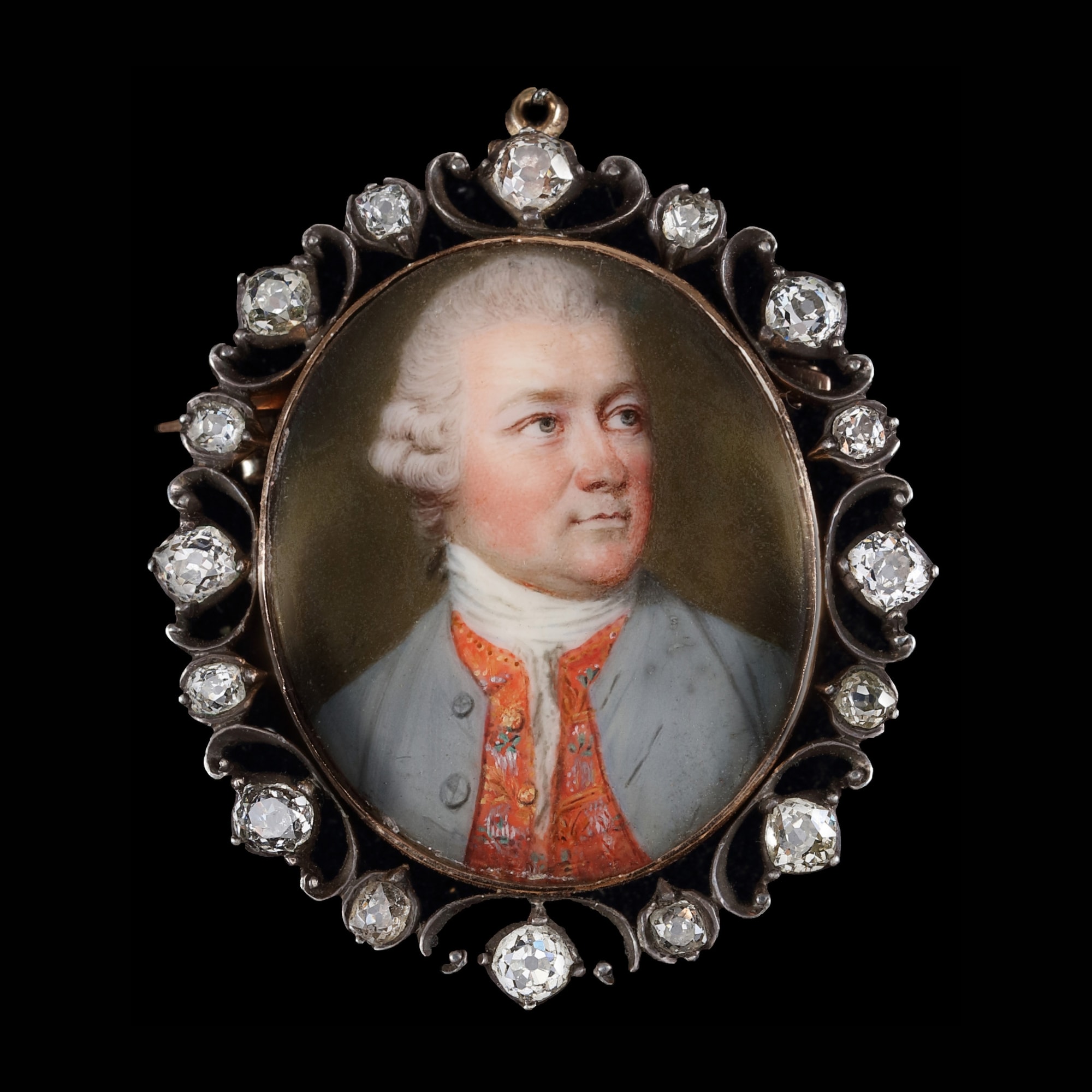
Portrait miniature of a Gentleman, wearing a pale grey coat, a scarlet waistcoat embroidered with flowers, and white stock, his powdered wig worn en queue
Marketplace
Portrait miniature of a Gentleman, wearing a pale grey coat, a scarlet waistcoat embroidered with flowers, and white stock, his powdered wig worn en queue
JOHN SMART
Portrait miniature of a Gentleman, wearing a pale grey coat, a scarlet waistcoat embroidered with flowers, and white stock, his powdered wig worn en queue
The Limner Company : Portrait Miniature
Date 1777
Origin English
Medium Watercolour on ivory
Dimension 2.8 cm (1¹/₈ inches)
The skill for detailed characterisation that made John Smart an exceptional miniaturist are evident in the ruddy face of this 18th-century gentleman. To indulge in some speculation… the sitter’s portly complexion was typical of the rising numbers of over-indulged gout sufferers of the 18th century. Much as a fuller figure was a signifier of wealth and health, gout was seen as a desirable condition given that it was often a complaint of the nobility.1 This gentleman was certainly a man of privilege – his florid visage complemented by a richly embroidered (likely silk) waistcoat.
Smart was very well established as a miniaturist by the mid-1770s, prolific in the portraiture of the moneyed middle classes as well as the occasional aristocratic sitter, including the Duchess of Devonshire. Indeed, a contemporary commentator suggests Smart’s greed for work and money led him to neglect his wife, Marianne (née Howard)2, who, two years’ prior to the date of the present miniature, had run off with fellow artist William Pars (1742-1782). The painter and writer Thomas Jones (1742-1803) described how Pars and Marianne had met while Smart was ‘busy at home, making his fortune’.3 When Pars (a scoundrel by all accounts) left London for Rome with Marianne in tow in 1775, Smart, according to Jones, ‘waited only for Sufficient Evidence to substantiate a criminal process against him’.4 The pair may have married once in Italy or simply lived as husband and wife, as tragically a ‘Mrs Pars’ was recorded as dying of tuberculosis in Rome shortly afterwards.5 Smart didn’t waste much time finding another companion however, and in 1776 had a son with Sarah Midgeley (dates unknown): John Smart Junior(1776-1809), who later also became an artist.6
A happier event for Smart during this period was his appointment as Vice-President of the Society of Artists, which sought to rival the recently founded Royal Academy.7 He had made a notable contribution a s Fellow of the Society for several years before being made Director. A portrait medal of Smart was struck in 17778 presumably in commemoration of the event. Towards the end of the following year, the Society elected Smart as President.
[1] Gout was also thought to ward off other illnesses and even have aphrodisiac properties. See Scholtens, M., ‘The glorification of gout in 16th-to 18th-century literature’, Canadian Median Association Journal Vol. 179, Issue 8, 7 October 2008 – accessed online 6/3/2026 https://doi.org/10.1503/cmaj.080312
[2] Recent research has uncovered his first wife’s name, previously unknown - see Rutherford, E., Hendra, L., John Smart: A Genius Magnified, catalogue to the exhibition held at Philip Mould & Co. 25 November – 9 December 2014, p.12
[3] Memoirs of Thomas Jones, Walpole Society, Vol. XXXII, pp.73-74 quoted in Fosket, D., John Smart: The Man and His Miniatures, p.10
[4] Ibid.
[5] Ibid, pp.10-11
[6] Sarah Midgeley would remain his partner for sometime and he fathered another child by her out of wedlock, Sarah (1781-1853). Although they never married, Smart made provision for her and the children when throughout his decade spent in India (1785-1795). He later married Mary Norton (1783-1851), who also bore him a son, John James. See Rutherford & Hendra, pp. 14, 82, 86
[7] Fosket, p.7
[8] It was modelled by Joachim Smith and cut by John Kirk. Several versions of the medal are extant, in both bronze (see Nelson Adkins Museum, F58-60/135 & 2018.10), silver and silver alloy.
Smart was very well established as a miniaturist by the mid-1770s, prolific in the portraiture of the moneyed middle classes as well as the occasional aristocratic sitter, including the Duchess of Devonshire. Indeed, a contemporary commentator suggests Smart’s greed for work and money led him to neglect his wife, Marianne (née Howard)2, who, two years’ prior to the date of the present miniature, had run off with fellow artist William Pars (1742-1782). The painter and writer Thomas Jones (1742-1803) described how Pars and Marianne had met while Smart was ‘busy at home, making his fortune’.3 When Pars (a scoundrel by all accounts) left London for Rome with Marianne in tow in 1775, Smart, according to Jones, ‘waited only for Sufficient Evidence to substantiate a criminal process against him’.4 The pair may have married once in Italy or simply lived as husband and wife, as tragically a ‘Mrs Pars’ was recorded as dying of tuberculosis in Rome shortly afterwards.5 Smart didn’t waste much time finding another companion however, and in 1776 had a son with Sarah Midgeley (dates unknown): John Smart Junior(1776-1809), who later also became an artist.6
A happier event for Smart during this period was his appointment as Vice-President of the Society of Artists, which sought to rival the recently founded Royal Academy.7 He had made a notable contribution a s Fellow of the Society for several years before being made Director. A portrait medal of Smart was struck in 17778 presumably in commemoration of the event. Towards the end of the following year, the Society elected Smart as President.
[1] Gout was also thought to ward off other illnesses and even have aphrodisiac properties. See Scholtens, M., ‘The glorification of gout in 16th-to 18th-century literature’, Canadian Median Association Journal Vol. 179, Issue 8, 7 October 2008 – accessed online 6/3/2026 https://doi.org/10.1503/cmaj.080312
[2] Recent research has uncovered his first wife’s name, previously unknown - see Rutherford, E., Hendra, L., John Smart: A Genius Magnified, catalogue to the exhibition held at Philip Mould & Co. 25 November – 9 December 2014, p.12
[3] Memoirs of Thomas Jones, Walpole Society, Vol. XXXII, pp.73-74 quoted in Fosket, D., John Smart: The Man and His Miniatures, p.10
[4] Ibid.
[5] Ibid, pp.10-11
[6] Sarah Midgeley would remain his partner for sometime and he fathered another child by her out of wedlock, Sarah (1781-1853). Although they never married, Smart made provision for her and the children when throughout his decade spent in India (1785-1795). He later married Mary Norton (1783-1851), who also bore him a son, John James. See Rutherford & Hendra, pp. 14, 82, 86
[7] Fosket, p.7
[8] It was modelled by Joachim Smith and cut by John Kirk. Several versions of the medal are extant, in both bronze (see Nelson Adkins Museum, F58-60/135 & 2018.10), silver and silver alloy.
Date: 1777
Origin: English
Medium: Watercolour on ivory
Dimension: 2.8 cm (1¹/₈ inches)
Provenance: Bonhams, New Bond St, London, 28 June 2005, lot 74;
Private Collection, UK.
Discover the Gallery

The Limner Company : Portrait Miniature
Potrait miniatures from the 16/17th century, the 18th century and 19th century
More artworks from the Gallery

-A portrait oil of a Nobleman, wearing armour, fur-trimmed blue cap, white jabot and powdered wig_T639119472650657624.jpg?width=500&height=500&mode=pad&scale=both&qlt=90&format=jpg)


