
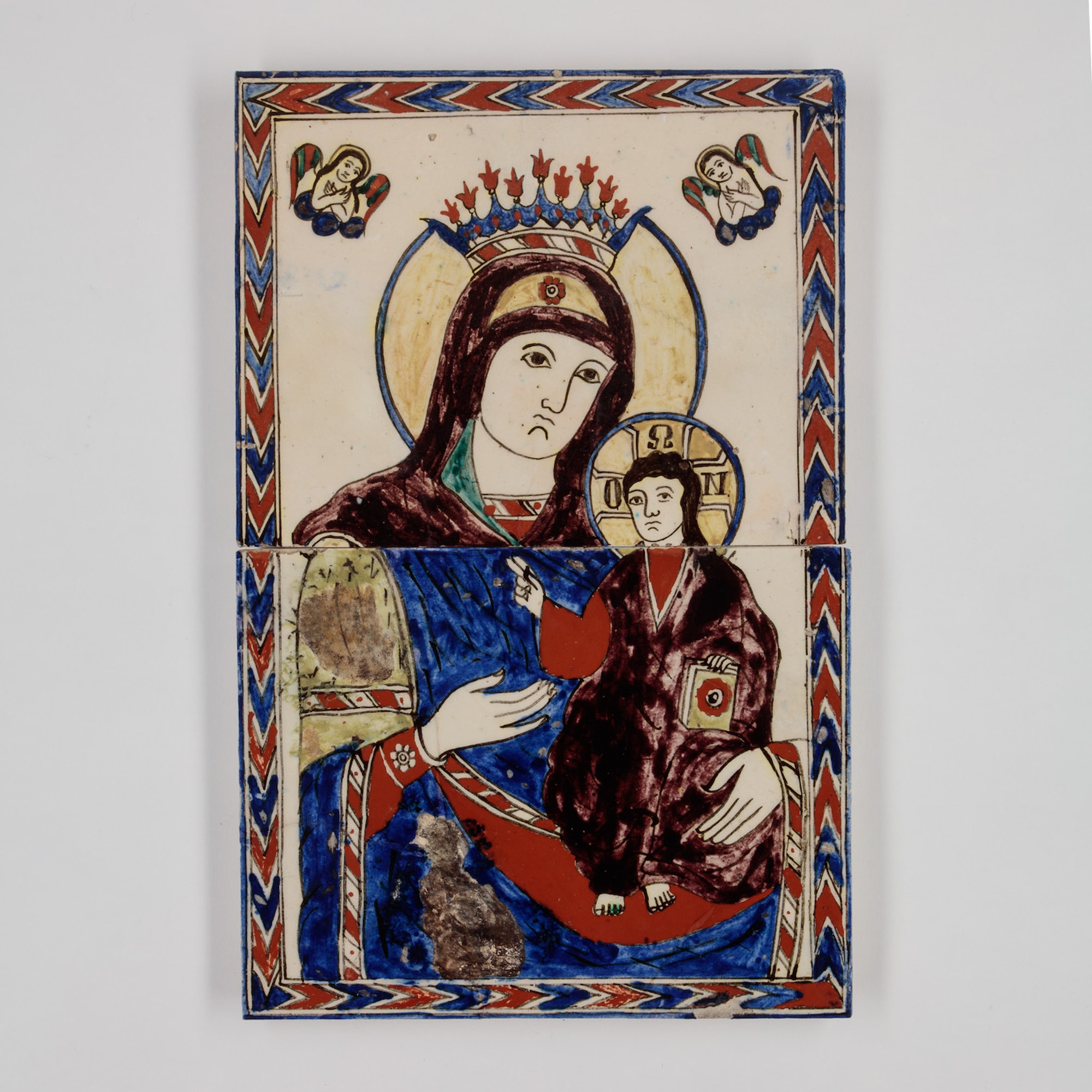
Tile Panel Depicting Virgin Mary and Child
Tile Panel Depicting Virgin Mary and Child
Date 19th century
Period 1750-1850, 1850-1900, 19th century
Origin Turkey, Kütahya
Medium Pottery
Dimension 8.6 x 23.9 cm (3³/₈ x 9³/₈ inches)
Following the demise of Iznik pottery and production in the 17th century, pottery work continued to be produced in Kütahya (Porter, p. 111). We are reasonably able to determine the various types of Kütahya wares which were produced in this region (in western Turkey on the Porsuk River - about 200km southeast of Istanbul) including bowls, plates, jugs and also tiles with winged angels and icons of the Virgin Mary and Child (Porter, p. 116). The most important works from this series can be found in the Armenian Cathedral of St James in Jerusalem (1718-19; Porter, p. 116).
Two nearly identical Kütahya tiles depicting a closely matching icon (with variations in colours) of the Virgin Mary and Child are in The British Museum, London, Accession Number 1928,1017.1, decorated in underglaze blue, red, yellow and black (see Porter, p. 115, fig. 106).
[1] Exodus 3:14King James Version (KJV)14 And God said unto Moses, I Am That I Am: and he said, Thus shalt thou say unto the children of Israel, I Am hath sent me unto you.
Date: 19th century
Period: 1750-1850, 1850-1900, 19th century
Origin: Turkey, Kütahya
Medium: Pottery
Dimension: 8.6 x 23.9 cm (3³/₈ x 9³/₈ inches)
Provenance: USA Museum Deaccession
Literature: Kürkman, G. Magic of Clay and Fire: A History of Kütahya Pottery and Potters, Suna and Inan Kiraç Foundation, Istanbul, 2006.
Porter, V. Islamic Tiles, The British Museum Press, London, 1995.

Amir Mohtashemi Ltd.
Indian,Islamic and Cross-Cultural Works of Art
More artworks from the Gallery