

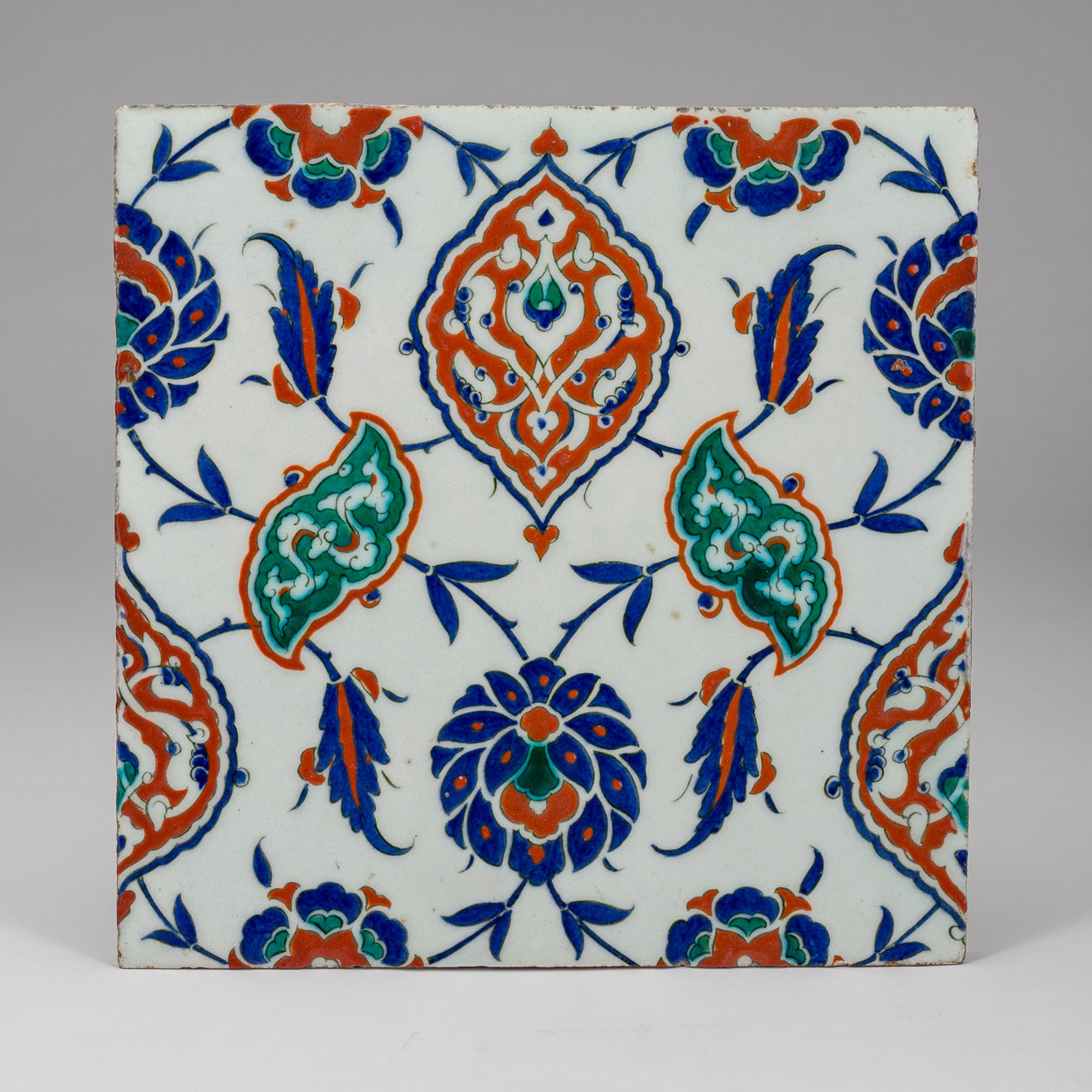
Iznik Tile Decorated with Mandorlas and Lotus Palmettes
Marketplace
Iznik Tile Decorated with Mandorlas and Lotus Palmettes
An Iznik tile with exceptionally refined rumi-hatayi decoration in bole red, cobalt blue, and viridian green with black outlines on a white ground. Connected by a network of swirling arabesque branches with saz leaf terminals are large red mandorlas filled with rumi or Ottoman split palmettes, green leaves decorated with hatayi or Chinese-derived tchi clouds in reserve, lotus palmettes, and rosettes. The use of red bole, recognisable for its tomato red shade and raised texture, helps to date the piece as it was only in use between the 1550s and 1580s.
Tiles of this pattern decorate the mausoleum of Selim II in Hagia Sophia, designed by the renowned architect Mimar Sinan.1 Three identical tiles are held in the Benaki Museum, Athens, dated to c. 1675.2 Another is in the Louvre, Paris, and dated 1560 to 1580 (no. OA 3919/2-75). Other tiles with different colour schemes but similar design comprising mandorlas and lotus flowers arranged on a network of vines are held in the Victoria & Albert Museum, London, (no. 347-1880) and the Louvre (OA 3919/172), both dated 1560-1580. The present tile is a particularly vibrant and flawless example of this design.
[1] Denny, Walter. 'Dispersed Ottoman unified-field panels', Μουσείο Μπενάκη 4 (2004). pp. 149-157: p. 150, fig. 1.
[2] Carswell, John and Moraitou, Mina. Iznik Ceramics at the Benaki Museum. Athens: The Benaki Museum, 2023. pp. 182-183, cats T11 and T12.
Discover the Gallery
Amir Mohtashemi Ltd.
Indian,Islamic and Cross-Cultural Works of Art
More artworks from the Gallery
_T638815408614370585.jpg?width=500&height=500&mode=pad&scale=both&qlt=90&format=jpg)