

Keith VAUGHAN
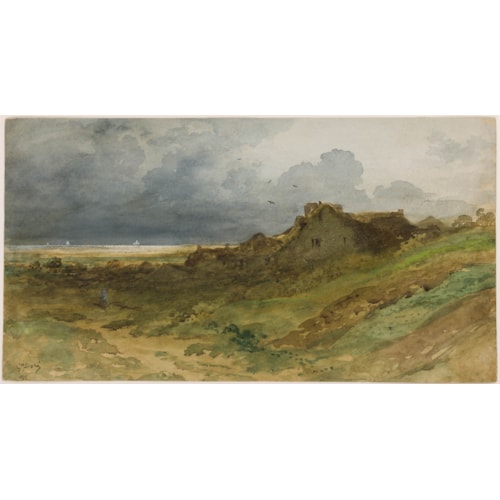
Landscape with Sunset
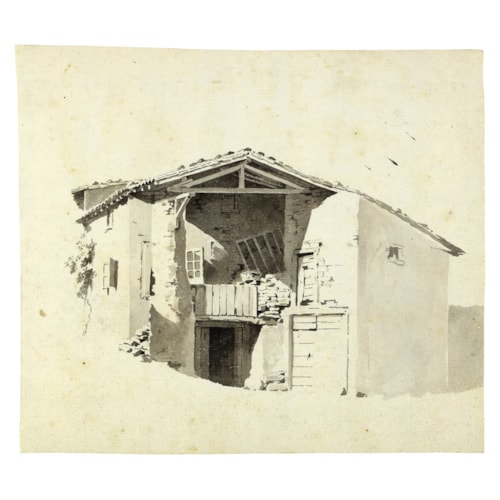
Marketplace
Landscape with Sunset
Keith VAUGHAN
Landscape with Sunset
Throughout much of his mature career Keith Vaughan’s work embraced both figuration and abstraction. In 1953 he saw an exhibition of the work of Nicolas De Staël and came away impressed with the French artist’s abstractions. Yet Vaughan never saw himself as a purely abstract painter, stating that ‘Painting has always been a representational art and if you remove the representational element from it, as a great many painters do, then you simply impoverish it. Even if you can’t see the representational element in the finished product it must be there to begin with; for me painting which has not got a representational element in it hardly goes beyond the point of design.’
Collaged compositions by Vaughan are quite rare. The present sheet, which can likely be dated to the first half of the 1970s, was sent as a Christmas greeting card to the artist’s friend Klaus Peter Adam (1929-2019), a German-born filmmaker and television producer. Born in Berlin, Peter Adam settled in England at the age of thirty and joined the BBC in the late 1960s, becoming a British citizen in 1965. He worked at the BBC for twenty-two years, during which he made over a hundred documentaries on arts and culture, and also published a biography of the designer and architect Eileen Gray. Adam was a close friend of several artists, notably Vaughan and Prunella Clough, and carried on an extensive correspondence with both. He had been introduced to Vaughan in 1958 and the two remained close until the artist’s death.
As Peter Adam recalled in his autobiography, published in 1995, ‘My other painter friend was Keith Vaughan, a stocky, slightly balding man of about fifty. Hailed in the 1950s as one of the great white hopes of British painting, his fame had been slightly eclipsed by the younger generation. We drove in an old and immaculate Morris Minor to the country or we spend the evening in his London home reading Rilke or Rimbaud, whose verses he had illustrated. He spoke very good French and German, having worked as an interpreter for German prisoners during the war…Despite his success he had little confidence in himself. He was very critical, often too critical for many: his wide knowledge of literature, music and the visual arts, as well as an acute sense of observation, often made him harsh in his judgement of others. Everything about Keith – his manners, his flat and his appearance – was orderly in an almost old-maidish way, but underneath ran a dangerous self-destructive current...It became my role to free him from some of his strictures and to make him laugh…People writing about Vaughan have always concentrated on his darker side, but in over twenty years I saw much light and a great capacity for friendship, even laughter. He could be very funny and he had great wit.’ As Adam wrote elsewhere of Vaughan, ‘a melancholic dignity surrounded everything he did [but] the man I learned to love and to value was also a man of many joys and much humour.’ After Vaughan’s death in 1977, Adam served as one of the executors of his estate, and also curated a number of exhibitions of his work.
In his private journals, Vaughan usually refers to Adam by his initials KP or KPA, and in one reference to him, written in 1976, notes: ‘Long letter from KPA about death having some meaning & living beautifully & how much he loves me. A letter which must have been difficult to write & acutely embarrassing to read. Poor dear, he tries so hard & means well but emotionally we are on different wave lengths.’
Collaged compositions by Vaughan are quite rare. The present sheet, which can likely be dated to the first half of the 1970s, was sent as a Christmas greeting card to the artist’s friend Klaus Peter Adam (1929-2019), a German-born filmmaker and television producer. Born in Berlin, Peter Adam settled in England at the age of thirty and joined the BBC in the late 1960s, becoming a British citizen in 1965. He worked at the BBC for twenty-two years, during which he made over a hundred documentaries on arts and culture, and also published a biography of the designer and architect Eileen Gray. Adam was a close friend of several artists, notably Vaughan and Prunella Clough, and carried on an extensive correspondence with both. He had been introduced to Vaughan in 1958 and the two remained close until the artist’s death.
As Peter Adam recalled in his autobiography, published in 1995, ‘My other painter friend was Keith Vaughan, a stocky, slightly balding man of about fifty. Hailed in the 1950s as one of the great white hopes of British painting, his fame had been slightly eclipsed by the younger generation. We drove in an old and immaculate Morris Minor to the country or we spend the evening in his London home reading Rilke or Rimbaud, whose verses he had illustrated. He spoke very good French and German, having worked as an interpreter for German prisoners during the war…Despite his success he had little confidence in himself. He was very critical, often too critical for many: his wide knowledge of literature, music and the visual arts, as well as an acute sense of observation, often made him harsh in his judgement of others. Everything about Keith – his manners, his flat and his appearance – was orderly in an almost old-maidish way, but underneath ran a dangerous self-destructive current...It became my role to free him from some of his strictures and to make him laugh…People writing about Vaughan have always concentrated on his darker side, but in over twenty years I saw much light and a great capacity for friendship, even laughter. He could be very funny and he had great wit.’ As Adam wrote elsewhere of Vaughan, ‘a melancholic dignity surrounded everything he did [but] the man I learned to love and to value was also a man of many joys and much humour.’ After Vaughan’s death in 1977, Adam served as one of the executors of his estate, and also curated a number of exhibitions of his work.
In his private journals, Vaughan usually refers to Adam by his initials KP or KPA, and in one reference to him, written in 1976, notes: ‘Long letter from KPA about death having some meaning & living beautifully & how much he loves me. A letter which must have been difficult to write & acutely embarrassing to read. Poor dear, he tries so hard & means well but emotionally we are on different wave lengths.’
Provenance: Given by the artist to (Klaus) Peter Adam, London and Sèvres
Thence by descent
Sale (‘Property from the Collection of the Late Peter Adam’), London, Chiswick Auctions, 26 March 2024, part of lot 30
Harry Moore-Gwyn, London and Gloucestershire.
Discover the Gallery
Stephen Ongpin Fine Art
Old Master, 19th Century and Modern Drawings, Watercolours and Oil Sketches
More artworks from the Gallery