
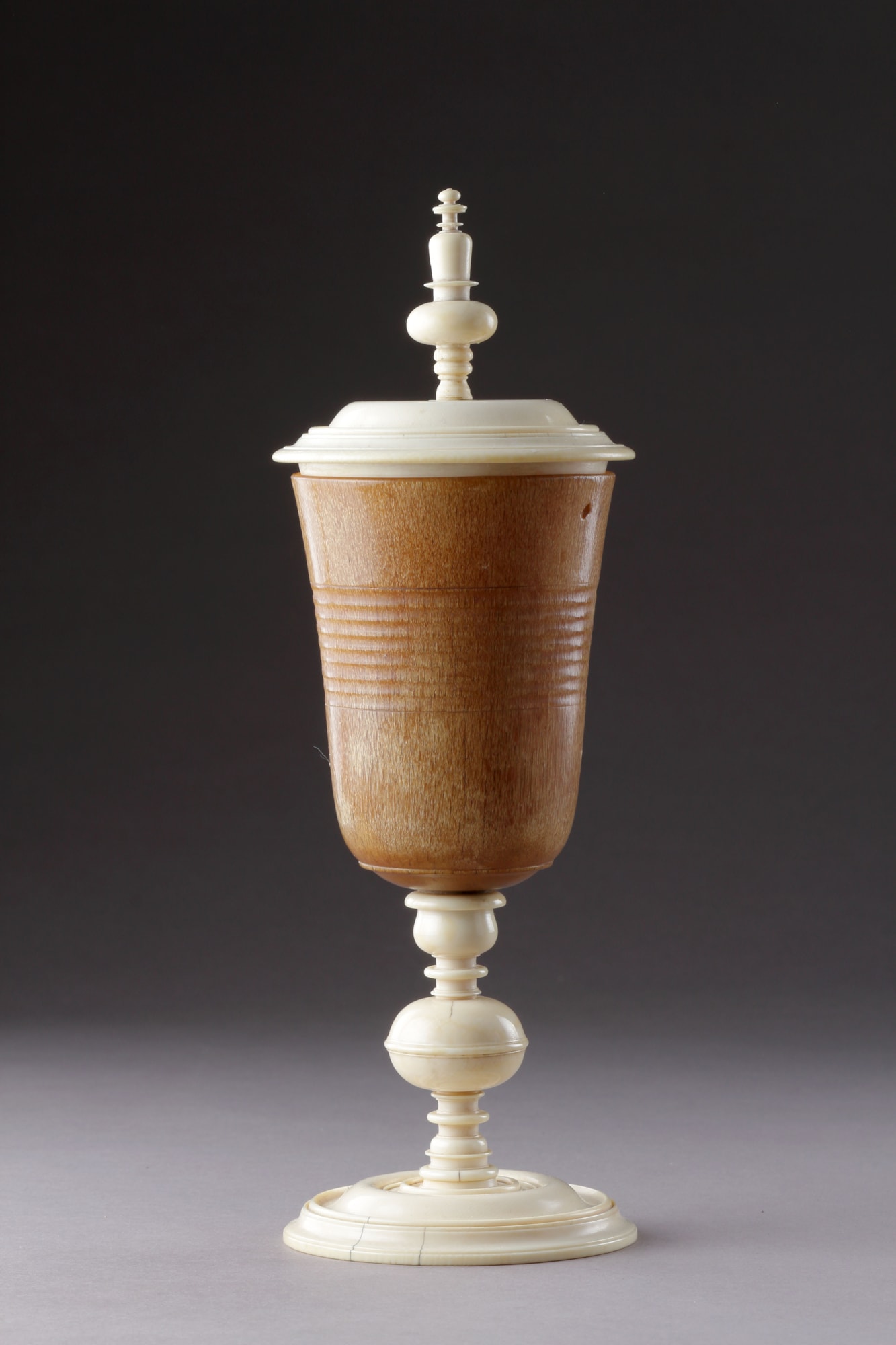
German Renaissance Turned Rhinoceros Horn and Ivory Cup and Cover
German Renaissance Turned Rhinoceros Horn and Ivory Cup and Cover
Period 1600-1700
Origin German, Germany
Medium Rhinoceros Horn, Ivory
Dimension 25 x 8.5 x 8.5 cm (9⁷/₈ x 3³/₈ x 3³/₈ inches)
Smooth silky patina
An old beetle hole to one side of cup
Early 17th Century
Size: 25cm high, 8.5cm dia. - 9¾ ins high, 3¼ dia.
Period: 1600-1700
Origin: German, Germany
Medium: Rhinoceros Horn, Ivory
Dimension: 25 x 8.5 x 8.5 cm (9⁷/₈ x 3³/₈ x 3³/₈ inches)
Provenance: Ex Private collection of the late Jean Claude Ciancimino
Exhibited: Every Object Tells a Story, Oliver Hoare's Cabinet of Curiosities, Pimlico, 6th June to 6th July 2012
Thence by descent
Literature: Works of art fashioned from rhinoceros horn, narwhal tusks, nautilus shells or coconuts are still viewed as prime examples of ‘Kunstkammer exotica’ long after they were first brought back as unworked natural materials to Europe by the Portuguese, English and Dutch merchants ships in the 16th century. Universally held in high esteem, rhinoceros horn was literally worth its weight in gold during the Renaissance. It was considered a divine wonder during the 17th century with powerful apotropaic properties that could protect its owner from poison, disease and even thunderstorms. Cups and goblets made from the horn were hugely popular with princely collectors both because of its rarity and because of its power to detect poison, and this belief persisted well into the 19th century even in the face of all scientific knowledge.

Finch & Co
Antiquities, ethnographica, natural history, sculpture and works of art
More artworks from the Gallery