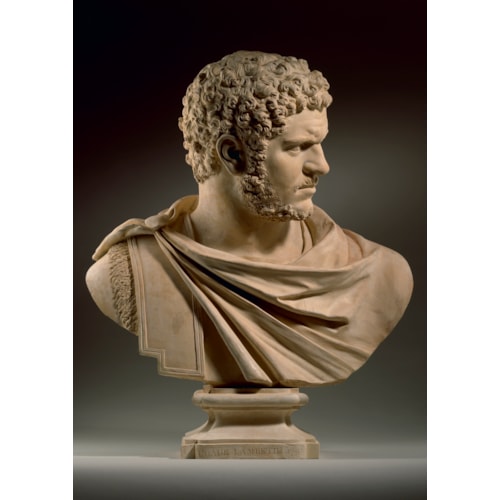

-31. Bust Representing a Young Woman_T639063181388143357.jpg?width=2000&height=2000&mode=max&scale=both&qlt=90)
31. Bust Representing a Young Woman
31. Bust Representing a Young Woman
Medium Terracotta, on flared grey marble socle
He won the first prize for sculpture in 1725 but gave up the trip to Rome to stay with his ill father. He was admitted to the Royal Academy of Painting and Sculpture in 1728, became a professor at the beginning of 1744 and nominated director in 1769.
He exhibited at the Salons du Louvre between 1737-1771, where he regularly presented bust portraits of the sovereign, succeeding in capturing a ‘perfect resemblance’ (Mercure de France, 1732). By the 1730s, Lemoyne was one of the greatest decorative and monumental sculptors in France. He asserted himself quickly as one of the most eminent portrait sculptors of the mid 18th century and became the official portraitist of the king. His talent as a portraitist was revealed during the creation of, in collaboration with his father, the equestrian statue of Louis XV for the city of Rennes, which received approval of the royal
model. This public recognition permitted Jean-Baptiste II Lemoyne to receive numerous private commissions. Alongside his friend Maurice Quentin de La Tour, he shared the ambition to lift the portraiture to the highest rank in the hierarchy of the traditional arts. “Virtuose du modelage” (Virtuoso of modelling.) (C. Champy-Vinas, 2017, p.354.)
He particularly distinguished himself in the field of terracotta and praised its malleability and the exceptional fidelity it offered in capturing the finest details. He innovated in presenting simple portraits, breaking with the previous tradition of lavish ceremonial portraits with intricate and complex draperies.
Réau classes the portraits made by Lemoyne into six categories: Louis XV and the royal family; the court (ministers, marshals, royal mistresses, great ladies); the judiciary and finance; scholars and doctors; writers; artists and actors.
Although the model remains unknown, our bust was created very early in the career of Lemoyne (around 1750) because we can very clearly recognise the style of his master Robert Le Lorrain. It very likely belongs to a class of busts from 18th century French high society, a milieu in which Jean Baptiste Lemoyne established himself as one of the most sought-after portraitists of his time. The numerous portraits that Jean-Baptiste II Lemoyne created, whether official or private, all have the same mark: an unvarnished realism highlighting the personality of the model. Whether she is an aristocrat, a woman of letters or an actress, the large social circle of the sculptor renders it difficult to determine with certainty the exact social standing of the subject. We find that the pupil of the eye is well-defined with the incised iris and raised eyelid characteristic of Lemoyne.
Two known clay busts are signed in the same manner as our bust with the initials “J.B.L.M”. One representing Victoire Martin signed “J.B.LM.”, and dated 1750, kept at the MFA in Boston (1986.988) and a second signed “J.B.L.M.” presently on the art market (Didier Aaron).
Medium: Terracotta, on flared grey marble socle
Signature: Signed J.B.L.M.
Provenance: Ader, sale (sold) 20th June 1957, Galerie Charpentier, Paris, lot.51
Christie’s London, sale the Brian Jahos collection from an estate in the South of France, May 1st, 2013. Lot.384.
Sale: European Works of Art and Clocks, Chiswick Auctions, London, December 13th, 2016, lot.702.
Literature: Louis Réau, “A Dynasty of Sculptors in the 18th Century, The Lemoynes,”, Les Beaux-Arts, Paris, 1927.
Lami, Dictionary of Sculptors of the French School in the 18th Century, Paris, 1911, vol. 2.
C. Champy-Vinas, Jean-Baptiste Lemoyne (1704-1778): A Sculptor to the King in the Age of Enlightenment, thesis, Paris, 2017.
C. Champy-Vinas, “Usually in His Studio... The Studio of the Sculptor Jean-Baptiste Lemoyne (1704-1778),” in. Dix- huitième siècle, 2018.
Tomasso
European Sculpture from the Early Renaissance to the Neoclassical periods, Master Paintings and Ancient Art
More artworks from the Gallery


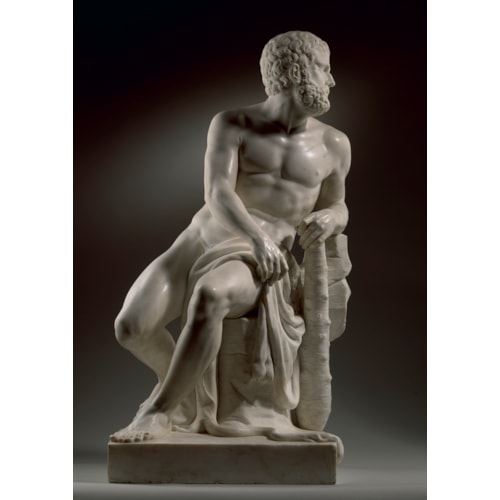
 (Attributed to)-34. River God Reclining on an Urn_T639063181389912999.jpg?width=500&height=500&mode=pad&scale=both&qlt=90&format=jpg)