
Sudanese Jibba
Marketplace
Sudanese Jibba
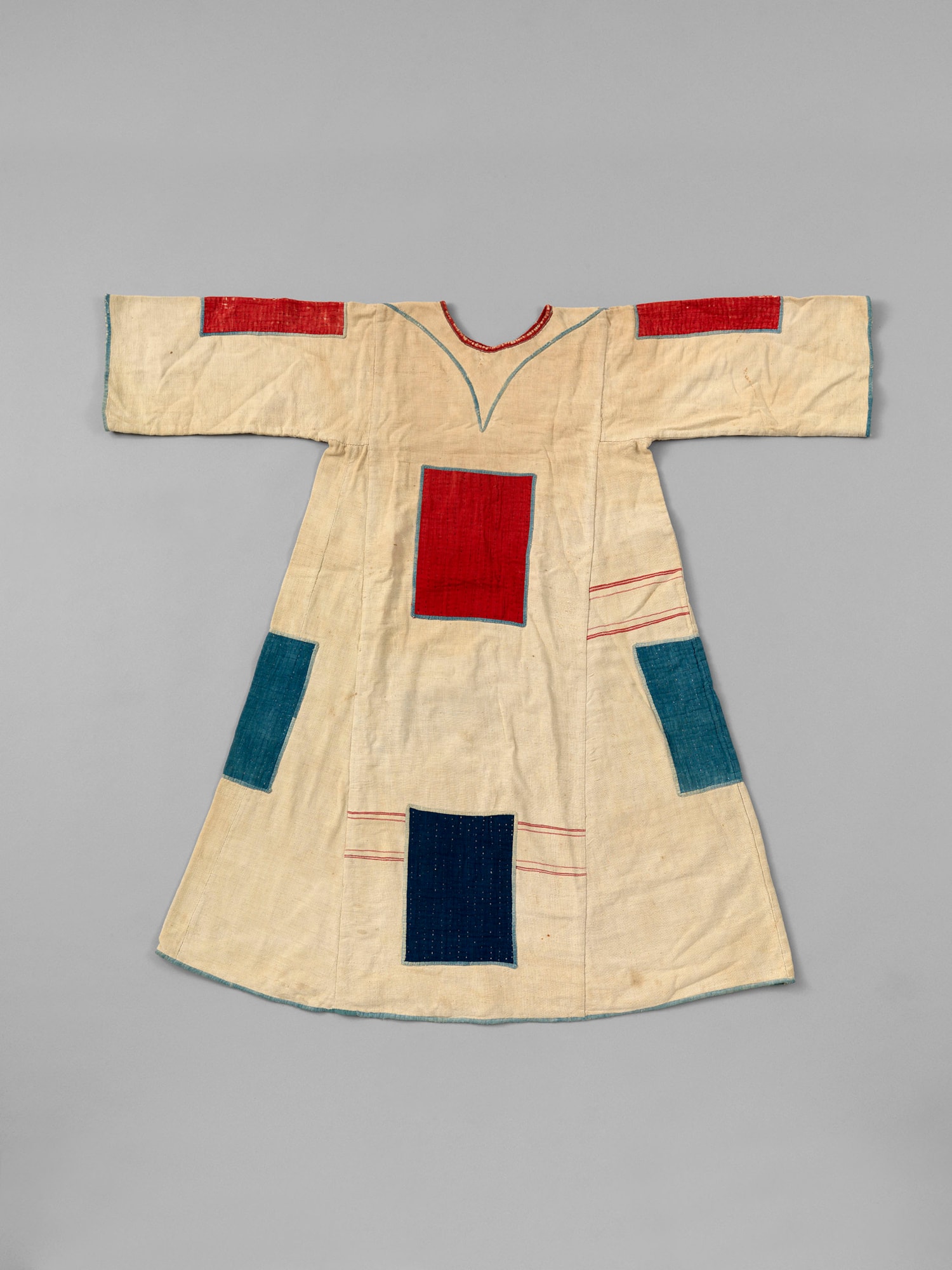
A Sudanese jibba made from rough cotton known as dammur, with felted wool appliqué patches. It has a round neckline, A-line body and straight sleeves. Red rectangular panels are applied to the arms, chest, and back, while blue rectangular panels are applied to the bottom of the garment.
The jibba is associated with followers of Muhammad Ahmad, the Mahdi of Sudan, a Sufi leader who led a holy war against the Ottoman-Egyptian ruling class of Sudan. He died shortly after his successful Siege of Khartoum in 1885, but a Mahdist State continued into 1899.1 The garment is derived from a ragged tunic worn by Sufi mendicants known as a muraqqa'a. Initially worn as a sign of ascetism, it became an increasingly lavish symmetrical, designed costume. It is thought that the appliquéd sections may have been used to distinguish different military ranks.2
Many jibbas were collected on the battlefield during the Anglo-Egyptian conquest of Sudan (1896–1899) and taken to Britain as war trophies. Indeed, this jibba was brought to the UK at this time, and used as a fancy dress costume by children in ca. 1900. Many examples are now housed in UK museums. Of the several Sudanese jibbas in the British Museum, all were produced between 1885 and 1900 (see accession nos Af1909,0315.4 and Af1979,01.5090 for similar examples). Others are held in the National Army Museum (accession no. NAM.1963-11-66-1), collected from the Battle of Omdurman, and Reading Museum (accession no. 1930.115.1), taken from the Battle of Tamai.
n.b. accession nos are clickable links
[1] Seri-Hersch, Iris. 'The Mahdiyya Movement in Sudan', in Andrea Alfred J. (ed.), World History Encyclopedia. Santa Barbara: ABC-CLIO, 2011, vol. 16, pp. 882–883.
[2] Picton, John, and John Mack. African Textiles. London: British Museum, 1989, p. 173.
The jibba is associated with followers of Muhammad Ahmad, the Mahdi of Sudan, a Sufi leader who led a holy war against the Ottoman-Egyptian ruling class of Sudan. He died shortly after his successful Siege of Khartoum in 1885, but a Mahdist State continued into 1899.1 The garment is derived from a ragged tunic worn by Sufi mendicants known as a muraqqa'a. Initially worn as a sign of ascetism, it became an increasingly lavish symmetrical, designed costume. It is thought that the appliquéd sections may have been used to distinguish different military ranks.2
Many jibbas were collected on the battlefield during the Anglo-Egyptian conquest of Sudan (1896–1899) and taken to Britain as war trophies. Indeed, this jibba was brought to the UK at this time, and used as a fancy dress costume by children in ca. 1900. Many examples are now housed in UK museums. Of the several Sudanese jibbas in the British Museum, all were produced between 1885 and 1900 (see accession nos Af1909,0315.4 and Af1979,01.5090 for similar examples). Others are held in the National Army Museum (accession no. NAM.1963-11-66-1), collected from the Battle of Omdurman, and Reading Museum (accession no. 1930.115.1), taken from the Battle of Tamai.
n.b. accession nos are clickable links
[1] Seri-Hersch, Iris. 'The Mahdiyya Movement in Sudan', in Andrea Alfred J. (ed.), World History Encyclopedia. Santa Barbara: ABC-CLIO, 2011, vol. 16, pp. 882–883.
[2] Picton, John, and John Mack. African Textiles. London: British Museum, 1989, p. 173.
Découvrez la galerie

Amir Mohtashemi Ltd.
Indian,Islamic and Cross-Cultural Works of Art
Plus d'œuvres d'art de la Galerie