
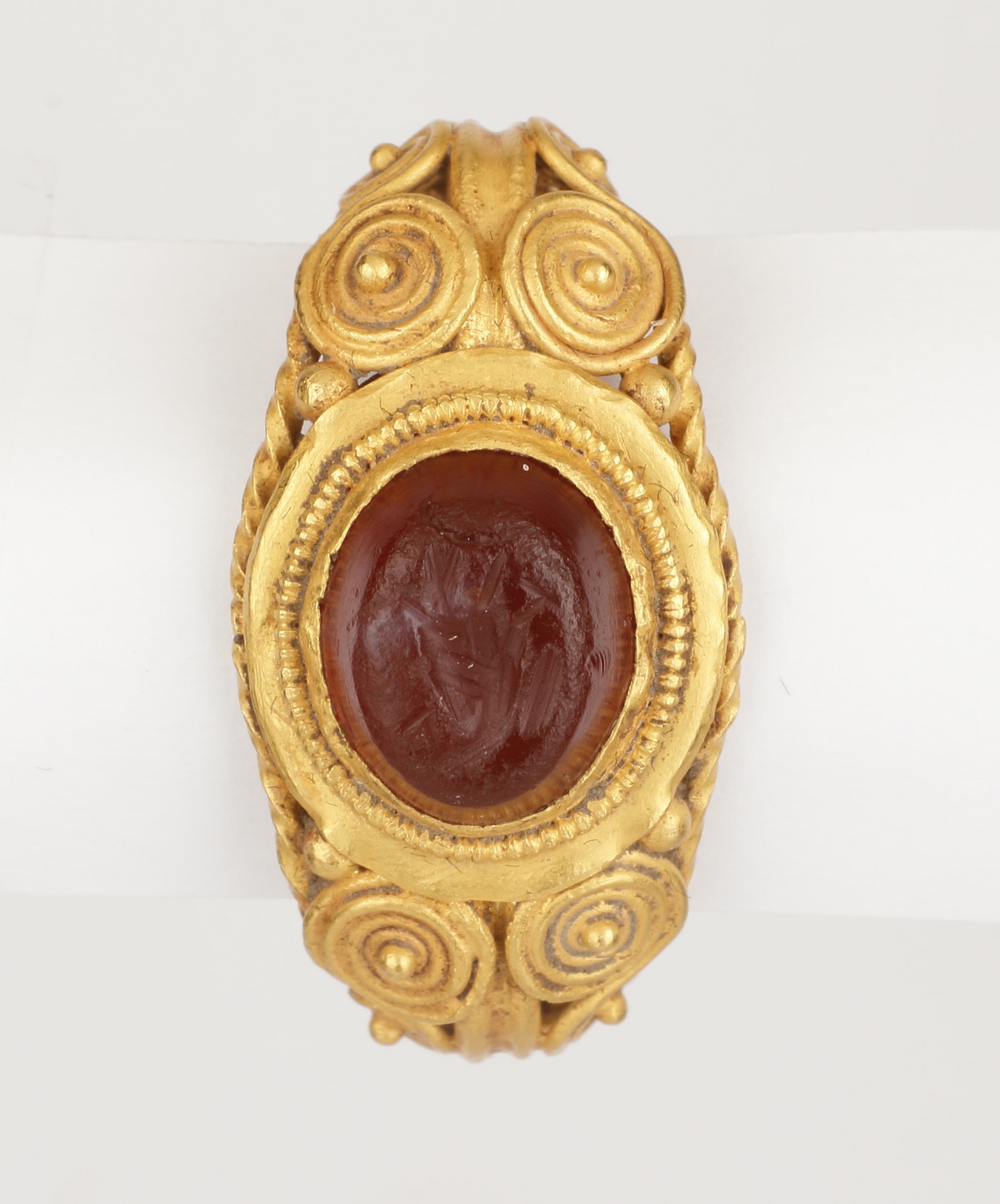
A Romano-British Finger-Ring with Filigree Wire Decoration and Carnelian Military Intaglio
A Romano-British Finger-Ring with Filigree Wire Decoration and Carnelian Military Intaglio
Epoque Late 4th or Early 5th Century AD
Origine Romano-British
Medium gold, Carnelian
Gold, carnelian
Romano-British
Late 4th or Early 5th Century AD
Size: 53 (EU) M 1/2 (UK) 6 1/2 (US)
Weight: 8.3 grams
Provenance: Formerly Hanns-Ulrich Haedeke collection, former Director, German Sword Museum, Solingen, and author of Schmuck aus drei Jahrtausenden: Sammlung Hanns-Ulrich Haedeke (Köln: Rheinland Verlag, 2000)
Ex Private collection
Epoque: Late 4th or Early 5th Century AD
Origine: Romano-British
Medium: gold, Carnelian
Provenance: Formerly Hanns-Ulrich Haedeke collection, former Director, German Sword Museum, Solingen, and author of Schmuck aus drei Jahrtausenden: Sammlung Hanns-Ulrich Haedeke (Köln: Rheinland Verlag, 2000)
Ex Private collection
Literature: Finger rings of this intricate filigree type with spiral-form ornamentation are well-represented in late Roman Britain. Examples are found both as isolated finds and in significant hoards of high-status objects from the late 4th and early 5th centuries, notably Thetford (Norfolk) and Hoxne (Suffolk). These rings are distinguished by bands composed of round, beaded, and semi-block-twisted wires, embellished with applied granules and coiled spirals, particularly large adorned S-scrolls at the shoulders. Outside Britain, such rings are uncommon; British examples are noteworthy for their tightly coiled spirals. The present ring closely resembles three documented pieces from Hoxne, Houghton (Hampshire) and Bromley (Essex). All share key characteristics: spirals formed from strip-twisted round wires, bands edged with semi-block-twisted wires, and a central gold strip with a convex V-profile providing structure in lieu of a backing sheet. The present and Bromley rings are so similar that they may originate from the same workshop, differing primarily in the beaded-wire edging of the box setting and ‘keeled’ shoulders. The prevalence of such rings in Britain likely reflects heightened loss and hoarding during the decline of Roman rule. With its military eagle intaglio, this ring may even be connected to the withdrawal of Roman garrisons between 383 and 406.

Finch & Co
Antiquities, ethnographica, natural history, sculpture and works of art
Plus d'œuvres d'art de la Galerie