
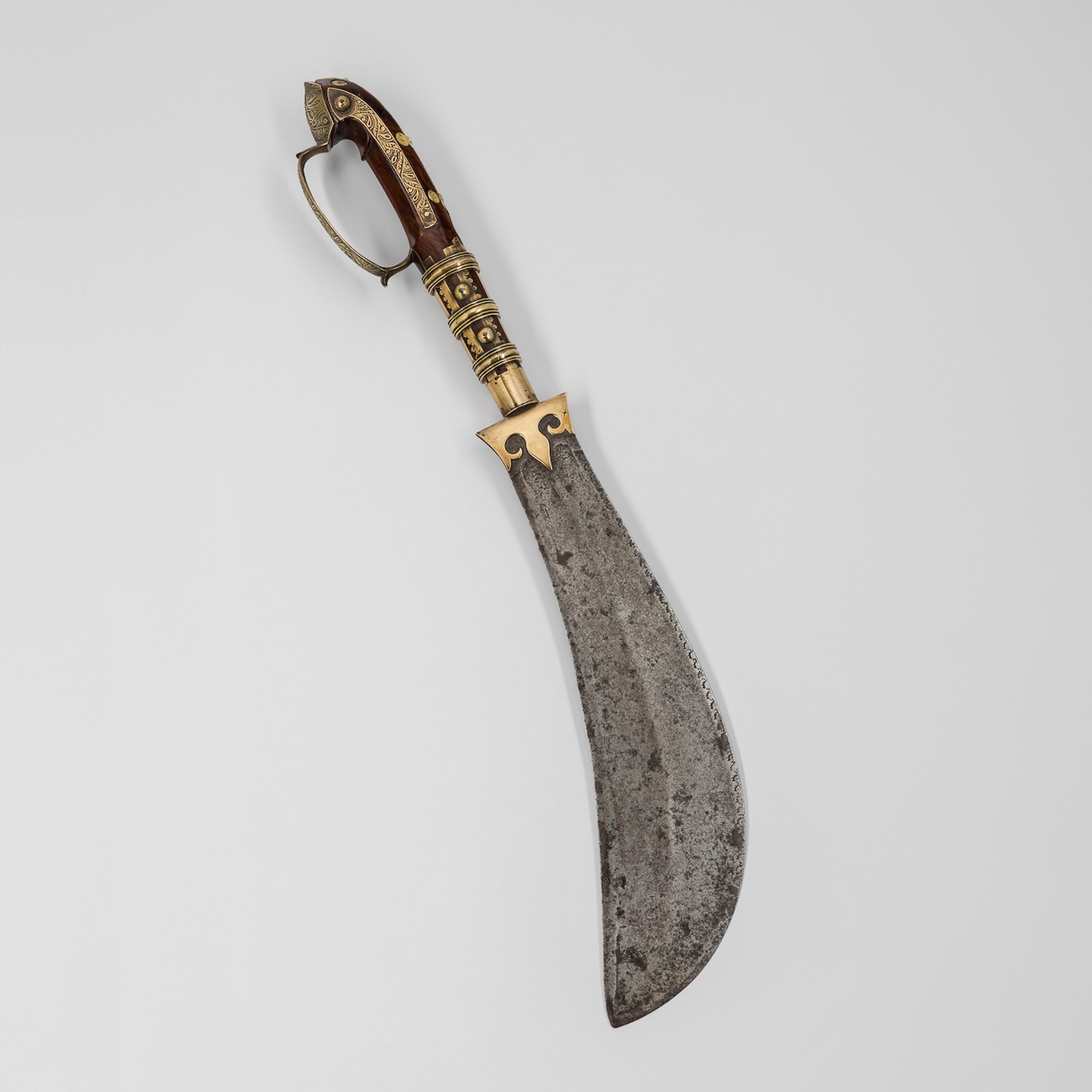
Moplah Knife
Marketplace
Moplah Knife
The Moplah sword originates from the Malabar Coast in Southwest India. It is named after the Mappila people, a Muslim community found predominantly in Kerala. Their characteristic wide, forward-curving blades are designed to cut through thick jungle foliage. It is distinguished from the similar Ayda Katti by its double-edged blade, as opposed to the single-edge of the Ayda Katti.1
Between 1836 and 1854, several Mappila revolts against the British resulted in an act banning Moplah knives. In March 1854, searches were conducted throughout Malabar to confiscate Moplahs, and blacksmiths were warned against making them.2 No men were allowed to keep weapons in Malabar without permission from the government. Consequently, the majority of surviving examples pre-date this period.
The form is characteristic of Southwest Indian examples dating from the 18th and 19th centuries in the Metropolitan Museum of Art (accession nos 36.25.937 and 36.25.935) and the Victoria & Albert Museum (accession nos 2855(IS) and 2798(IS)).
[1] Stone, George Cameron. A Glossary of the Construction, Decoration, and Use of Arms and Armor in All Countries and in All Times: Together with Some Closely Related Subjects. Portland: Southworth Press, 1934.
[2] Hathika, K. ‘The Sophisticated “Moplah War-Knife” and the British Empire’, Proceedings of the Indian History Congress 80 (2019), pp. 690-695: p. 692.
n.b. accession nos are clickable links
Between 1836 and 1854, several Mappila revolts against the British resulted in an act banning Moplah knives. In March 1854, searches were conducted throughout Malabar to confiscate Moplahs, and blacksmiths were warned against making them.2 No men were allowed to keep weapons in Malabar without permission from the government. Consequently, the majority of surviving examples pre-date this period.
The form is characteristic of Southwest Indian examples dating from the 18th and 19th centuries in the Metropolitan Museum of Art (accession nos 36.25.937 and 36.25.935) and the Victoria & Albert Museum (accession nos 2855(IS) and 2798(IS)).
[1] Stone, George Cameron. A Glossary of the Construction, Decoration, and Use of Arms and Armor in All Countries and in All Times: Together with Some Closely Related Subjects. Portland: Southworth Press, 1934.
[2] Hathika, K. ‘The Sophisticated “Moplah War-Knife” and the British Empire’, Proceedings of the Indian History Congress 80 (2019), pp. 690-695: p. 692.
n.b. accession nos are clickable links
Découvrez la galerie

Amir Mohtashemi Ltd.
Indian,Islamic and Cross-Cultural Works of Art
Plus d'œuvres d'art de la Galerie