
Indo-Portuguese Coverlet or Colcha
Marketplace
Indo-Portuguese Coverlet or Colcha
Indo-Portuguese Coverlet or Colcha
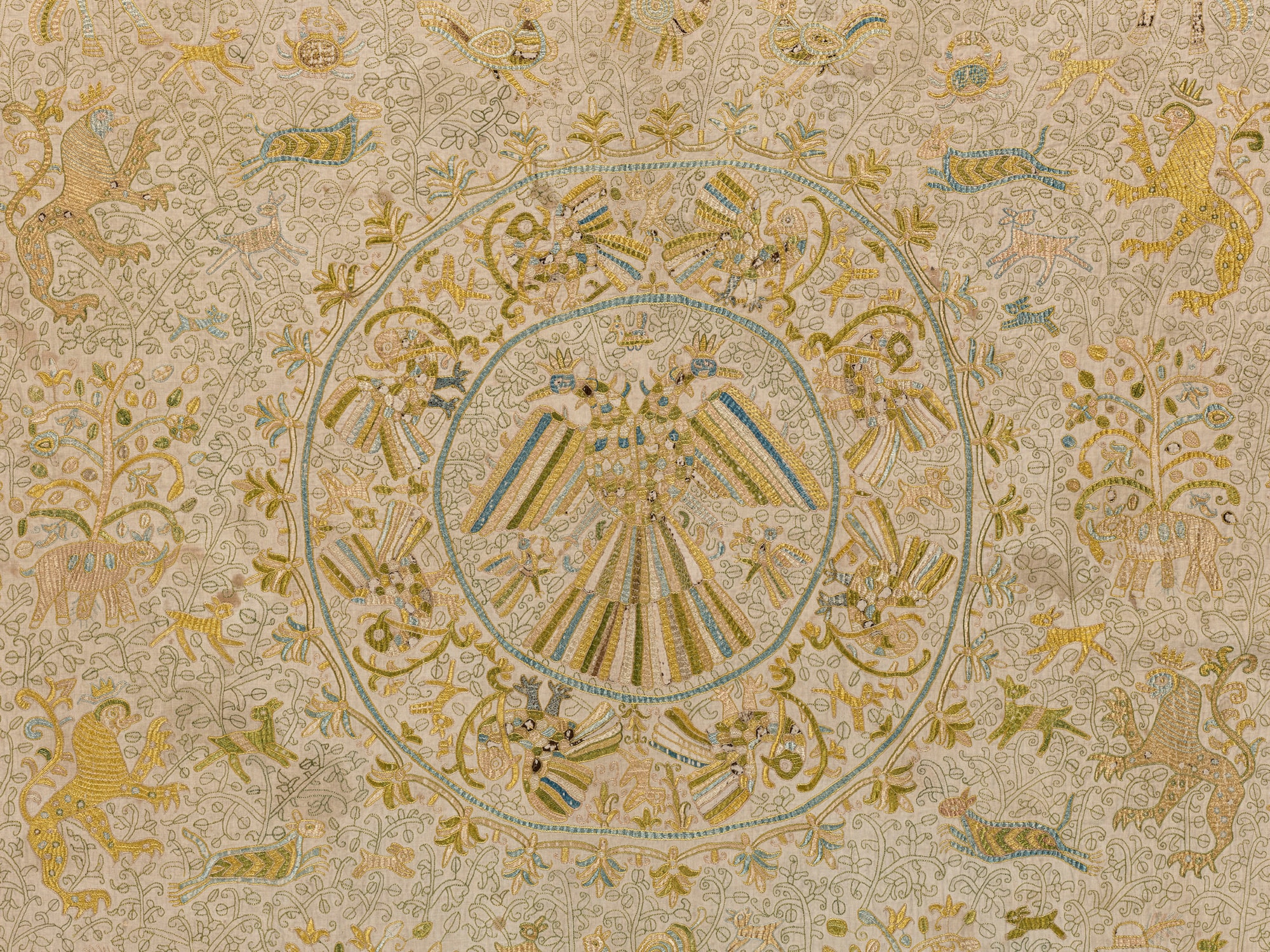
A large cotton coverlet embroidered in silk threads with a symmetrical arrangement of animals and mounted European figures and at the centre, a large medallion containing a double-headed eagle. This colcha is unusually colourful, featuring shades of yellow, gold, blue, brown, and pink. The embroidery is more typically carried out in pale yellow raw silk (tussah) on a white ground or occasionally indigo-dyed blue ground.1
The layout and technique share many similarities with Bengali kantha embroideries. However, as no surviving kanthas pre-date 1800, a direct connection between the two techniques cannot be drawn.2
Colchas were made specifically for Europeans, both at home and in India, who used them like tapestries, hanging from the wall or to cover doorways.3 Those textiles destined for the European market were stored in warehouses in Goa and Cochin, from which they were shipped to Lisbon, which has led to the misidentification of the group as Goan.4 In inventories, however, Bengal and the name of the city Satgaon are sometimes cited.5
While 16th-century colchas frequently feature Hindu motifs, by the early 17th century European motifs predominated.6 Not only did Portuguese traders provide materials (silk and cotton), but they could also provide European prints. Popular sources were medieval Physiologos or bestiaries and armorial books.7 The animals on this textile, including crabs, elephants, lions, and dogs, are armorial in origin. The lions are rampant and crowned, typical of heraldry. Elephants with trees growing behind them are also drawn from heraldry. This is the charge of the Lords of Blacy, in the Champagne region of France.8
The central medallion features a double-headed eagle, which features on other Indo-Portuguese textiles. This motif has often been identified as the Reichsadler or ‘Imperial Eagle’, used by the Holy Roman Emperors and the Habsburgs. However, it is unlikely to be the arms of a specific family, rather a symbol of strength and rulership more generally. It may also have been selected due to its significance in India, where it is an avatar of Vishnu (Gandabherunda) and appears in temple architecture.
The border features peacocks holding snakes in their mouths. Several European coats of arms feature birds holding snakes in their beaks: notably storks, herons, and eagles. The Indian craftsmen may have substituted these birds for the peacock, as the image of a peacock eating a snake figures in Hindu folklore.
Some of the animals have unusual spots and stripes, possibly a misinterpretation of printed armorials, where colours are represented by hatching in different directions or dots when colour cannot be printed.
The mounted figures wear European clothing, including hats with feathers, short swords, breeches gathered at the knee, and large ruffs. The clothing as well as the short, cropped hair and moustache are typical of fashions between 1570 and 1630.9
An Indo-Portuguese colcha in the Museo Nazionale, Bargello (inv. no. C 2255), also has double-headed eagle motifs.10 An example in the Victoria & Albert Museum, London (accession no. 432-1882) is attributed to Satgaon, 1600–25. It also features prominent armorial motifs, such as the double-headed eagle, gryphons, and wyverns. Its border comprises various hunting scenes, including mounted European men.
[1] Austin, Emily (17.03.2015) ‘Bengali Bedhangings & Portuguese Portraits’, The Bowes Museum, retrieved online via https://thebowesmuseum.org.uk/bengali-bedhangings-portuguese-portraits/ on 19.02.2026.
[2] Bean, Susan S (28.07.2023) ‘Connecting Cultural Worlds: An Embroidery from India Celebrating Portugal’s Monarchy’, Isabella Stewart Gardner Museum, retrieved online via https://www.gardnermuseum.org/blog/connecting-cultural-worlds-embroidery-india-celebrating-portugals-monarchy on 19.02.2025.
[3] Karl, Barbara. ‘The Narrative Scheme of a Bengal Colcha dating from the Early 17th Century Commissioned by the Portuguese’, Textile Society of America Symposium Proceedings (2006), pp. 438–448: p. 438.
[4] Fanelli, Rosalia Bonito. ‘An Indo-Portuguese Embroidery in the Bargello’, Bulletin of the Needle and Bobbin Club 53.1 (1970), pp. 16–23: p. 17; Karl, Barbara. “Marvellous Things are Made with Needles”…Bengal Colchas in European inventories, c. 1580–1630’, Journal of the History of Collections 23.2 (2011), pp. 301–313: p. 306.
[5] Satgaon cited in the East India Company records: W. Foster (ed.) English Factories in India 1618-1669. Oxford: 1906–27, vol. 1, pp. 195, 204, cited in Karl (2011), op. cit., p. 305.
[6] Fanelli, op. cit., p. 18.
[7] Karl (2006), op. cit., p. 441.
[8] See Louis-François le Fèvre de Caumartin. Recherche de la Noblesse de Champagne. Paris : 1673, retrieved from https://www.coats-of-arms-heraldry.com/armoriaux/caumartin.html on 19.02.2026.
[9] Fanelli, op. cit., p. 19.
[10] Ibid.
Discover the Gallery

Amir Mohtashemi Ltd.
Indian,Islamic and Cross-Cultural Works of Art
More artworks from the Gallery