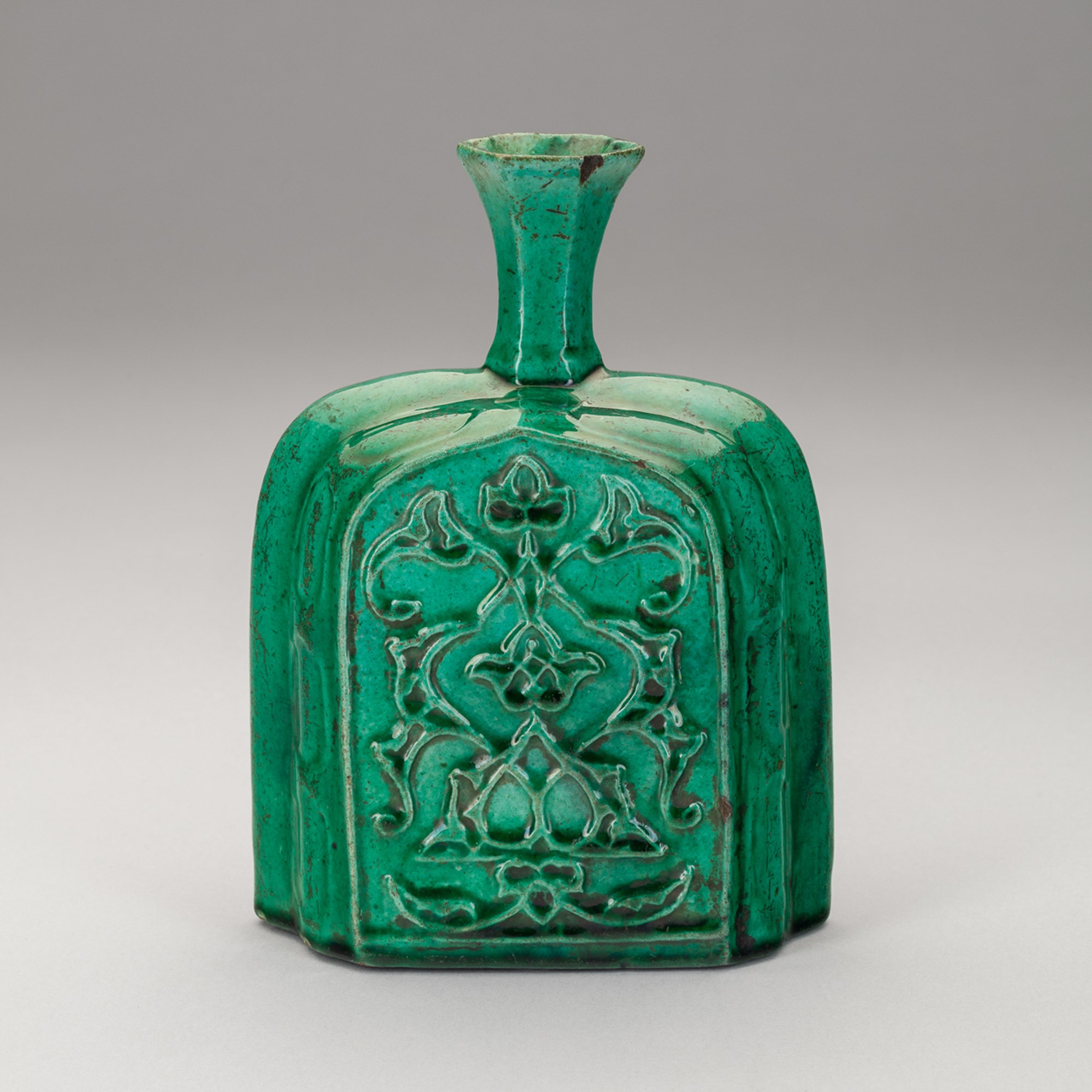
Safavid Monochrome Bottle
Marketplace
Safavid Monochrome Bottle
A small, flattened bottle made of fritware, moulded with split-palmette arabesques under a green-blue copper glaze. It belongs to a group identified by Arthur Lane, dating to the first half of the 17th century and probably made in Isfahan, Iran.1
Examples with similar arabesque decoration are held in the Ashmolean Museum, Oxford (accession no. EAX.1615; dated 17th century) and the St. Louis Art Museum (accession no. 924:1920; dated 16th or early 17th century). Another, with a more ornate floral pattern is in the Victoria & Albert Museum, London (accession no. 2492&A-1876; 1600-1650). Others of the same flattened form but with moulded figural decoration under the glaze are held in the Louvre, Paris (accession no. OA 7780; Isfahan, 1600-1650), the Doris Duke Foundation for Islamic Art, Honolulu (inventory no. 48.36; Isfahan, 17th century), the Metropolitan Museum of Art, New York (accession no. 1988.247; mid-17th century, probably Isfahan), and the David Collection, Copenhagen (accession no. 40/2001; first half of the 17th century).
[1] Arthur Lane. Later Islamic Pottery. London: Faber & Faber, 1957, p. 109, plate 97 b, c, d.
n.b. accession nos are clickable links
Découvrez la galerie
Amir Mohtashemi Ltd.
Indian,Islamic and Cross-Cultural Works of Art
Plus d'œuvres d'art de la Galerie

_T638295248852049140.jpg?width=500&height=500&mode=pad&scale=both&qlt=90&format=jpg)