
Sarah Bernhardt
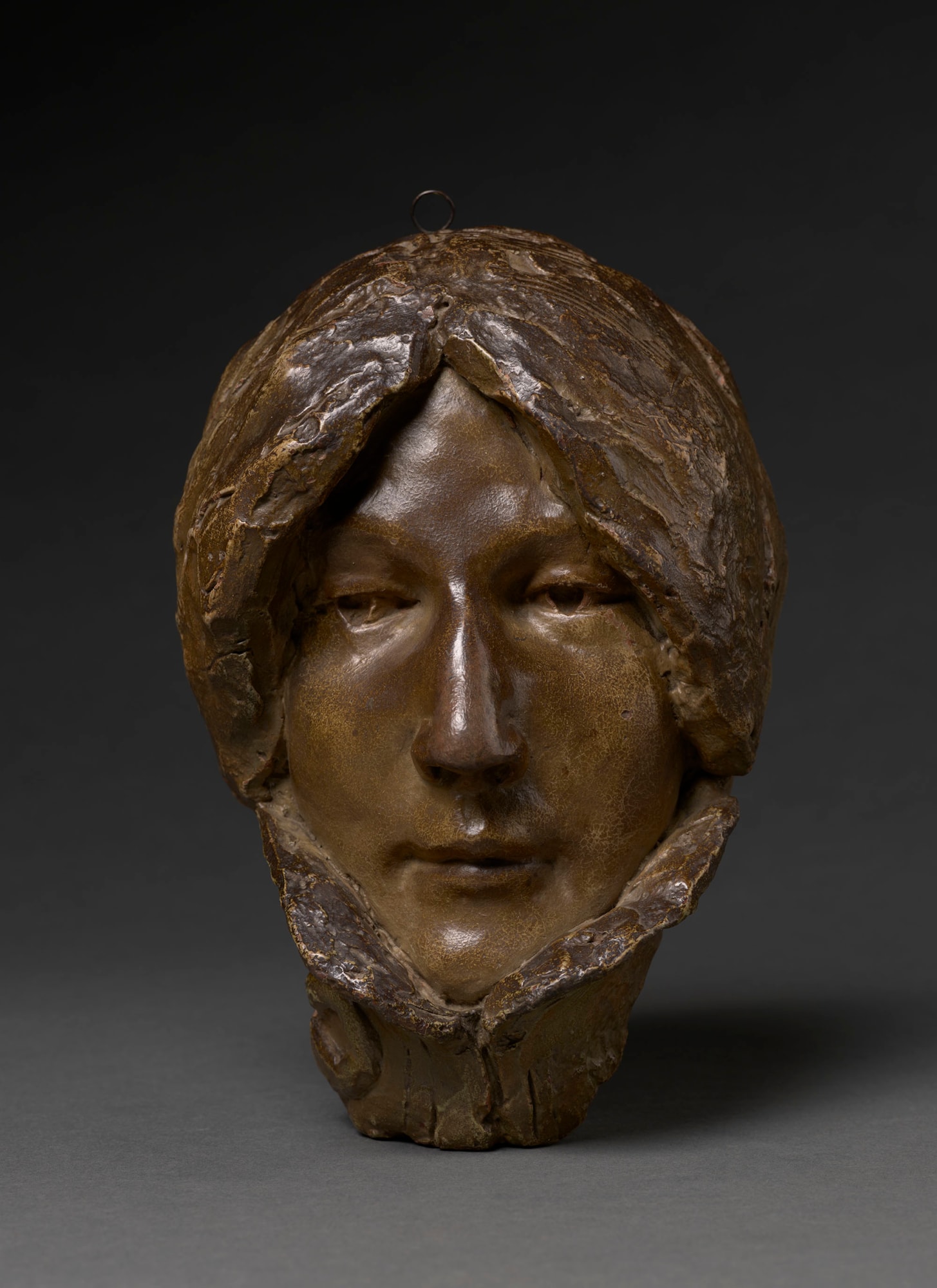
Self-Portrait
Sarah Bernhardt
Self-Portrait
Date c.1870
Medium Patinated plaster
Dimension 23 cm (9 inches)
Bernhardt was raised by a foster family and initially attended a Catholic convent before joining a stage school. Her natural talent and affinity for captivating an audience brought her into the public eye early in her career. Bernhardt’s performances gained her a dedicated following, due to her silken voice and particular exuberance on stage following her debut in 1866. In 1879, Bernhardt made her first tour to Britain and recalls in her memoirs how thousands of people lined the streets and chanted her name. During her time in London, through the aid of her agent Edward Jarrett, she was able to hold her first exhibition in Piccadilly, showcasing her sculptural artistic talent. This exhibition proved immensely popular and was attended by prominent figures such as John Everett Millais and Charles Dickens. During this exhibition, her work was also admired by William Gladstone and Lord Leighton. Thus, her reputation as a talented performer grew to include her accomplishments as an artist.
Bernhardt’s decision to exhibit her work whilst performing in London reveals her acute business acumen, recognising the unique position of her fame and contemporary appeal. In her memoirs, she reveals that she used the money from a sale of her work at this exhibition to purchase a pet cheetah from a zoo in Liverpool.
Whilst touring in America in the 1880s, she also exhibited her art. An exhibition at O’Brien’s Gallery was advertised on the theatrical programme of the McVicker’s Theatre in Chicago in 1881, further highlighting how her roles as both an artist and actress were interlinked throughout her career. Bernhardt was close friends with a number of prominent 19th century artists, most notably Georges Clairin whom she posed for several times.
An expert in self-promotion, Bernhardt remained a significant public figure throughout her life, offering her likeness to be reproduced on now iconic Art Nouveau posters. As her fame and reputation grew, Bernhardt faced backlash for her confident outspoken persona, despite now being seen by many as a feminist icon of the 19th century. In many cases, Bernhardt received criticism with a high-spirited endurance. Following attacks in newspapers regarding her nationality, Bernhardt confirmed her pride in her Jewish heritage and cosmopolitan upbringing, alongside her French identity.
In 1915, following a long-term injury to her knee, Bernhardt chose to amputate her leg in order to perform without pain during a tour to entertain French troops on the front lines during the First World War.
To this day, there remains an air of mystique around such an enigmatic individual, with rumours that she slept in a coffin and had a close relationship with the Prince of Wales. Whilst her skill as a performer cannot be viewed by a modern audience, as her limited film repertoire does not provide much evidence, her talents as an artist can be recognised in the sculpture she produced during her lifetime.
The present work is an example of her imaginative artistic approach. Providing a fascinating glimpse into the artists’ perception of her appearance, this plaster self-portrait was conceived by Bernhardt in c.1870 and depicts the face of the artist in pose, her hair parted and neck concealed by a decorated collar. The format of the portrait resembles a life mask and highlights the precision of her portraiture. The delicately modelled face is set into a serene expression, with her richly textured hair framing her in an almost angelic manner. Akin to her legacy, there is something decidedly enigmatic about her expression, which can be interpreted simultaneously as both tranquil and pointedly mysterious.
This self-portrait was shown in a recent exhibition at the Petit Palais in 2023 to mark the centenary of her death titled Sarah Bernhardt. Et la Femme Créa la Star. Other works by Sarah Bernhardt feature in the collections of the Victoria and Albert Museum, London and the Metropolitan Museum of Art, New York.
Date: c.1870
Medium: Patinated plaster
Dimension: 23 cm (9 inches)
Provenance: Lloyd Macklowe, New York
Victor and Gretha Arwas, London, acquired from the above in the late 1980s, to 2025
Literature: Duckett, V (2023). ‘Sarah Bernhardt: Transformative Fame in Britain and America’, in Transnational Trailblazers of Early Cinema: Sarah Bernhardt, Gabrielle Réjane, Mistinguett (1st ed., Vol. 5, pp. 19–55). University of California Press.
Sarah Bernhardt, (1907) My Double Life: Memoirs of Sarah Bernhardt. London: William Heinemann, pp. 297, 313-317.
Arwas, V (2002). Art Nouveau: The French Aesthetic. London: Andreas Papadakis Publisher, pp. 160.
Annick, L and Cantarutti, S (contributors) 2023, Sarah Bernhardt: et la femme crea la star. Paris: Musee du Petit Palais, pp. 243.
Huret, Jules. Sarah Bernhardt. Préface de Edmond Rostand. Paris: c. 1899; English translation by G. A. Raper, London: 1899.
Petit Palais (2023) Sarah Bernhardt: Et la femme créa la star, Paris Musées, pp.67.
Exhibition: L'Art Nouveau: La Revolution Decorative, Pinacotheque de Paris, 18 April – 8 September 2013
Sarah Bernhardt, Petit Palais, Paris, 14 April – 27 August 2023.
Daniel Katz Gallery
Fine Art from Antiquity to the Twentieth Century
Plus d'œuvres d'art de la Galerie