
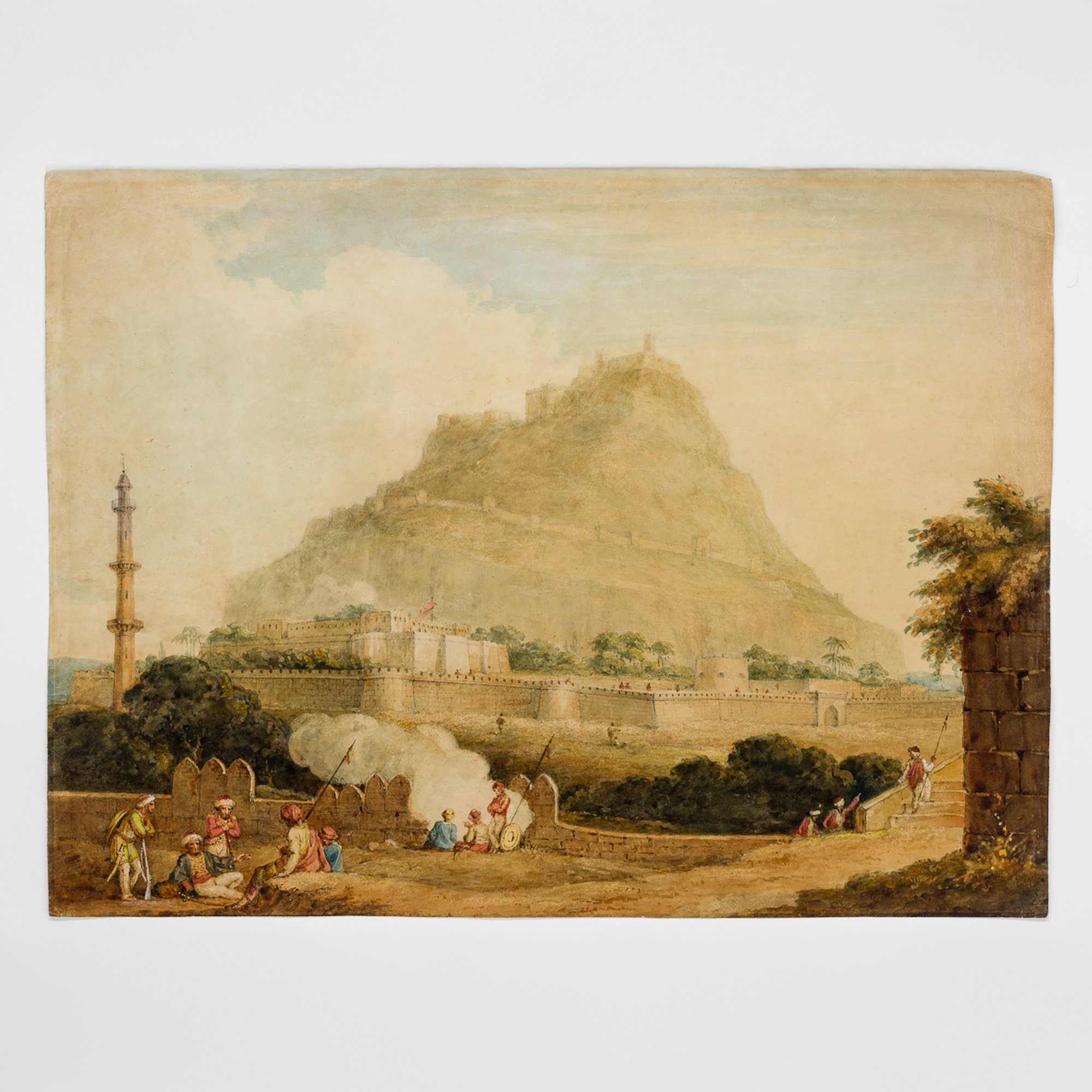
The Daulatabad Fort and the Chand Minar Tower
Marketplace
The Daulatabad Fort and the Chand Minar Tower
The Daulatabad Fort and the Chand Minar Tower
A watercolour of the historic fortified hilltop town of Daulatabad, viewed from the Northeast. Located near Aurangabad, Maharashtra, Daulatabad served as the capital of three different Empires between the 9th and 17th centuries: the Yadavas, the Delhi Sultanate, and the Ahmadnagar Sultanate. The awe of Mughal emperor Shah Jahan (r. 1628–58) on seeing the Daulatabad Fort is recorded in the Shah Jahan Nama:
Everyone who gazes on it comes to the conclusion that this cannot be the work of man. For neither is the physical strength of mere mortals adequate to the task of such stupendous excavating and quarrying; nor in the present age, is their span of life sufficiently long to admit of their completing so vast an undertaking.[1]
The paper is numbered verso ‘N. 71’, presumably denoting its place within the sketchbook. It is inscribed verso ‘Doulutabad/ A strong fortress, the repository of the jewels and treasures of the Sultans of the South of India’.
Indian soldiers in colourful dress relax in the foreground. Some carry spears, and others are armed with swords and rifles. The fortifications snake up the mountain in the background. On the lefthand side is the Chand Minar, an Indo-Islamic victory tower built in the mid-15th century.
Captain Robert Melville Grindlay was a self-taught amateur artist who travelled India with the Bombay Native Infantry between 1803 and 1820. Indulging his own interest in architecture, he made many sketches of the scenery around him.[2] On his return to England, these were published in Scenery, Costumes and Architecture, chiefly on the Western Side of India between 1826 and 1830. Several of these artworks were handed over to professional artists, including William Daniell, to be worked into oil paintings.. The resulting painting is held in India, with lithographs in several museums (Victoria & Albert Museum, IS.4:9-1955).
[1] The Shah Jahan Nama of ‘Inayat Khan, completed and edited by W. E. Begley and Z. A. Desai, Delhi/Oxford: Oxford University Press, 1949, p. 114 in Markel, Stephen. ‘Once the Capital of India: The Great Fort of Daulatabad’, Orientations 25.2 (1994), pp. 47–52: p. 47.
[2] Windeatt, Barry. ‘Rare Book Series: Captain Robert Grindlay in India’, Emmanuel College, Cambridge (15 October 2020), retrieved online via https://apps.emma.cam.ac.uk/members/blog/?id=479 on 29/08/2025.
Discover the Gallery

Amir Mohtashemi Ltd.
Indian,Islamic and Cross-Cultural Works of Art
More artworks from the Gallery
_T638295248852049140.jpg?width=500&height=500&mode=pad&scale=both&qlt=90&format=jpg)