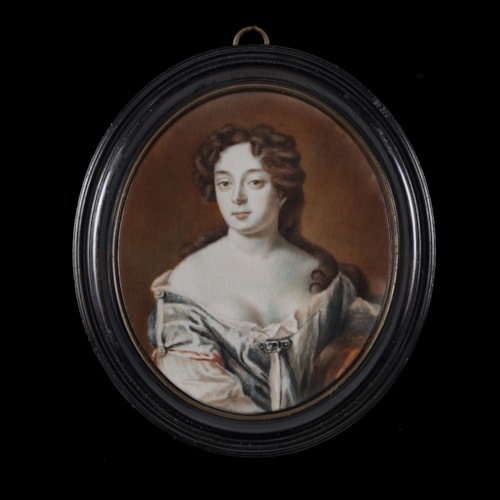


ISMAEL 'ISRAEL' MENGS
A Self-Portrait in miniature, wearing a fur-trimmed blue hat, brown jacket with fur trim and shirt with white lawn collar (‘Polish Costume’)
ISMAEL 'ISRAEL' MENGS
A Self-Portrait in miniature, wearing a fur-trimmed blue hat, brown jacket with fur trim and shirt with white lawn collar (‘Polish Costume’)
The Limner Company : Portrait Miniature
Date circa 1720
Medium Watercolour on vellum / parchment / paper
Dimension 8.7 x 7.2 cm (3³/₈ x 2⁷/₈ inches)
The obvious comparison with this portrait lies in the only other extant version of Meng’s self-portrait, now in the collection of the Gemäldegalerie Alte Meister, Dresden[3]. The Dresden version is described as a ‘Self-Portrait in Polish Costume’, as it depicts the artist wearing a traditional brown Polish hat, often identified as a konfederatka, complete with a heron’s feather. This was typically a soft cap with fur trim and in the present work has been replaced with a bright blue version.[4] In both portraits, Mengs’s shaved head and open mouth showing his teeth suggest an unconventional character in a frank appraisal of his own face. Pre-dating by some decades the work of artists such as Jean-Antoine Liotard (1702-1789), who would also paint himself with unnerving honesty, Meng’s self-portrait here is a hauntingly beautiful reminder of the talent of an artist whose output was quickly overshadowed by his son’s brilliance. The emergence of this rare work by Ismael comes at a time when he and his son’s work is undergoing review – with a comprehensive, monographic exhibition at the Prado in Madrid which opened in November 2025 and recently closed.[5]
Both self-portraits reflect the Sarmatian clothing popular at the Saxon-Polish court in Dresden, where Ismael Mengs served as a court painter.[6] Sarmatian refers to the era of Polish-Lithuanian nobility (szlachta) under Saxon kings (Augustus II and III), where they adopted Sarmatism, a cultural ideology linking them to ancient warrior Sarmatians, blending Oriental styles with Western traditions. Polish nobility believed themselves descendants of the ancient Sarmatian warrior tribe, Sarmatia (in Polish: Sarmacja) being a semi-legendary, poetic name for Poland. In aping this mode of dress, Mengs was aligning himself with Saxon nobility and ultimately with his ruler and first major patron, Augustus II, the Strong (1670-1733) (he would show his strength by bending horseshoes and tossing foxes), Elector of Saxony and King of Poland.[7]
In early 2026, The Limner Company sold a portrait miniature, also painted on vellum, by Ismael Mengs. This portrait of an elderly man – likely a type of image known as a tronie - would appear to be one of only four miniatures on vellum by the artist. The discovery of the present, previously unknown, self-portrait is perhaps the fourth miniature noted by his son, Anton Raphael. Writing in his memoirs, Ismael’s son notes that his father never ‘finished more than four [miniatures], three of the which are in my possession’.[8] Only the early self-portrait, dated 1711, is currently lost.[9]
The two miniature self-portraits are datable to circa 1714, the year in which Mengs was appointed Court Painter to Augustus II. Ismael’s son, Anton Raphael Mengs (1728-1779), followed his father with a court appointment to Augustus III at the tender age of seventeen. Raphael’s father proved a strict master, teaching and travelling with his son who eventually surpassed him as an artist. Ismael’s ambitions for his children were not confined to his son – his eldest daughter Therese Maron was also a painter, as was his youngest daughter Julia. Recognising the early genius of Raphael, Augustus III bought all his available pastels from his father Ismael Mengs and had them transferred to the Cabinet of Rosalba in the Royal Picture Gallery (the Venetian artist Rosalba Carriera (1675-1757) being a favourite artist of the ruler).
At the Dresden court, the name Mengs finally became recognised as culturally significant – even if Ismael’s output had been on the meagre side, his children took up the artistic baton with aplomb. In the two volumes of his ‘Umständliche Beschreibung Dresdens mit allen seinen inneren und äußeren Merkwürdigkeiten historisch und architektonisch’ (Comprehensive description of Dresden with all its internal and external historical and architectural features), published in 1781 and 1783, local historian Johann Christian Hasche offers a description of the wonders and history of the Saxon electoral city. He wrote:
‘Also here [in the pastel cabinet] is a table with three long drawers, which holds over 100 quite excellent miniature paintings by the master hand of the two Mengses and Theresa Mengs, mostly in tortoise shell or set in gold. On it lies quite a stock of pictures in enamel. Among the former, Cupid who sharpened his arrows is a Mengs: more beautiful his ideal can be imagined; then Ismael Mengs’ Magdalena and Theresa Mengs’ beautiful night: all quite enchanting pieces. Who does not already see from this dry list that our gallery is one of the most beautiful in Europe!’[10]
Ismael was a fascinating character – he was a rebel, who lived outside societal norms. The artist’s religion is still a matter of debate – long thought to have been born into a Jewish family, he became a Lutheran around 1710. His longstanding affair with his housekeeper, Christiana Charlotta Bornmannin (1703-1731), produced four children, but the couple did not marry until near the end of her life in 1729. This unconventional relationship caused many issues, including the status of these illegitimate children.[11] Ismael was, it seems, a tyrannical father and teacher – his son’s memoirs recalling ‘a man more severe and rigid to his children never was known.’[12] Ismael’s interests extended to chemistry and he worked developing colours for the Meissen porcelain factory. In 1764, perhaps in recognition of the successful training he had given his children, he was made an honorary professor at the newly established Academy of Fine Arts in Dresden, dying just six weeks after this prestigious appointment.
[1] Writing in his memoirs, Ismael’s son Raphael notes that his father never ‘finished more than four [miniatures], three of the which are in my possession’. We can assume that this work was one of those four.
[2] Also known as Daniel Heimlich. For more information see Fondation Custodia news: https://www.fondationcustodia.fr/E-news-15
‘‘Heimlich’ means ‘secret’ in German, and the artist bearing this name is indeed somewhat evasive. For many years, sources regarded the signature attached to a series of Views of the Environs of Paris, which appeared in 1765, as the pseudonym of the German artist Johann Eleazar Schenau (1737-1806).’
[3] Ismael Mengs, Self-portrait in Polish Costume, circa 1714, Gemäldegalerie Alte Meister, Dresden. Watercolour on parchment. Dimensions 9.3 x 7.4 cm.
[4] See the later ‘Self Portrait in “Konfederatka" Hat’, by Marcello Bacciarelli (1731-1818) (National Museum, Warsaw).
[5] Museo Nacional del Prado, Madrid, 25/1/2025 - 1/3/2026.
[6] Staatliche Kunstsammlungen, Dresden, Gemäldegalerie Alte Meister.
[7] Ismael made many enamels for Augustus the Strong. One enamel portrait of the ruler exists in the Dresden, Gemäldegalerie Alte Meister Dresden, and another is noted in the Louvre, Paris by Schidlof.
[8] Anton Raphael Mengs (1728-1779), ‘The works of Anthony Raphael Mengs, first painter to His Catholic Majesty Charles III.’ Azara, José Nicolás de, Marqués de Nibbiano, 1730 or 31-1804; Waddilove, Robert Darley, 1736-1828, p. 17.
[9] Ismael Mengs, Self-portrait, signed and dated 1711, now lost (black and white photograph in Schidlof, The Miniature in Europe, 1964, pl. 812). Watercolour and bodycolour on vellum.
[10] “Auch steht hier [im Pastellkabinett] ein Tisch mit drei langen Schubkasten, der über 100 ganz vortreffliche Miniaturbilder von der Meisterhand der beyden Mengse, und der Theresa Mengs, meist in Schildkrotrahm oder in Gold gefaßt, aufbewahrt. Auf ihm liegt ein ziemlicher Vorrath von Bildern in Email. Unter erstern ist Amor welcher seine Pfeile schärfte ein Mengs: schöner läßt sich sein Ideal denken; dann Ismael Mengs Magdalena und Therea Mengs schöne Nacht: alles ganz bezaubernde Stücke. Wer sieht nicht schon aus diesem trocknen Verzeichnisse, daß unsere Gallerie eine der schönsten in Europa sey!” (Johann Christian Hasche, Umständliche Beschreibung Dresdens mit allen seinen inneren und äußeren Merkwürdigkeiten historisch und architektonisch, Vol. 2 (Leipzig: Schwickertscher Verlag, 1783), 90-91.
[11] Whenever Christiana was pregnant, her and Ismael rented a house in Ústí nad Labem, Mírové Square, where they stayed until his wife gave birth. When the time came, Ismael Mengs visited the mayor, gave him a gift for the city’s needs, and requesting that he became the godfather of his children. He confirmed that they were born within marriage and were properly baptized in the Roman Catholic faith at the church in Ústí nad Labem.
[12] Mengs (1728-1779), op. cit., p. 6.
Date: circa 1720
Medium: Watercolour on vellum / parchment / paper
Dimension: 8.7 x 7.2 cm (3³/₈ x 2⁷/₈ inches)
Provenance: Probably Ismael Mengs to his son Anton Raphael Mengs (1728-1779)[1];
Possibly gifted to Augustus III of Poland (1696-1763) by Ismael or his son Anton Raphael;
Dukes of Saxe-Coburg-Gotha, Ducal Museum, Gotha;
By 1912, Ducal Museum, Gotha as a portrait by Jean-Elezar Schenau (also known as Johann Eleazar Zeissig, but also thought to be under Schenau’s pseudonym of Daniel Himlich)[2] (1737-1806);
Collection of the late Mr. Muller Jabusch, Sotheby’s Amsterdam Nov. 16th. 2004, lot 108 (part);
Frölich Antiques, Enschede 2004/2005;
Private Collection, The Netherlands, since 2004/05.
Literature: Exposition de la miniature Brussels, B. (1913). L' Exposition de la miniature à Bruxelles en 1912: no.199, record 1091b; recueil des oeuvres les plus remarquables des miniaturistes de toutes les écoles, du xvie au xixe siècle. Bruxelles: G. van Oest & cie.
Exhibition: L' Exposition de la miniature à Bruxelles en 1912, as a portrait by/ of Jean-Elezar Schenau no. 199, loaned by Musee Ducal de Gotha.

The Limner Company : Portrait Miniature
Potrait miniatures from the 16/17th century, the 18th century and 19th century
More artworks from the Gallery
, wearing ‘Ottoman’ clothing a red cloak with black fur trim, a gold embroidered jacket, _T639176566194891460.JPG?width=500&height=500&mode=pad&scale=both&qlt=90&format=jpg)

 wearing the ribbon and Lesser George of the Order of the Garter, a white s_T639195510025052482.jpg?width=500&height=500&mode=pad&scale=both&qlt=90&format=jpg)
-Portrait miniature of a chef d’escadron of the Polish Light Horse Guard, possibly Seweryn Fredero (b.1785), wearin_T639117100843786546.jpg?width=500&height=500&mode=pad&scale=both&qlt=90&format=jpg)
, the band tassels visible below, his ha_T639131522303800948.jpg?width=500&height=500&mode=pad&scale=both&qlt=90&format=jpg)