
, wearing white dress, with gold _T639174777651646334.JPG?width=2000&height=2000&mode=max&scale=both&qlt=90)
WILLIAM GRIMALDI, R.A.
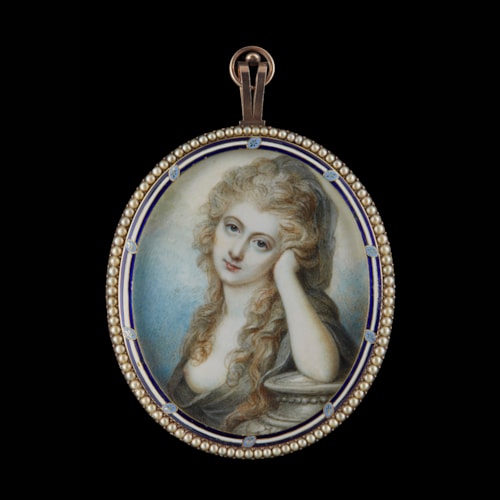
Portrait miniature of Maria Anne Fitzherbert (née Smythe; earlier married name Weld; 1756-1837), wearing white dress, with gold band and gloves, stood in front of a column with red drapery and a landscape background
WILLIAM GRIMALDI, R.A.
Portrait miniature of Maria Anne Fitzherbert (née Smythe; earlier married name Weld; 1756-1837), wearing white dress, with gold band and gloves, stood in front of a column with red drapery and a landscape background
The Limner Company : Portrait Miniature
Date 1789
Period Georgian
Origin England
Medium Watercolour on ivory
Dimension 10.6 cm (4¹/₈ inches)
Maria had been widowed twice by the time she first met George in 1784. She was six years older than the Prince, and he soon became smitten with her. She was a Catholic, meaning that if they ever married, George would have lost his right to inherit the throne, though this did not stop him from proposing to her with a ring borrowed from the Duchess of Devonshire. They were married a year later in a secret ceremony. George and Maria should not be confused with Prince Augustus Frederick, George’s brother, and Augusta Murray, who were also married in secret a few years before.
George split with Maria in 1794 and was forced to marry Caroline of Brunswick (1768-1821) to please both his father and parliament. Despite this change, it seems that Maria never fell out of love with her prince, and she remained a companion throughout his life, bar periods during which she was practically exiled from the court.
Maria Anne Fitzherbert is listed as a sitter in a catalogue of Grimaldi’s works produced by a descendant of the artist in the 19th century. It is not surprising that he would have painted Maria, given that he was the Prince of Wales’ enamel painter. There are two enamel miniatures of her listed, one of a Mistress Fitzherbert and one of a Mrs Fitzherbert. As they are not illustrated, it is not possible to confirm which of these the present miniature is. However, it is highly likely that this is the miniature painted by Grimaldi for himself, listed as ‘Mrs’ rather than ‘Mistress’, as she is named ‘Mrs’ on the inscription on the reverse of this miniature. It should be noted that this portrait of Maria is not a direct copy of the portrait painted of the same sitter by Joshua Reynolds in the National Portrait Gallery (L162), but it is likely that Grimaldi either took artistic licence when painting this miniature, or took it from a work which has since gone untraced.
Date: 1789
Period: Georgian
Origin: England
Medium: Watercolour on ivory
Signature: Inscribed verso ‘1789./ H.B.G …/ Mrs Fitzherbert./ after a picture of/ Sir Joshua Reynolds/ By W. Grimaldi, Enamel/ Painter to H: R: H: Prince/ of Wales.’
Dimension: 10.6 cm (4¹/₈ inches)
Provenance: Probably the collection of the artist;
Collection of Mary Ann Grimaldi (1803-1877), the artist’s daughter in law;
Private collection.
Literature: A.B Grimaldi, A Catalogue, Chronological and Descriptive, of Paintings, Drawings, & Engravings, by and after William Grimaldi, R.A., Paris., London, 1873, no. 33, p. 15.
Exhibition: London, An Evening Soiree at King’s College, 1857;
London, Ironmongers Company Fine Art Exhibition, May 3-5 1861.

The Limner Company : Portrait Miniature
Potrait miniatures from the 16/17th century, the 18th century and 19th century
More artworks from the Gallery