


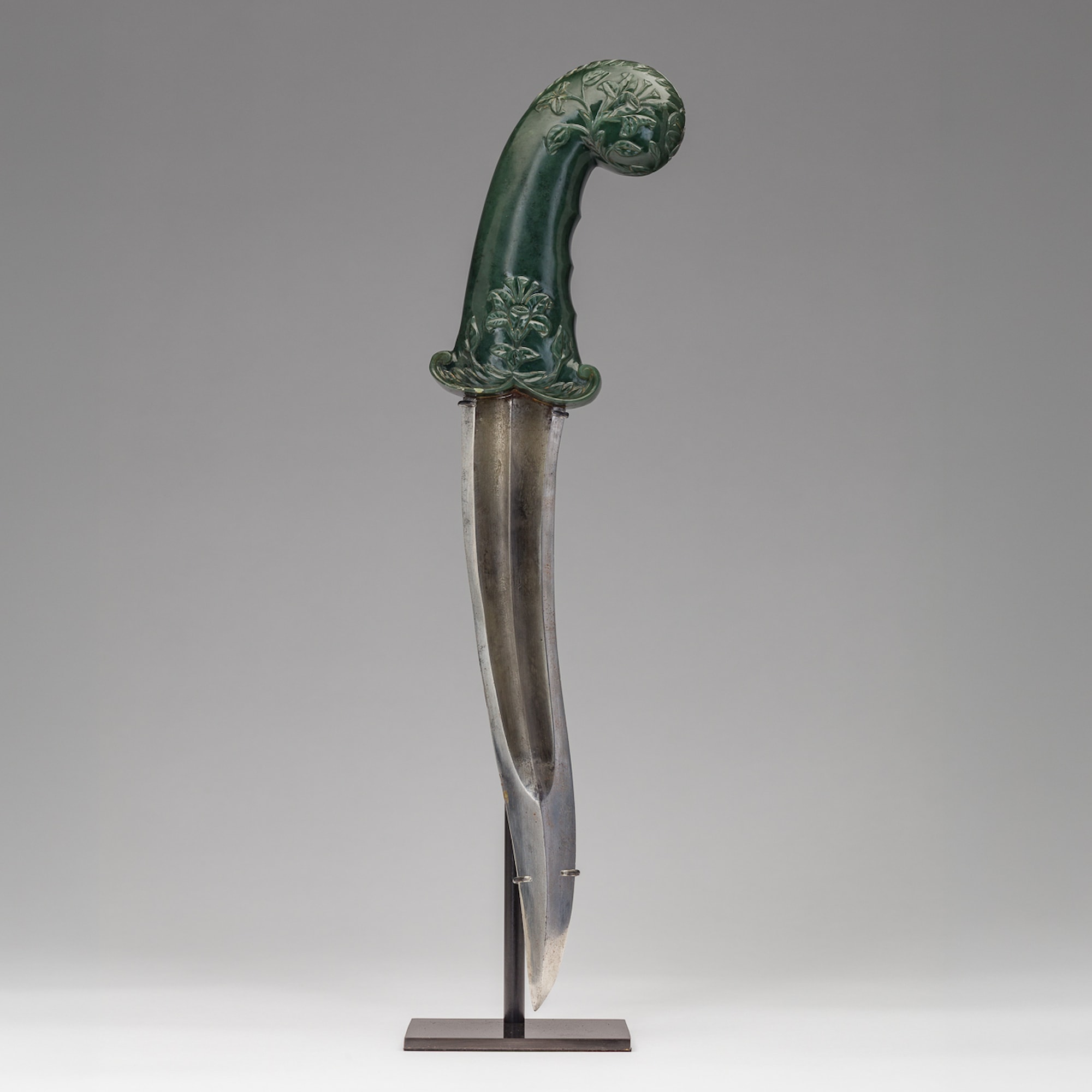
Mughal Dagger
Marketplace
Mughal Dagger
A Mughal khanjar, comprising pistol grip jade hilt and a watered steel curved double-edge blade. The jade hilt is decorated with floral sprays. A similar dagger, also dated to the 18th or 19th century, is in the Metropolitan Museum of Art, New York (no. 36.25.563). A hilt with similar floral relief is in the Victoria & Albert Museum, London (no. 02555(IS)).
Alongside gemstones and jewellery, jade-hilted weapons are the most frequently mentioned presentation gift to or from Mughal emperors.1 Stuart Cary Welch’s study of the Padshah-nama reveals that the most common form of dagger worn was the katar, with the khanjar in second place. Jade was particularly highly prized in Mughal India, in part because it was imported from Central Asia and was therefore a reminder of their Timurid ancestry, and in part because it required so much time and skill to abrade and polish it.2
[1] Markel, Stephen. ‘Inception and Maturation in Mughal Jades’ in Markel (ed.) The World of Jade. Mumbai: Marg Publications, 1992. pp. 49–64: p. 51.
[2] Markel, Stephen. ‘Carved Jades of the Mughal Period’, Arts of Asia 17.6 (1987), pp. 123–30; p. 124.
Alongside gemstones and jewellery, jade-hilted weapons are the most frequently mentioned presentation gift to or from Mughal emperors.1 Stuart Cary Welch’s study of the Padshah-nama reveals that the most common form of dagger worn was the katar, with the khanjar in second place. Jade was particularly highly prized in Mughal India, in part because it was imported from Central Asia and was therefore a reminder of their Timurid ancestry, and in part because it required so much time and skill to abrade and polish it.2
[1] Markel, Stephen. ‘Inception and Maturation in Mughal Jades’ in Markel (ed.) The World of Jade. Mumbai: Marg Publications, 1992. pp. 49–64: p. 51.
[2] Markel, Stephen. ‘Carved Jades of the Mughal Period’, Arts of Asia 17.6 (1987), pp. 123–30; p. 124.
Discover the Gallery

Amir Mohtashemi Ltd.
Indian,Islamic and Cross-Cultural Works of Art
More artworks from the Gallery


_T638563782373054250.jpg?width=500&height=500&mode=pad&scale=both&qlt=90&format=jpg)
_T638839371494677624.jpg?width=500&height=500&mode=pad&scale=both&qlt=90&format=jpg)