


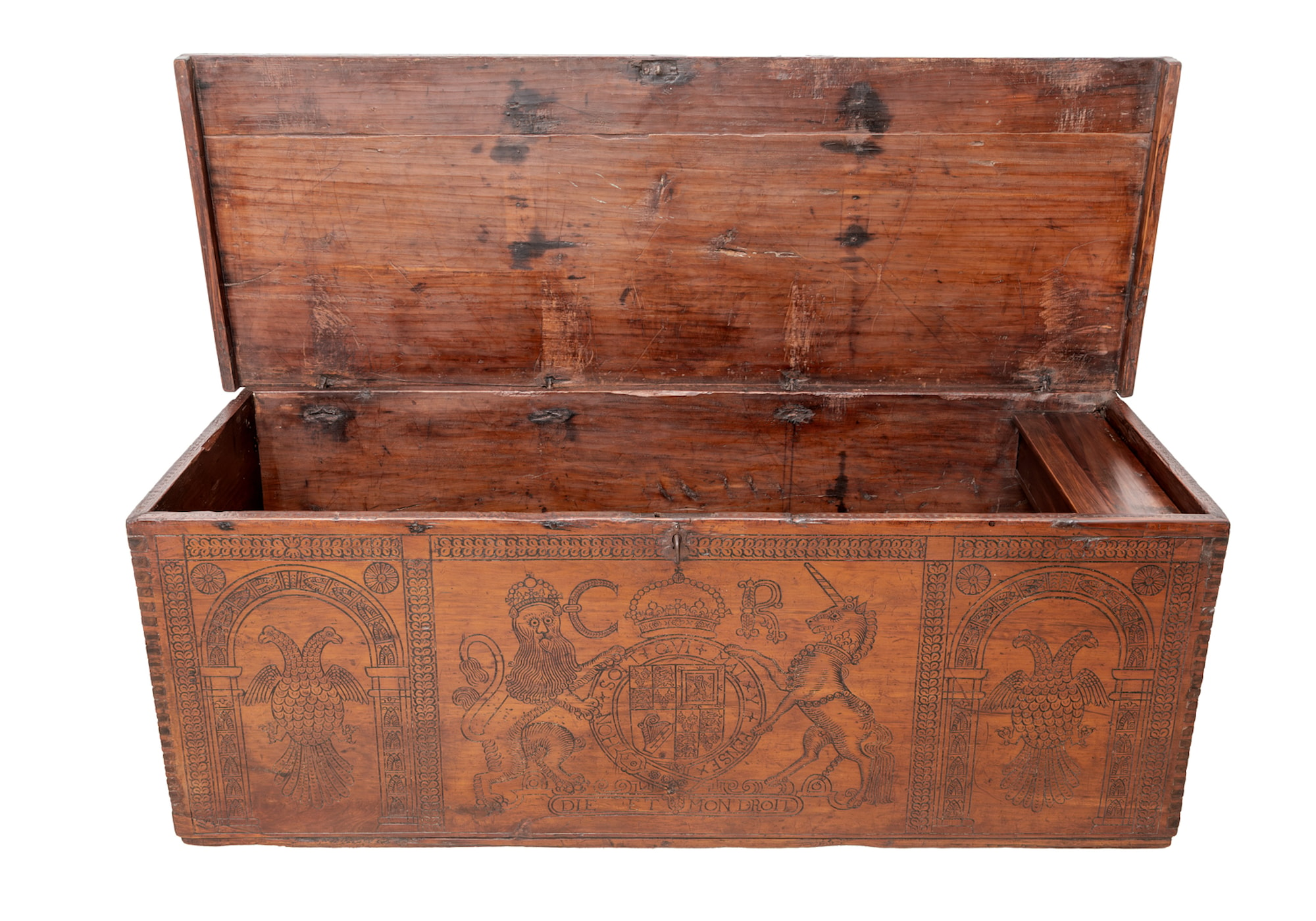
A King Charles I of England Royal Arms engraved chest
A King Charles I of England Royal Arms engraved chest
Date 2nd quarter of the 17th century
Dimension 60 x 163.5 x 58.5 cm (23⁵/₈ x 64³/₈ x 23 inches)
Historically significant cypress wood made chest (Cupressus semprevirens)[1], characterised by the elaborate pyrography decorative composition that fills its frontal surface. Made in Italy, and destined to the English market, it was produced during the reign of King Charles I (r. 1625 - 1649) and belongs to a group of case furniture whose manufacture has often been attributed to the Archipelago of the Azores, but which in fact originates from a distinct northern Italian production centre.[2]
Parallelepiped in shape, it features a flat hinged top formed by four joined boards which, as is common in this production, extend over the sides in a protruding edge, contrary to the back and rear edges which align along the chest width. The simple case lock, with no bolt or other visible outer elements, is contemporary to the chest making and fitted to its inner surface. The four case elevations, whose upper edges are decorated by simple punched motifs, are assembled at the angles by chromatically alternating joints. Contrary to other analogous extant examples, our chest, featuring an inner storage lidded tray to its right-hand side, does not include a stand, therefore sitting directly on the ground.
The chest’s particular importance is justified by the pyrographed iconography that fills the entirety of its front panel. Obtained by burning the decorative motifs onto the wood surface with heated metal tools, this contrasting ornamental technique that enhances the cypress warm honey tones, creates three sections of classical architectural elements framed by decorative friezes of geometric and foliage motifs, which present an unusual combination of heraldic motifs and insignia.
Standing out from the larger central section, the Royal Crest of Arms for England, Scotland and Ireland wrapped in the Garter, the most senior Order of Chivalry in the British Honorific hierarchy, featuring the order’s motto “Honi soit qui mal y pense”. These elements are surmounted by the crown and the monogram C R, and flanked by a crowned rampant lion and unicorn, as it was customary during the various Stuart dynasty reigns between 1603 and 1707. This composition sits on a banner with the British monarchy motto “Dieu et mon droit”, alluding to the monarch’s divine right to rule. São Roque keeps in its archive a print dated 1616 that does feature an identical armorial shield.[3]
This central arrangement is flanked by two smaller rectangular panels centred by round arches resting on columns that feature sequences of superimposed pointed arches and plain capitals, from which stand out exuberant double-headed eagles.
In spite of its early 17th century origin, the chest’s formal and archaistic simplicity takes us back to the Medieval and Renaissance periods. The classicism of decoration, as well as the heraldic references and associated inscriptions, hint at a form of political and personal affirmation still common in this period. Absorbed from Flemish prints, or other European erudite sources, is the characteristic Renaissance repertoire of dragons, birds, dogs, lions and foliage motifs.
During the 17th century reigns of King James I (James VI of Scotland), Charles I and Charles II, a period encompassing the second phase of the Renaissance in England, furniture was profoundly impacted by both Italian and Flemish prototypes, mainly made in oak and featuring sober decorative elements and heraldic motifs, whose presence had emerged in the previous century. This taste is also clearly evident in a significant number of Italian imported chests, following the prototypes from the well-known cassone produced in Milan and Venice from the medieval period onward, of incised, pyrographed and coloured decoration and, as is the case with the chest herewith described, made in cypress wood, a timber that was much-appreciated in England.
The crowned monogram C R for Carolus Rex identifies it as belonging to King Charles I of England. This ownership mark was used on the art objects from the Monarch’s collections and, in addition to the chest herewith described, it is also present on the back of a painting by Osias Beert (ca. 1580-1624), formerly in the King’s collection[4], and presently also with São Roque, Lisbon. In addition to the former monogram, this painting does also feature the monogram H P for Henricus Princeps (Charles I elder brother and Prince of Wales between 1594 and 1612), who, on his premature death of typhus aged 18, opened the path for Charles ascension to the throne.
Besides their role as storage for 17th century dowries, chests were also used for transporting textiles, a commodity widely exported by England. During Charles I reign, the King himself a collector and admirer of such luxury goods, the presence of this furniture typology increased substantially in royal palaces interiors, a fact that reflects the taste instilled by the monarch onto the crown estate.[5] Considering Charles I interest for textiles, it is also possible to suggest that these chests may have been used as containers for diplomatic gifts.
Contemporary Stuart inventories mention many cypress made chests, probably of Italian origin, that were used to store bed linens and clothing belonging to the queen, while also referring their good quality and resistance against damp and moth damage.[6]
The double headed eagle corresponds to an iconography that was used in the distant past by the Hittite Emperors in Anatolia, and later, in the 13th century, by the sovereigns of the last Byzantine dynasty, the Palaeologus. In the same century it was also the attribute of Frederick I, Barbarossa, adopted by the succeeding Holy Roman Emperors. It would become widely used from the mid-15th century onwards in the Austro-Hungarian and Russian contexts.[7] It is also associated to the Spanish Habsburg rulers as the insignia taken by King Carlos I of Spain, himself Holy Roman Emperor as Carlos V. In the 17th century this Imperial Christian symbol became also increasingly adopted by Religious Orders as their heraldic, as was the case with the Augustinians.[8]
Although it is admissible that this specific attribute is purely decorative, it can also be a reference to the ties established between the Anglican and the continental Protestant Churches. To reinforce the links between his kingdom, and the protestant Holy Roman Empire princes, in 1619 James I succeeded in marrying his daughter Elizabeth Stuart, sister to Charles, Prince of Wales and later Charles I, to Frederick V, Elector Palatinate, who reigned as King of Bohemia. Their particularly short reign would earn them the sobriquet “Winter King” and “Winter Queen”.
This type of chests has overtime been identified as of Portuguese production for their similarities with contemporary Azorean chests.[9] The latter however, are mostly made in juniper and cedarwood with incised decoration, the grooves outlining the patterns cut into the wood and filled with bees wax darkened with grounded gallnut[10], as is recorded in contemporaneous extant documents that do also refer the numerous carpentry workshops in the Azorean city of Angra do Heroísmo.[11]
Various other sources do corroborate the existence of such workshops dedicated to the exporting of chests to Spain, Flanders and particularly to England, carried by English merchants trading via regional Azorean routes [12], considering that some depicting the heraldic for Queen Elizabeth I (r. 1558 - 1603), King James I (r. 1603 - 1625) and King Charles I (r. 1625 - 1649), have been located. It is thus possible to identify two groups of chests of distinct Portuguese and Italian origins, both destined to exporting to England and rivalling for their erudition, with the English oak made furniture.
These variants diverge both on material and on technical levels, not only for their distinct raw materials, but for the fact that the Italian cypress planks were thicker than those of Azorean juniper or cedar and exhibited a characteristic reddish colour that contrasts with the yellow tone of the cedar, an autochthonous resinous tree. Equally distinct are the decorative techniques as, contrary to the incised motifs of Azorean attributed chests, the Italian feature pyrographic decoration, a technique in which the design outlines are shallower.
Related chests can be seen in major English and Portuguese museum collections such as at the Museu Nacional de Arte Antiga in Lisbon, or at the Victoria and Albert Museum in London, which has in its collection a very similar chest to the ones herewith described, but resting on a stand instead.
We would like to thank Dr. Pedro Pascoal de Melo for his invaluable cooperation
Leonor Liz Amaral
[1] The cypress was introduced to the eastern Mediterranean in antiquity, from Persia and Asia Minor (Turkey). Its use flourished in Europe during the Renaissance, having a special meaning in Italy.
[2] Information based on research developed by historian Dr. Pedro Pascoal de Melo, who kindly assisted us in the classification of this chest as originating from a non-Azorean production centre.
[3] We would like to thank Dr. Pedro Pascoal de Melo for this identification. The publication of the "Theatrum imperii Magnae Britanniae, …", by Jonh Speed, London, 1616. J. Sudbury and G. Humble, belonged to Gaston d’Orléans, uncle to King Louis XIV of France, who owned an important library that would be integrated in the French state (in 1666, the Printed Books collection), including also some gems from the Duke of Buckingham library. It must be referred that King Charles I married Henrietta Maria, sister to King Louis XIII of France, in 1625.
[4] His taste for art collecting was reinforced by his visit to Madrid to admire the Spanish Royal collection of paintings.
[5] FASTNEDGE, Ralph, English Furniture Styles: From 1500-1830, Penguin Books, 1961, p.3, pp. 32-35.
[6] The Diary of John Evelyn, 1666 (In MACQUOID, Percy, EDWARDS, Ralph, The Dictionary of English Furniture: From The Middle Ages to The Late Georgian Period, 1954, Vol 2, p.17).
[7] Insignia adopted by Ivan III of Russia upon his marriage to Byzantine Princess Sophia, from the Palaiologos Dinasty, inheriting the crest of arms to represent Russia as the “third Rome” heir to the both the Eastern and Western Empires.
[8] TRINDADE, Joelson B., “O Império dos Mil Anos e a arte do “tempo barroco”: a águia bicéfala como emblema da Cristandade”, Anais do Museu Paulista. São Paulo. N. Sér. v.18. n.2. p. 11-91. jul.- dez. 2010.
[9] Bernardo Ferrão refers the earlier identification of incised decoration furniture by Arthur de Sandão, Maria Helena Mendes Pinto, Irene Quilhó (FERRÃO, Bernardo, Mobiliário Português, Dos Primórdios ao Maneirismo, Vol. IV, Porto, 1990, pp. 3-5). The wood selected for the manufacture of one of these pieces of furniture was scientifically analysed, confirming its geographic origin (PIMENTEL, António Filipe, BORGES DE SOUSA, Maria da Conceição, Mobiliário Português, MNAA, 2019, p.17).
[10] From the 16th century onwards, and for its geographic relevance, the Azorean Archipelago became a thoroughfare and a stopping point for the two main European maritime routes, the Portuguese east India route and the Spanish western route.
[11] According to Gaspar Frutuoso (1522-91), in Terceira Island “from the cedar wood grown in the land, many expensive chests, boxes, fine cabinets as well as tables and armchairs are made and send to the whole of Spain and other overseas places” (In CASTILHO, Manuel, De Lalibela a Nagasaki, 2012, pp. 45-46).
[12] Idem, pp. 46-47; TELES E CUNHA, João, Um clássico reeditado: o arquipélago dos açores no século xvii. Aspectos socioeconómicos (1575-1675) de Maria Olímpia da Rocha Gil, 2017, pp. 503-504.double
Date: 2nd quarter of the 17th century
Dimension: 60 x 163.5 x 58.5 cm (23⁵/₈ x 64³/₈ x 23 inches)
Provenance: A.R. Collection, Oporto

São Roque
Fine Furniture, Silver, Portuguese Tiles and Ceramics, Arts of the Portuguese Expansion, Chinese Porcelain, Fine Arts
More artworks from the Gallery


