
Thomas Shotter BOYS
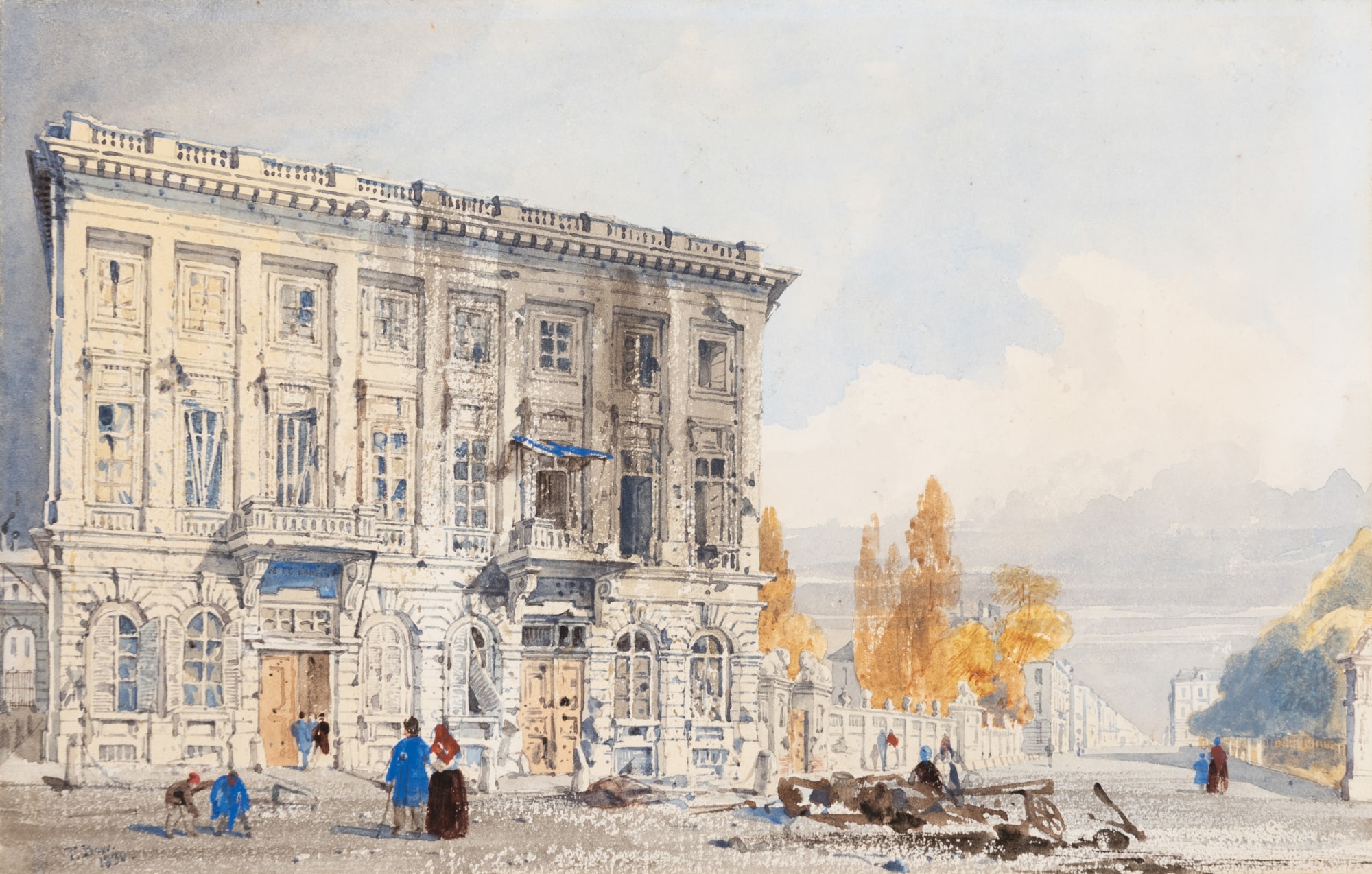
The Café de L’Amitie and the Former Palace of Prince William Frederick of the Netherlands on the Place Royale in Brussels
Marketplace
The Café de L’Amitie and the Former Palace of Prince William Frederick of the Netherlands on the Place Royale in Brussels
Thomas Shotter BOYS
The Café de L’Amitie and the Former Palace of Prince William Frederick of the Netherlands on the Place Royale in Brussels
Thomas Shotter Boys’s brief period in Brussels in 1830 was marked by the turmoil of the Belgian Revolution that took place during the summer of that year. Following the end of the Napoleonic wars, the Northern Netherlands (formerly the Dutch Republic) and the Southern Netherlands (modern-day Belgium) had been united as one country at the Congress of Vienna in 1815. The United Netherlands was ruled by the Protestant king William Frederick, son of Wilhelm V, Prince of Orange, who styled himself William I, King of the Netherlands. The citizens of the southern provinces, who were mainly Catholic, resented the influence and interference of the Protestant King and in August 1830 riots erupted in Brussels and elsewhere in the southern provinces. William responded by sending in his army but on 27 September 1830, after four days of fierce fighting, they were driven out of Brussels. The southern provinces then seceded and on 4th October a provisional Belgian government declared independence, which was soon recognized by other major European powers.
The Café de L’Amitie, on the Place Royale in Brussels, was a meeting place popular with Belgian writers, artists, politicians and members of the social elite, as well as French visitors to the city. During the Belgian Revolution the building was targeted by the Dutch forces and its facade was severely damaged during the conflict. Boys also painted another watercolour of the same battle-scarred building seen from a different angle. Today in a private collection, The Hôtel de Bellevue and the Café de L’Amitie seen from the Park is slightly larger than the present sheet and depicts the Place Royale as viewed from the Parc Royale, with the Café de L’Amitie at the centre right and the Hôtel de Belle-Vue at the left, and with groups of soldiers and a cannon in the foreground. The present sheet shows the view from the opposite end of the street, looking towards the park, with the low wall extending along the Rue Royale and its gatepost, adjacent to the Café de l’Amitié, marked by two sculpted lions. This watercolour places more emphasis on the damage to the façade of the building, as well as the shattered remains of a carriage in the foreground.
Yet in both watercolours Boys has somewhat underplayed the effects of the battle and the damage to the structure, to judge from a colour lithograph showing the Café de L’Amitie and its surroundings immediately after the fighting of 23 to 26 September 1830 that gives a more accurate of how the area looked at the time, with much more severe damage to the façade readily evident. Another contemporary print shows almost the exact same view as the present watercolour, albeit with very different staffage, and may have been based on it.
Boys produced a handful of other watercolours of Brussels in 1830, each of similar dimensions to the present sheet. These include The King’s Palace, Brussels in the collection of the Ulster Museum in Belfast and Brussels after an Artillery Attack sold at auction in 1971, as well as The Place des Palais, Brussels, showing some of the same buildings as in the present sheet, which appeared at auction in London in 2007.
The Café de L’Amitie, on the Place Royale in Brussels, was a meeting place popular with Belgian writers, artists, politicians and members of the social elite, as well as French visitors to the city. During the Belgian Revolution the building was targeted by the Dutch forces and its facade was severely damaged during the conflict. Boys also painted another watercolour of the same battle-scarred building seen from a different angle. Today in a private collection, The Hôtel de Bellevue and the Café de L’Amitie seen from the Park is slightly larger than the present sheet and depicts the Place Royale as viewed from the Parc Royale, with the Café de L’Amitie at the centre right and the Hôtel de Belle-Vue at the left, and with groups of soldiers and a cannon in the foreground. The present sheet shows the view from the opposite end of the street, looking towards the park, with the low wall extending along the Rue Royale and its gatepost, adjacent to the Café de l’Amitié, marked by two sculpted lions. This watercolour places more emphasis on the damage to the façade of the building, as well as the shattered remains of a carriage in the foreground.
Yet in both watercolours Boys has somewhat underplayed the effects of the battle and the damage to the structure, to judge from a colour lithograph showing the Café de L’Amitie and its surroundings immediately after the fighting of 23 to 26 September 1830 that gives a more accurate of how the area looked at the time, with much more severe damage to the façade readily evident. Another contemporary print shows almost the exact same view as the present watercolour, albeit with very different staffage, and may have been based on it.
Boys produced a handful of other watercolours of Brussels in 1830, each of similar dimensions to the present sheet. These include The King’s Palace, Brussels in the collection of the Ulster Museum in Belfast and Brussels after an Artillery Attack sold at auction in 1971, as well as The Place des Palais, Brussels, showing some of the same buildings as in the present sheet, which appeared at auction in London in 2007.
Provenance: Private collection
Anonymous sale, London, Sotheby’s, 25 November 2004, lot 202 (sold for £89,600)
Private collection
Anonymous sale (‘The Property of a Family'), London, Christie’s, 10 July 2014, lot 207 Private collection, London.
Discover the Gallery
Stephen Ongpin Fine Art
Old Master, 19th Century and Modern Drawings, Watercolours and Oil Sketches
More artworks from the Gallery
_T638638229729894607.jpg?width=500&height=500&mode=pad&scale=both&qlt=90&format=jpg)