
Gwen JOHN
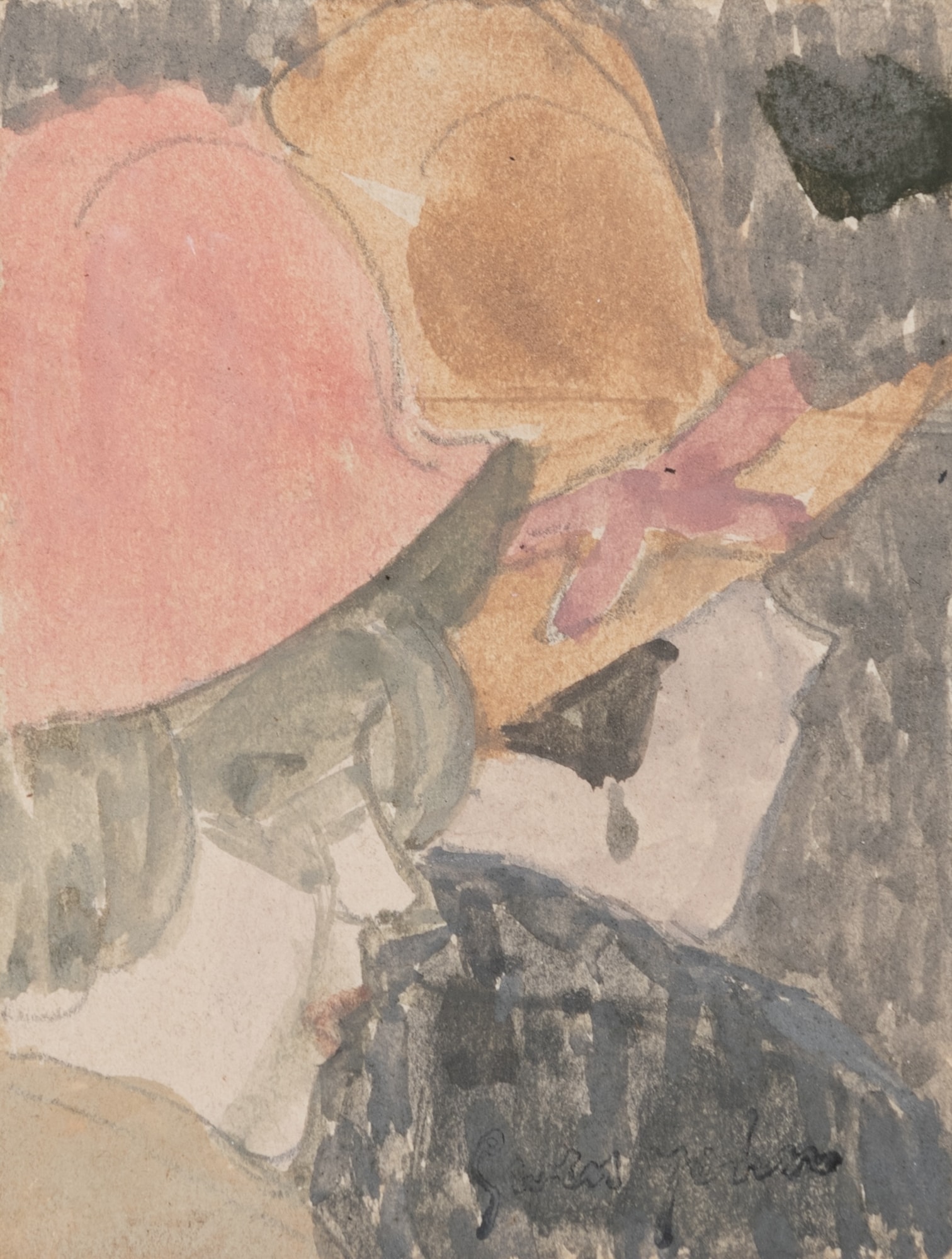
Two Women at Church, Meudon
Gwen JOHN
Two Women at Church, Meudon
A more recent biography has noted that ‘The Meudon Curé was shocked by her appearing with her sketchbook to draw the other churchgoers and instructed her that what she was doing was wrong…Gwen John was unmoved. In a draft letter to [her friend Véra] Oumançoff she wrote: ‘When I told you I am going to continue to draw at Vespers, evening services and retreats I wanted to vex you, I don’t know why. I regret having told you that because I’m going to carry on, I think…Like everyone else I like to pray in church, but my spirit is not able to pray for a long time at a stretch…The orphans with those black hats with white ribbons and their black dresses with little white collars charm me, and the others charm me in church. If I cut off all that there would not be enough happiness in my life.’…The watercolour and gouache paintings of the Meudon congregants – nuns, orphans and others – that emerged from Gwen John’s refusal to obey the Curé cannot but make one relieved that she did not listen. They have a deftness and wit about them, a wonderful clarity and simplicity of line and colour.’
As another writer has pointed out, ‘There are more drawings of people in church than of any other single subject. The church pictures reflect the circumstances of their production. They are small in scale – small enough to have been drawn on the pages of pocket sketch-books – and most are done in watercolour or gouache over an underdrawing in pencil or, occasionally, charcoal. It seems improbable that she would have encumbered herself in church with the paraphernalia of the watercolour artist and the pictures themselves suggest that the colour was added in the studio. Almost every subject is repeated several times over (in some cases more than a dozen times). Sometimes there is only the slightest of variations between one of these repetitions and the next; at other times the repetitions incorporate important changes in tone, in colour, and in composition. In other words, many of these little pictures, for all their lively observation of fact, are reflective experiments in form and structure.’ The John scholar Cecily Langdale adds that, ‘The church drawings are both reticent and intimate; their subjects, usually seen from behind, are captured in an essentially private moment. In design, palette, scale and subject, these drawings are in the French intimiste tradition.’
Among closely related works is a slightly larger gouache drawing of a girl and a woman with prayer books in church, which was formerly in the collection of Catherine Auchincloss and was sold at auction in 2018, and a very similar gouache and watercolour study of two women wearing hats, shown at the Gwen John memorial exhibition in London in 1946, which appeared at auction in 2017.
Provenance: The estate of the artist
By descent to the artist’s nephew, Edwin John (Inv. EJ 610)
Anonymous sale, London, Phillips, 17 July 2001, lot 30
Anonymous sale, London, Bonham’s, 30 June 2010, lot 108
Anonymous sale, London, Roseberys, 11 February 2020, lot 10
Private collection, London.
Exhibition: London, Anthony d’Offay Gallery, Gwen John 1876-1939, March 1976, part of no.54 (‘Six small church groups. Pencil, ink, watercolour and gouache. From 2 5/8 x 2 in to 3 5/8 x 2 3/4 in.’); Chichester, Pallant House Gallery, Gwen John: Art and Life in London and Paris, 2023, unnumbered.
Stephen Ongpin Fine Art
Old Master, 19th Century and Modern Drawings, Watercolours and Oil Sketches
More artworks from the Gallery
_T639196266054335822.jpg?width=500&height=500&mode=pad&scale=both&qlt=90&format=jpg)