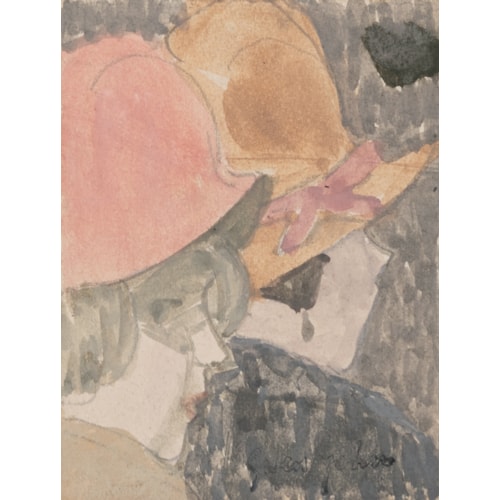


Duncan GRANT
Provençal Landscape
Marketplace
Provençal Landscape
Duncan GRANT
Provençal Landscape
Some of Duncan Grant’s finest landscapes were painted on the annual trips to France and Italy that he and Vanessa Bell took from the late 1920s onwards. This small landscape was probably painted in the south of France, near the coastal town of Cassis, several kilometres to the east of Marseille. As Grant’s biographer has noted of the artist’s first visit to the region in 1927, ‘Cassis in the spring captivated him…he began thinking of building a studio in the area. He was seized with the idea that Cassis should from now on become an annual refuge from the darkness and gloom which, like a metal dish-cover, descended every winter over cold, grey London.’ Later that year Grant and Bell began renting La Bergère, a small farm cottage just outside Cassis. Surrounded by the vineyards of the Château de Fontcreuse, La Bergère – described by one writer as ‘Charleston in France’ – became Grant and Bell’s base in the south of France during the next decade, and was visited by them every year between 1927 and 1938.
As Richard Shone has noted, ‘Grant made several paintings and drawings of the farmhouses and cottages around the Château de Fontcreuse, its surrounding vineyards and olive groves…Grant’s first prolonged stay in Cassis [in 1928] was highly productive, giving him a new range of subject matter and uninterrupted peace. Much of his work from this stay is in a fluent, calligraphic manner, the paintings carried out in a loose web of turpentine-thinned brushwork, the drawings and pastels in heightened colour…and with vigorous passages of rhythmic cross-hatching.’ Landscapes such as the present example, executed with vibrant colours applied with loose brushstrokes, reveal the influence of French Post-Impressionist painting on Grant. As can be seen from a stamp on the stretcher, the artist purchased the blank canvas from a frame-maker in nearby Marseille.
Among closely comparable landscapes by Duncan Grant is a small painting of a farmhouse among trees, likewise dated 1928, in the collection of the National Gallery of Scotland in Edinburgh. Other, similar views of the South of France include an oil sketch on paper of a view near Cassis in the Ashmolean Museum in Oxford and a Provençal Landscape of 1929 in the Laing Art Gallery in Newcastle.
The stretcher of this small oil sketch also bears a label of the London Artists’ Association, established, at the suggestion of Roger Fry, in 1926 by John Maynard Keynes and the collector Samuel Courtauld to support young artists. Grant was one of a select group of seven artists, also including Bell, Fry and the sculptor Frank Dobson, invited to join the Association. These artists would be provided by the LAA with a guaranteed income of £150 a year, offset by sales of their works at exhibitions organized by the Association, the proceeds of which would go to the artists after a commission had been deducted. The inaugural London Artists’ Association exhibition, held at the Leicester Galleries in 1926, was a critical and commercial success, with Grant regarded by many critics as the most gifted member of the group. In April 1927 the LAA organized a small exhibition of 'Paintings by Duncan Grant' on New Bond Street in London, in which seven of the eleven works on view sold quickly. In later years the Association counted artists such as William Coldstream, Paul Nash, Victore Pasmore, William Roberts and Christopher Wood among its members, while Matthew Smith exhibited with the group but was not an official member. Many of the LAA exhibitions were held at the Cooling Galleries at 92 Bond Street, where Grant presented solo shows of recent work in 1929 and 1931. Later in 1931, however, both Grant and Bell resigned from the LAA and signed contracts to sell their work through the Agnew’s and Lefevre galleries in London. The London Artists’ Association was eventually disbanded at the end of 1933, with a final retrospective exhibition held at the Cooling Galleries in 1934.
The present work was acquired, probably from an LAA exhibition at the Cooling Galleries between 1929 and 1931, by the wealthy American heiress, philanthropist and social activist Dorothy Payne Whitney Elmhirst (1887-1968). With her second husband, Yorkshireman Leonard Knight Elmhirst, she had acquired the late 14th century Dartington Hall, a country house and estate in Devon, in 1925. The Elmhirsts developed Dartington Hall into a rural estate, establishing a progressive co-educational boarding school (whose alumni included Lucian Freud) on the grounds and providing support for local artists and craftsmen, so that by the 1930s Dartington was a gathering place for numerous artists, writers and intellectuals. The Elmhirsts supported many of the young artists of the day, inviting them to stay at Dartington and acquiring their work. In 1961 they established the Dartington College of the Arts at Dartington.
This Provençal Landscape was presented by Dorothy Elmhirst to Wyatt Rawson (1894-1980), a member of the progressive New Education Movement who helped to set up the Dartington Hall School in 1926 and taught there until 1931, and thence passed by descent to the present owner.
As Richard Shone has noted, ‘Grant made several paintings and drawings of the farmhouses and cottages around the Château de Fontcreuse, its surrounding vineyards and olive groves…Grant’s first prolonged stay in Cassis [in 1928] was highly productive, giving him a new range of subject matter and uninterrupted peace. Much of his work from this stay is in a fluent, calligraphic manner, the paintings carried out in a loose web of turpentine-thinned brushwork, the drawings and pastels in heightened colour…and with vigorous passages of rhythmic cross-hatching.’ Landscapes such as the present example, executed with vibrant colours applied with loose brushstrokes, reveal the influence of French Post-Impressionist painting on Grant. As can be seen from a stamp on the stretcher, the artist purchased the blank canvas from a frame-maker in nearby Marseille.
Among closely comparable landscapes by Duncan Grant is a small painting of a farmhouse among trees, likewise dated 1928, in the collection of the National Gallery of Scotland in Edinburgh. Other, similar views of the South of France include an oil sketch on paper of a view near Cassis in the Ashmolean Museum in Oxford and a Provençal Landscape of 1929 in the Laing Art Gallery in Newcastle.
The stretcher of this small oil sketch also bears a label of the London Artists’ Association, established, at the suggestion of Roger Fry, in 1926 by John Maynard Keynes and the collector Samuel Courtauld to support young artists. Grant was one of a select group of seven artists, also including Bell, Fry and the sculptor Frank Dobson, invited to join the Association. These artists would be provided by the LAA with a guaranteed income of £150 a year, offset by sales of their works at exhibitions organized by the Association, the proceeds of which would go to the artists after a commission had been deducted. The inaugural London Artists’ Association exhibition, held at the Leicester Galleries in 1926, was a critical and commercial success, with Grant regarded by many critics as the most gifted member of the group. In April 1927 the LAA organized a small exhibition of 'Paintings by Duncan Grant' on New Bond Street in London, in which seven of the eleven works on view sold quickly. In later years the Association counted artists such as William Coldstream, Paul Nash, Victore Pasmore, William Roberts and Christopher Wood among its members, while Matthew Smith exhibited with the group but was not an official member. Many of the LAA exhibitions were held at the Cooling Galleries at 92 Bond Street, where Grant presented solo shows of recent work in 1929 and 1931. Later in 1931, however, both Grant and Bell resigned from the LAA and signed contracts to sell their work through the Agnew’s and Lefevre galleries in London. The London Artists’ Association was eventually disbanded at the end of 1933, with a final retrospective exhibition held at the Cooling Galleries in 1934.
The present work was acquired, probably from an LAA exhibition at the Cooling Galleries between 1929 and 1931, by the wealthy American heiress, philanthropist and social activist Dorothy Payne Whitney Elmhirst (1887-1968). With her second husband, Yorkshireman Leonard Knight Elmhirst, she had acquired the late 14th century Dartington Hall, a country house and estate in Devon, in 1925. The Elmhirsts developed Dartington Hall into a rural estate, establishing a progressive co-educational boarding school (whose alumni included Lucian Freud) on the grounds and providing support for local artists and craftsmen, so that by the 1930s Dartington was a gathering place for numerous artists, writers and intellectuals. The Elmhirsts supported many of the young artists of the day, inviting them to stay at Dartington and acquiring their work. In 1961 they established the Dartington College of the Arts at Dartington.
This Provençal Landscape was presented by Dorothy Elmhirst to Wyatt Rawson (1894-1980), a member of the progressive New Education Movement who helped to set up the Dartington Hall School in 1926 and taught there until 1931, and thence passed by descent to the present owner.
Provenance: The London Artists’ Association at The Cooling Galleries, London
Probably acquired from them by Dorothy and Leonard Elmhirst, Dartington Hall, nr. Totnes, Devon
Given by Dorothy Elmhirst to Wyatt Rawson in c.1931
Thence by descent.
Exhibition: Possibly London, London Artists’ Association at The Cooling Galleries, Recent Paintings by Duncan Grant, 1931.
Découvrez la galerie
Stephen Ongpin Fine Art
Old Master, 19th Century and Modern Drawings, Watercolours and Oil Sketches
Plus d'œuvres d'art de la Galerie


_T639038882382326384.jpg?width=500&height=500&mode=pad&scale=both&qlt=90&format=jpg)