

Giorgio VASARI
The Stoning of Saint Stephen
Giorgio VASARI
The Stoning of Saint Stephen
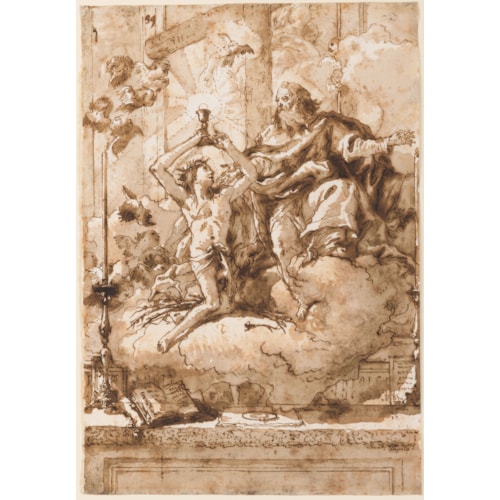
Datable to the end of 1569 or the beginning of 1570, the present sheet is one of only two preparatory drawings by Vasari that can be connected with the Pisa altarpiece. A pen and ink sketch in the collection of Anne Searle Bent in Chicago is much less finished than this drawing and must have preceded it. Both drawings, however, show differences from the final painting. While the bottom part of the altarpiece follows the lower half of the present sheet quite closely, Vasari significantly altered the upper half of the painted composition. As Härb has noted, ‘in the upper register [of the Pisa altarpiece], dominated by the Holy Trinity in both [the Chicago drawing and the present sheet], Vasari introduced a new solution; he moved the Holy Trinity to the left, adding on the right a view of the façade of the Chiesa dei Cavalieri, which he had designed. The differences between the two drawings and the painting may also be due to the different dates of execution; both, however, were probably made at an early stage in the design process. Since the execution of the painting began in earnest only about a year and a half after Vasari had made the first preparatory drawing, compositional changes were probably introduced subsequently.’
At around the same time that he was working on the Pisa altarpiece, Vasari painted another version of The Stoning of Saint Stephen, possibly with the assistance of Jacopo Zucchi, for a chapel in the Torre Pio of the Vatican; that altarpiece is today in the Pinacoteca Vaticana. Although Vasari had received the commission for the Vatican painting sometime after that for the altarpiece in Pisa, he actually completed the former work earlier, around May 1571. While the compositions of the two paintings are somewhat related, with a handful of figures repeated in each, the present sheet is much closer to the painting in Pisa.
The handwriting of the old inscription Giorgio Vasari at the bottom centre of this drawing is very similar to that found on several drawings in the Uffizi, and has been tentatively identified as that of the 17th century biographer, art historian and collector Filippo Baldinucci (1625-1696), who is best known for his biographies of Florentine artists published as Notizie dei professori del disegno da Cimabue in qua from 1681 onwards. Baldinucci was charged with assembling a collection of drawings for Cardinal Leopoldo de’ Medici, although he also acquired drawings for his own collection, eventually numbering over a thousand sheets kept in four albums. These volumes, which contained mainly drawings by Florentine artists - including at least six sheets by Giorgio Vasari - were acquired in 1806 by Dominique Vivant-Denon for the Musée Napoleon and are now in the Louvre.
This fine drawing by Vasari was later acquired by the 18th century English portrait painter, author and connoisseur Jonathan Richardson Senior (1667-1745), whose extensive collection of nearly five thousand drawings was comprised mainly of Italian works of the 16th and 17th centuries. Assembled over a period of about fifty years, Richardson’s collection was organized by school and date, and the drawings were further classified with a system of shelfmarks inscribed on the reverse of his mounts, as can be seen with this drawing.
The present sheet also bears the previously unrecorded collector’s mark of David Hoffman H. Felix (1904-1988) of Philadelphia, and at his death passed to his widow, Claire S. Felix (1906-1993).
This drawing has been requested for the forthcoming exhibition Vasari e Roma, to be held at the Musei Capitolini in Rome from March to July 2026.
Provenance: Possibly Filippo Baldinucci, Florence
Jonathan Richardson, Senior (1665-1745), London (L. 2983 and his mount, with his attribution Giorgio Vasari and shelfmark H.45 on the verso)
David Hoffman Harry Felix, Philadelphia (his collector’s mark D.H.H.F., not in Lugt, stamped on the reverse of the mount)
By descent to his wife, Claire Schoenberger Felix, Philadelphia
Her posthumous sale, New York, Christie’s, 12 January 1995, lot 6 (unsold)
Her posthumous sale, New York, Christie’s, 10 January 1996, lot 102
Herbert Kasper, New York.
Literature: Maria Giulia Aurigemma, ‘Un corpus perduto? Sui disegni di Jacopo Zucchi’, Studiolo, 2007, p.138, note 23; Jordan Bear et al, Mannerism and Modernism: The Kasper Collection of Drawings and Photographs, exhibition catalogue, New York, 2011, pp.70-73, no.19 (entry by Rhoda Eitel-Porter); Suzanne Folds McCullagh, ed., Capturing the Sublime: Italian Drawings of the Renaissance and Baroque, exhibition catalogue, Chicago, 2012, p.65, under no.26 (entry by Florian Härb) and p.266, fig.26.1; Florian Härb, The Drawings of Giorgio Vasari (1511-1574), Rome, 2015, pp.559-561, no.376; Claire Van Cleave, The Farnese Drawings Collection, Rome and Naples, 2025, p.211, under no.47, note 5.
Exhibition: New York, The Morgan Library & Museum, Mannerism and Modernism: The Kasper Collection of Drawings and Photographs, 2011, no.19.
Stephen Ongpin Fine Art
Old Master, 19th Century and Modern Drawings, Watercolours and Oil Sketches
More artworks from the Gallery