



Portrait of a Mughal Prince, Possibly Muhammad Shah 'Azam, known as 'Azam Shah
Marketplace
Portrait of a Mughal Prince, Possibly Muhammad Shah 'Azam, known as 'Azam Shah
Portrait of a Mughal Prince, Possibly Muhammad Shah 'Azam, known as 'Azam Shah
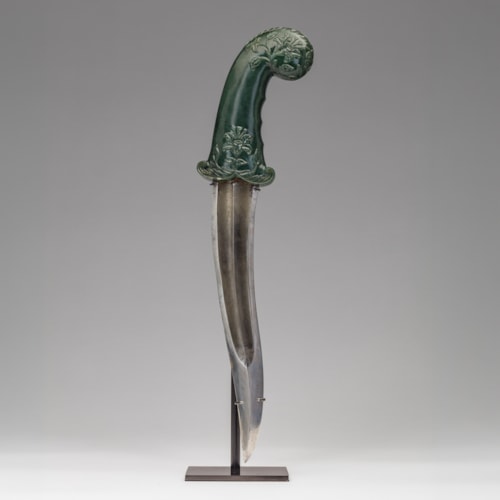
A Mughal prince stands tall and erect against a light green background, emphasizing his slender form. Wearing a gold embroidered white jama and gold boots, he stands with one hand resting on the jewelled handle of a sword, sheathed in what appears to be a stamped, leather scabbard. A jade-handled dagger with velvet scabbard is tucked into his patka (waist sash), from which also hangs a large gold and pearl tassel. Simple pearl bracelets are visible on his wrists, and a long strand of pearls around his neck. Pearls, rubies, and emeralds also decorate his bazuband, shorter necklace, and turban. In his left hand he holds a small emerald and gold sarpech (turban ornament), an accoutrement rife with imperial symbolism.
The figure bears an uncanny resemblance to portraits of Prince Muhammad Shah ‘Azam (1653–1707),1 popularly known as ‘Azam Shah. The third son of the Mughal emperor, ‘Alamgir (r. 1658–1707), he was named as ‘Alamgir’s heir-apparent on 12 August 1681. An almost identical portrait of ‘Azam Shah from ca. 1680–1700 is in the Bodleian Library.2 In it, the prince is depicted in an identical stance, the folds of the jama are the same, as are the outlines, representation, and placement of the hands, and the physiognomic characteristics of the face. The repeated, distinctive ear shape is of particular note. These parallels are so similar that the artists of our portrait and the Bodleian one must have been using the same source image, or one served as the source for the other. These same elements were again featured when the portrait was made in mirror-image by a Golcondan artist, ca. 1700.3 A slightly earlier ca. 1670 bust portrait in the National Museums, Scotland, exhibits very similar facial features, including the distinctive ear, on a slightly younger ‘Azam Shah.4
[1] The prince has previously been identified as Bidar Bakht, son and heir of ‘Azam Shah, based on an anachronistic inscription on an almost identical painting sold at A Private Collection Donated to Benefit the University of Oxford, Islamic and Indian Works of Art on Paper, Christie’s, Lot 17, 26 April 2012. The Christie’s attribution is questionable as Bidar Bakht was born in 1670, and the painting is dated ca. 1675.
[2] MS. Douce Or. a. 3, fol. 3r. Two later handwritten inscriptions, one in Persian and one in English, identify the Bodleian figure as ‘Azam Shah son of ‘Alamgir.
[3] See An Eye Enchanted: Indian Paintings from the Collection of Toby Falk, Christie’s, 27 October 2023, lot 64.
[4] Portrait miniature of ‘Azam Shah, 1670–80, National Museums Scotland, V.2021.38.11.
Discover the Gallery

Amir Mohtashemi Ltd.
Indian,Islamic and Cross-Cultural Works of Art
More artworks from the Gallery


_T639052962000728479.jpg?width=500&height=500&mode=pad&scale=both&qlt=90&format=jpg)
